
 XM
XM Bybit
Bybit Binance
 Robinhood
 Webull
 IC Markets
 Pepperstone
 OKX
OKX Vantage
 VT Markets
 BingX
BingX Gate.io
 Kucoin
 MEXC
MEXC Exness
 Bitget
Before diving into the exciting details of the entry/exit strategy with the Pin bar, we need to discuss a very important topic. That is the Risk-Reward Ratio, and you should not overlook it. The Pin bar entry strategy that TradaFX mentions in this article will be meaningless if you don’t understand the risk-reward ratio.
Moreover, having the appropriate risk-reward ratio is crucial, especially if you want to succeed as a forex trader. I truly believe that this is the missing knowledge for many traders who are struggling.
1. RISK-REWARD RATIO
So, what is the “Risk to Reward Ratio”? The Risk to Reward Ratio is simply the amount of capital at risk in order to achieve the desired profit. Since it’s a ratio, we can express it as follows:
1:2 – in this case, “1” represents the risk, and “2” represents the reward. An example would be risking $50 to make $100. Let’s look at another way to express the risk-reward ratio.

2. R MULTIPLE
Don’t worry, it’s not as complicated as you think. The R multiple is simply the ratio expressed as a multiple. So, in our example above, the 1:2 ratio can be written as 2R.
Here are a few examples:
1:3 can be written as 3R
1:2.5 can be written as 2.5R
1:3.52487 can be written as 3.52487R
Basically, we just place the “R” after the second number (the reward) in the risk-reward ratio. Since risk is always considered as 1, the reward will always be divisible by it. It’s an easier way to express the risk-reward ratio.
It’s not so complicated anymore, right?
The reason I say that an appropriate Risk to Reward Ratio, or R multiple as we now know it, is crucial to your success is because it allows you to have more losing trades than winning ones while still being profitable. How is that possible? By maintaining a minimum of 2R for each trade, that’s how I always do it. If you maintain an average of 2R, you can actually lose 65% of your forex trades and still be profitable.
Now that you understand the R multiple and the benefits of maintaining a minimum of 2R, let’s dive into how to enter a trade with the Pin bar. The rest of this article assumes we’ve already gone through our confluence checklist. And now, you’re ready to enter/exit trades using the Pin bar.
3. ENTERING A TRADE WITH A PIN BAR
There are two ways to enter a trade with a Pin bar. Both are effective and depend on the trader as well as market conditions.
3.1. Trading a Breakout Beyond the Pin Bar Range
Trading when the price breaks the high/low of the pin bar is a very popular trading method. It’s for traders with a cautious style. So, how does this strategy work to enter a trade?
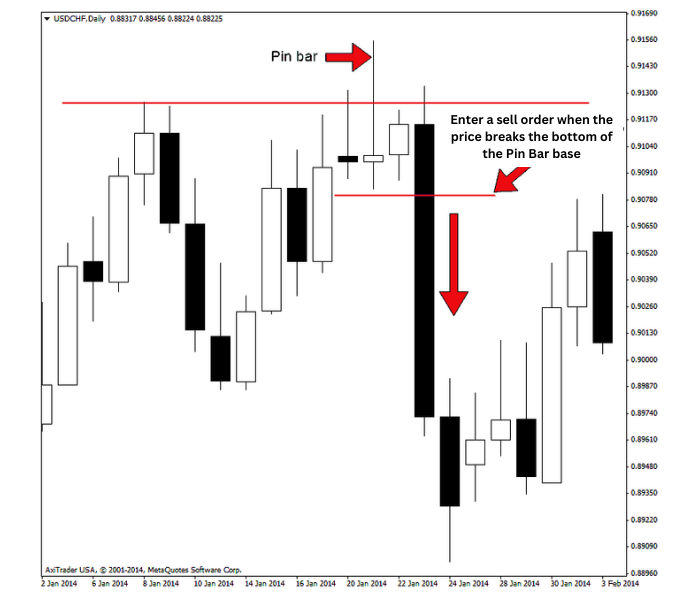
Entering a trade when the price breaks the low of the Pin bar means placing a Sell Stop order just below the low of the Pin bar. In the example above, I placed the Sell Stop order just below the low of the Pin Bar. The distance at which you place the order depends on your personal preferences and the currency pair being traded, but a general rule is around 5-10 pips. This helps protect against potential false breakouts.
3.2. Entering a Trade with a 50% Retracement of the Pin Bar
This is my preferred entry strategy with the Pin bar. I absolutely love it because it gives me an optimal entry point, significantly increasing my R multiple. This means that when you trade a breakout beyond the Pin Bar, it might give you a profit of up to 2R.
Now, with the 50% retracement entry strategy for the Pin bar, the potential profit can reach 3R or more for the same trade setup. If used correctly, the 50% retracement strategy with the Pin Bar can help grow your account over time.
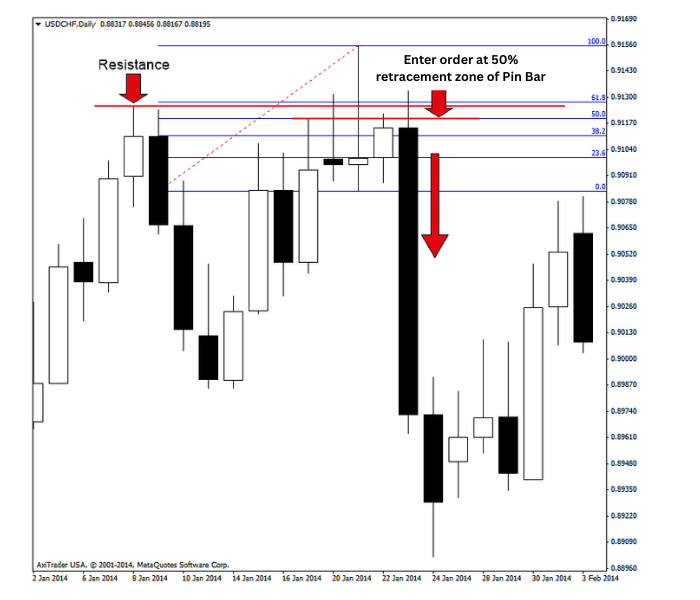
To enter a trade with the Pin bar using the 50% rule, we simply pull the Fibonacci Retracement tool from the high to the low of the Pin bar. Over time, you will feel confident with this strategy to the point where you won’t need the Fibonacci tool. However, you should still use it because it helps you maintain discipline.
The 50% entry point can offer better profits, but it can still have its flaws. About half the time (or even less with some currency pairs), the market won’t retrace to the 50% of the Pin Bar. This means your Limit Order might not get filled.
This means that if you find a special Pin Bar setup and decide to use the 50% Pin Bar strategy, there’s a chance your order won’t be executed, and you’ll be left behind. There’s nothing worse than waking up in the morning to see the market has moved 200 pips in the desired direction, but you missed your Limit order by 5 pips. This is a risk many, including myself, are willing to take to achieve a higher R multiple.
4. EXITING A TRADE WITH A PIN BAR
We should agree that, instead of calling it exit strategies with the Pin bar, it should be called exit plans with the Pin Bar. I’ve titled this section “exiting from the ‘plan,'” not “exit from the ‘strategy.'” The reason is that I want to emphasize that you need to have an exit plan before you enter a Pin Bar trade, or any trade at all. The saying, “plan your trade and trade your plan,” couldn’t be truer for those who have found success in the forex market.
There are two types of exit plans with the Pin Bar. It’s pretty clear, but I’ll still list them:
- Exiting with a losing trade
- Exiting with a profitable trade
Sounds simple, right? Do you wonder why I listed exiting with a losing trade first? It’s no secret that our minds naturally focus on profit first and the possibility of loss second. But to become a successful forex trader, you need to be defensive 100% of the time. This means putting the possibility of loss at the forefront. This is also the advice TradaFX wants to share with anyone stepping into this field.
Always, always, always define your exit plan first. Then, define your profit target. It may take you a while to adjust to this mindset. I even catch myself sometimes thinking about profit first. But I think this small change will create a BIG improvement in your trading. It will force you to think more carefully, making you a more diligent and disciplined trader in the process.
4.1. Placing a Stop Loss at the High/Low of the Pin Bar
So, how do you plan for a potential loss when setting up the Pin Bar? By always ensuring you have a stop-loss order in place. The best place to set your stop-loss for a Pin Bar trade is above the high or below the low of the Pin Bar. This is always true, regardless of the entry method with the Pin Bar that you use.
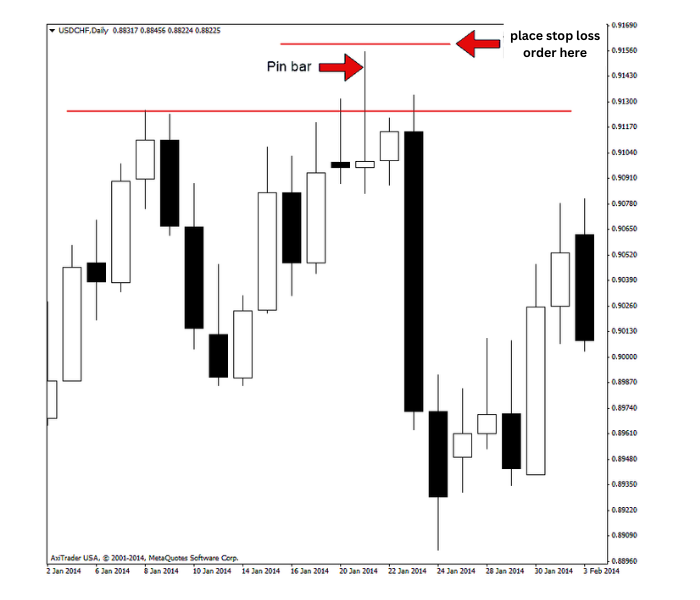
For a bullish Pin bar setup, we will place the stop-loss strategy just below the tail of the Pin Bar. The distance at which you set the stop-loss order depends on your level of confidence and the currency pair being traded. However, a small guideline is around 5-10 pips from the end of the Pin bar’s tail.
4.2. Setting a Take Profit for the Pin Bar Trade
Now, this part is truly interesting—how to set a take-profit for the Pin Bar trade. This can be a bit harder to explain, but I will try to make it as simple as possible.
First, you need to identify support and resistance levels on the chart. In practice, this will be the first step before identifying a potential Pin Bar setup. It will show whether the Pin Bar setup is valid; you need to see if there is confluence and have drawn these levels on the chart.
Although this is true, I always look for additional levels on the chart when I detect a potential Pin Bar setup. I do this to ensure that I don’t miss any important price levels that could affect the validity of the Pin Bar setup.
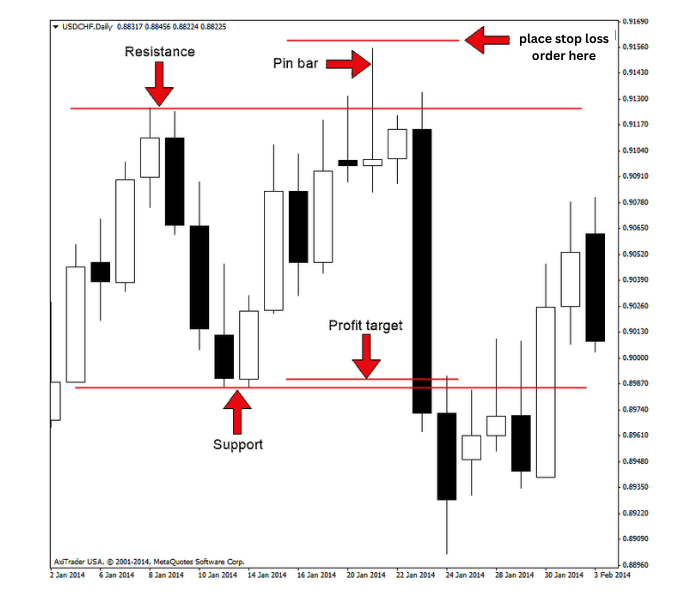
Using the same Pin Bar setup as before, the first support level seems to be around 0.8987. Therefore, this would be a safe place to take profits. Upon reflection, the market may have dropped further, but always place your take-profit at the first level or at a support/resistance zone.
When you become truly proficient with the Pin Bar strategy, you may allow some trades to run further by observing how the price reacts to a certain level, but for now, focus on taking profits at the first price level.
Now that we understand how to enter trades with the Pin Bar, I have a little test for you. What happens if you use the entry method when the price breaks the low of the Pin Bar above… what’s wrong with that? I’ll give you a little time to analyze it…
If you know, that’s great. Here we have the first support level (profit target) very close to the Pin Bar setup entry signal. So, placing a Sell order after the price breaks the low of the Pin Bar would violate the minimum 2R rule we established earlier. So what should we do? … If you say you will use the entry method when the price retraces to 50% of the Pin Bar, then you are correct.
Here are 2 strategies for entering and exiting trades with the Pin Bar when they are active…
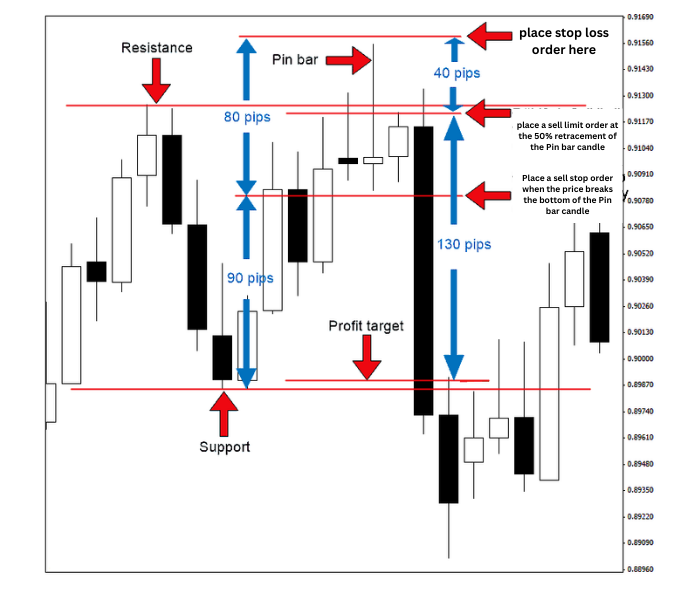
In the example above, you can see that when using the entry strategy of breaking the low of the Pin Bar, we would have to place a stop-loss around 80 pips, and the potential profit is 90 pips. As mentioned earlier, this violates our minimum 2R rule. The reason is that your profit target needs to be at least 160 pips. So, we should not use this method here.
Meanwhile, if you use the 50% retracement strategy, the stop-loss would be around 40 pips. At this point, the potential take-profit level would be 130 pips! This is the advantage of this strategy.
For the same Pin Bar entry/exit setup, when you enter using the method of breaking the low of the Pin Bar, you would only achieve 1.1R, whereas using the 50% retracement method, your profit increases to 3.25R. If you risk $100, the two potential profits would be $110 and $325, respectively, for the two trading methods. That’s why I prefer the 50% retracement entry strategy.
5. SUMMARY
There are 2 ways to enter with a Pin Bar. Key notes for trading Forex with the Pin Bar:
- Think of every trade in terms of R-multiples.
- Always maintain a minimum of 2R for each trade.
- Use the 50% retracement entry strategy whenever possible to maximize R-multiples.
- Place the stop-loss 5-10 pips away from the tail of the Pin Bar.
- Always calculate the potential loss before assessing the potential profit.
- Use the next support/resistance level as your profit target when trading the Pin Bar.
I wish you success in your trading career!!!
- t.me/finance_solutes
- Website: https://finance-solutes.com
- Hotline: +1 929 5636 439 ( Hotline )
- 26 Broadway, Suite 934, New York, 10004, US
