
 XM
XM Bybit
Bybit Binance
 Robinhood
 Webull
 IC Markets
 Pepperstone
 OKX
OKX Vantage
 VT Markets
 BingX
BingX Gate.io
 Kucoin
 MEXC
MEXC Exness
 Bitget
For those new to forex trading, you might find yourself asking: What is a stop level? Or, what is a stop-out level? You may have even experienced a stop-out before. However, for newcomers to the market, this term can be quite confusing and easy to misunderstand.
So, what exactly is a stop out? How can you calculate the stop-out level? How does it work? And how can you avoid being stopped out? Keep reading to find the answers!
1. WHAT IS STOP OUT?
Stop out in forex is a term used when your open positions are automatically closed by the broker due to insufficient margin to maintain the positions. This occurs when the margin level falls to a certain threshold and is no longer sufficient to sustain the open positions.
In other words, stop out happens when the equity-to-margin ratio equals the stop out level set by the broker.
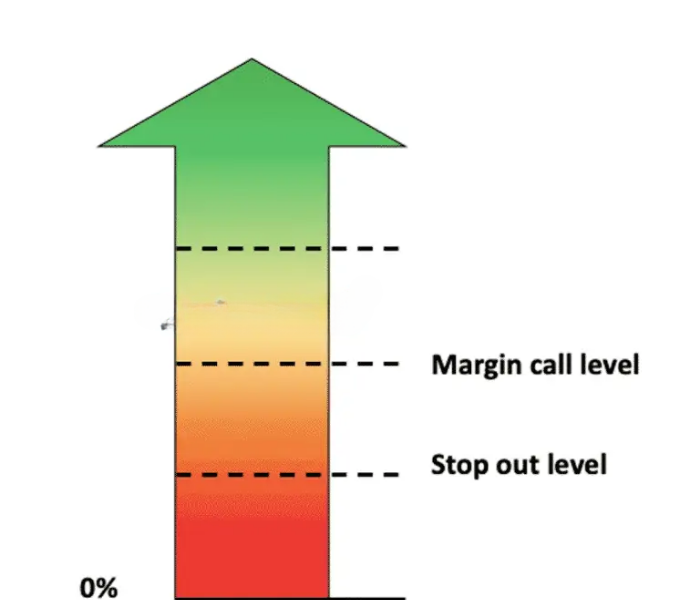
This is the concept of stop out in the forex market. In the stock market, it describes a stock that has hit the stop-loss level, where traders have placed orders to sell it.
The scope of stop out varies between brokers. However, it typically involves closing the position causing the largest loss to the trading account.
1.1. What is a Stop Out Level?
The stop out level is similar to the margin call level mentioned in the previous article but even more severe.
In forex trading, the stop out level is the point when your margin level falls to a specific percentage (%) at which one or all of your open positions will be automatically closed (“liquidated”) by the broker.
This happens because your trading account can no longer support open positions due to insufficient margin. Specifically, the stop out level is the point at which your equity falls below a certain percentage of your used margin.
1.2. How to Calculate the Stop Out Level?
At this point, many people may wonder, “So how can traders calculate the stop out level?”
The margin maintenance ratio (%) that triggers a stop out is calculated using the following formula:
(Total Usable Margin / Required Margin) x 100
Where:
– Total Usable Margin equals the account balance +/- profits/losses from open positions. The higher this value, the higher the margin maintenance ratio.
– Required Margin is the minimum amount of money needed to execute a trade.
The stop out level varies between brokers. For example, the stop level at Exness will differ from that at IC Markets. Therefore, to be sure, always confirm with your broker.
2. HOW DOES THE STOP OUT MECHANISM WORK?
If your account hits the stop out level, your broker will automatically close your trades, starting with those using the most margin, until your margin level rises above the stop out level.
If your margin level equals or falls below the stop out level, the broker will close any or all of your open positions as quickly as possible to protect you from further severe losses.

Keep in mind that Stop Out is not executed arbitrarily. Once the process begins, it is usually unstoppable as it is an automated procedure. The broker’s support team likely cannot assist you beyond listening to your complaints over the phone.
The “Stop Out Level” is also known as the Margin Closeout Value, Liquidation Margin, or Minimum Required Margin.
The stop out level exists to protect you from losing more money than you deposited. Ultimately, if your trades continue to incur losses, you will end up with no funds in your account and may face a negative account balance.
Brokers generally do not want to chase after clients to recover unpaid balances. Therefore, the stop out mechanism is an effort to prevent your account balance from turning negative—in other words, to avoid a margin call meltdown.
Additionally, you might experience a stop out if the market moves in one direction and then suddenly reverses sharply.
3. EXAMPLES OF STOP OUT AND STOP OUT LEVEL
Suppose your broker has a stop out level set at 20%. This means that your trading platform will automatically close your positions if your margin level reaches 20%.
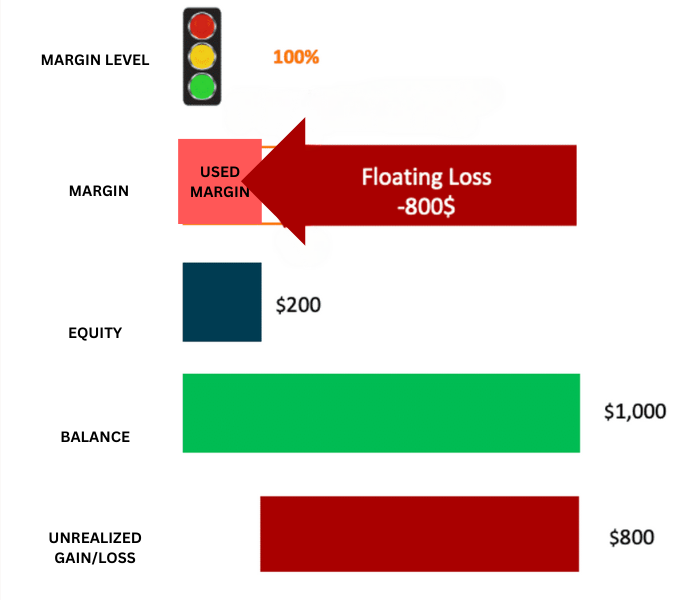
You received a margin call when your margin level reached 100%, but you decided not to deposit additional funds because you believed the market would reverse.
Unfortunately, you were completely wrong. The market continued to decline and has now dropped by 960 pips. Assuming $1/pip, your current floating loss is $960. This means your equity is now down to just $40.
Equity = Initial Balance +/- Unrealized Profit/Loss
= $1,000 – $960 = $40
Your current margin level stands at 20%.
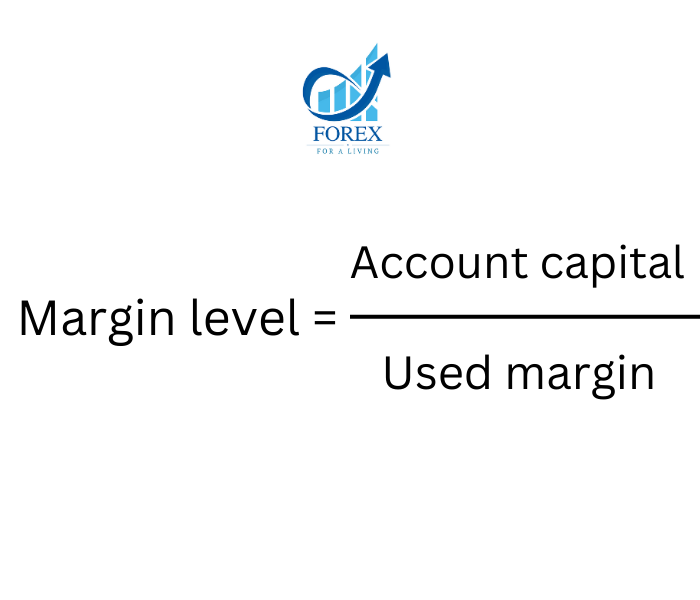
Margin Level = (Equity / Used Margin) x 100%
= ($40 / $200) x 100% = 20%
(*) The used margin cannot fall below $200, as this is the minimum margin required to open a position.
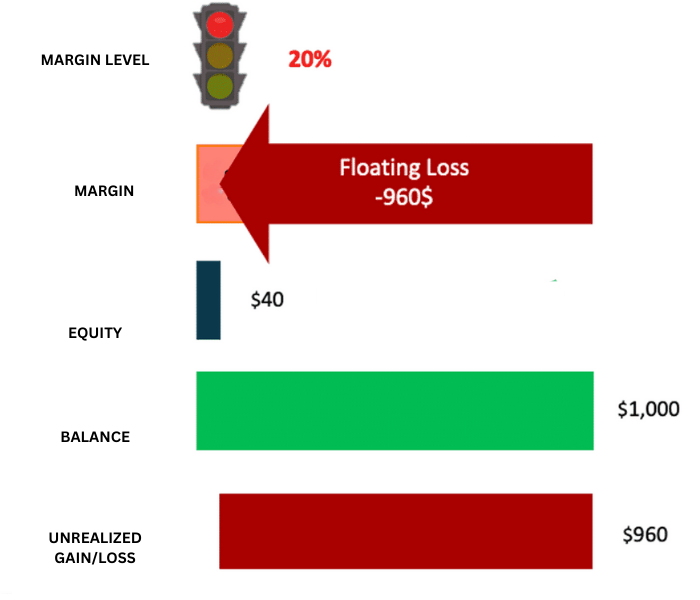
At this point, your position will be automatically closed (“liquidated”).
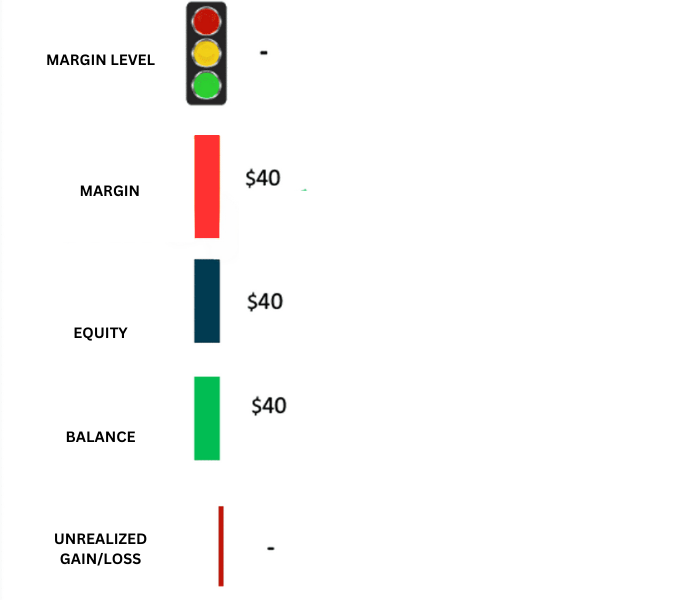
When your position is closed, the previously “locked” used margin will be “released” and converted into free margin. However, the final result is still unfortunate. The floating loss of $960 will be realized, and your new balance will be $40. Since you no longer have any open trades, both your equity and free margin will now equal $40.
Account Overview at Each Margin Level
| Margin level | Capital | Margin Used | Remaining Margin | Balance | Unrealized Gain/Loss | |
| Margin Call Level | 100% | $200 | $200 | $0 | $1,000 | -$800 |
| Stop Out Level | 20% | $40 | $200 | $0 | $1,000 | -$960 |
| Stop Out | – | 40$ | – | $40 | 40$ | – |
If you have multiple open positions, the exchange will typically close the position that is providing the least profit. Each closed position will “release” the used margin, which will increase your margin level.
If closing these positions still doesn’t bring your margin level back above 20%, your broker will continue to close other positions until it reaches the required level.
4. DIFFERENCE BETWEEN STOP OUT AND MARGIN CALL
Traders often confuse the concepts of Stop Out and Margin Call. Before discussing the differences between Stop Out and Margin Call in forex trading, let’s review the key points and things you need to know about a Margin Call.
4.1. Margin Call
A Margin Call occurs when the trader’s margin value falls below the broker’s required minimum level. A margin call refers to the requirement for traders to deposit more funds into their account to bring the balance up to or above the minimum requirement.
When a margin call occurs, traders have two options: deposit more funds or close one or more of their open positions. If traders do not deposit additional funds, the exchange will force the trader to close one or more positions to meet the minimum margin requirement.
An important term to note is “margin level”. The Margin Level is calculated using the following formula:
4.2. Example Analysis
You have an account with a broker that has a margin call level of 50% and a stop-out level of 20%. Your trading account balance is $20,000. You open a position with a margin of $2,000.
If the loss on the position is $19,000, your account equity would be $1,000 (= $20,000 – $19,000), which is 50% of the margin used. At this point, your broker will issue a margin call warning.


- t.me/finance_solutes
- Website: https://finance-solutes.com
- Hotline: +1 929 5636 439 ( Hotline )
- 26 Broadway, Suite 934, New York, 10004, US
