
 XM
XM Bybit
Bybit Binance
 Robinhood
 Webull
 IC Markets
 Pepperstone
 OKX
OKX Vantage
 VT Markets
 BingX
BingX Gate.io
 Kucoin
 MEXC
MEXC Exness
 Bitget
Slippage in forex is a completely “normal” phenomenon during Forex trading; however, it is often misunderstood. Understanding how slippage works can help traders minimize the negative risks associated with it and even maximize the potential benefits it can offer.
So, what is slippage? Why does slippage occur? How can you avoid slippage? Let’s explore these questions with Forex in today’s article!
Let’s get started!
1. WHAT IS SLIPPAGE?
Slippage is a term in Forex that refers to the price difference during trading on the platform. The initially anticipated price does not match the current price, causing traders confusion. It creates a gap between the price paid and the actual price, which is referred to as the Gap.
1.1. What is slippage in Forex?
Slippage occurs when a trade order is executed at a price different from the originally requested price. This phenomenon mostly happens when the market is experiencing high volatility, and in such cases, these orders often fail to match the desired price.
Example of slippage in the foreign exchange market:
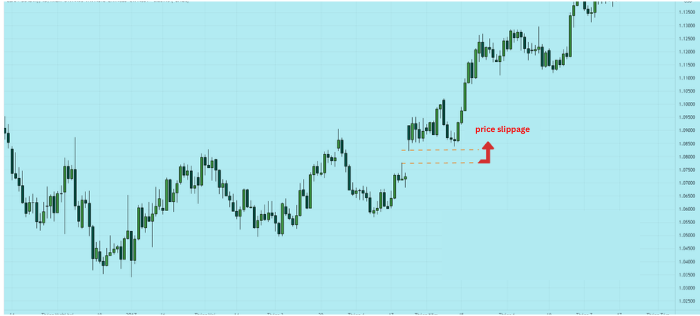
Slippage (Forex Slippage) in the foreign exchange market is often associated with negative aspects; however, in normal market conditions, it can sometimes be advantageous. When forex trading orders are executed by liquidity providers or banks, they are carried out at the best price available at that moment, regardless of whether the price is above or below the initial expectation.
1.2. Real-Life Examples of Slippage
To better understand what slippage is, I’ll use numerical illustrations of this phenomenon. Suppose you want to buy EUR/USD at the current market price of 1.3650. When the price is executed, there are three possible scenarios: no slippage, positive slippage, or negative slippage.
| SCENARIO | DETAILS |
|---|---|
| No Slippage | The order entry point is set, and the best price at that moment is 1.3650 (the price we desired); hence, the order is executed at 1.3650. |
| Positive Slippage | The order is placed, and the best price at that moment unexpectedly shifts sharply to 1.3640—10 pips lower than the initial desired price; it is executed at the better price of 1.3640. |
| Negative Slippage | The order is placed, and the best price at that moment unexpectedly shifts sharply to 1.3660—10 pips higher than the initial desired price; it is executed at 1.3660. |
As you can see, whenever the price is executed differently from the desired price at the time of placing the order, it is referred to as slippage.
2. TYPES OF SLIPPAGE IN FOREX
In practice, there are two types of slippage in Forex:
2.1. Positive Slippage
When executing a buy order, the actual price is lower than the expected price. This allows the buyer to benefit from a better rate than initially anticipated.
Example of Positive Slippage:
Suppose you plan to buy the GBP/USD currency pair at 1.3211, but the price slips down, and the buy order is triggered at 1.3204—7 pips lower than the initial planned price. This is positive slippage (advantageous) for the trader.
2.2. Negative Slippage
When an order is executed, the actual price is higher than the expected price. In this case, the buyer must execute the order at a price higher than the anticipated one.
Example of Negative Slippage:
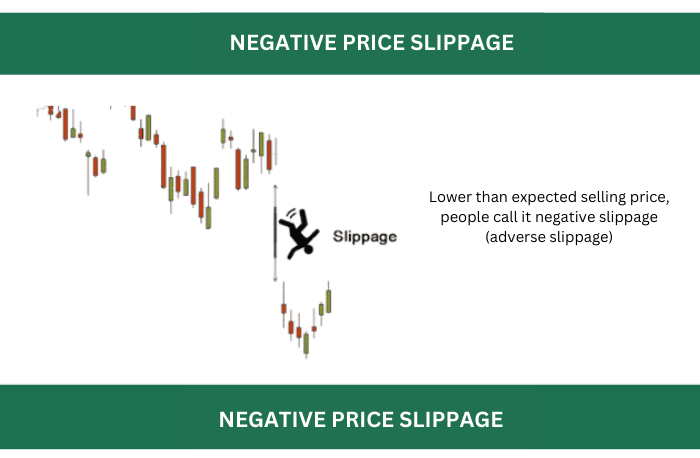
You place a sell order for the GBP/USD pair at a price of 1.3220, but the price slips and the sell order is triggered at 1.3210. This is 10 pips lower than the intended sell price, and it is referred to as negative slippage (disadvantageous slippage).
3. WHAT CAUSES SLIPPAGE?
Why does slippage occur in Forex? Why can’t our orders always be executed at the initially desired price? The answer lies in the fundamental nature of the market, which consists of buyers and sellers. For every buyer at a specific price and trading volume, there must be an equal number of sellers at the same price and with the same trading volume. If this balance is disrupted, the market moves either up or down.
For a Forex trader, if you want to buy 100,000 EUR/USD at 1.3650 but there aren’t enough people (or anyone) willing to sell their euros at 1.3650 USD, your order will be executed at the next best price and purchase euros at a higher price. This results in negative slippage.
Conversely, if there is enough volume of people willing to sell their euros when your order is executed, you may find a seller offering a better price (lower than your initial request), leading to positive slippage.
Slippage in Forex can also occur with stop-loss orders—stop losses that are triggered at a price different from the one initially set when placing the order.
This is why the term “guaranteed stop-loss order” has emerged, and it differs from regular stop-loss orders. A guaranteed stop-loss order will be executed at a specific price with a promise from the broker that the order will be fulfilled at the requested price, regardless of market conditions at that time.
In other words, the broker absorbs any losses arising from slippage. As a result, the “guaranteed stop-loss order” service comes with an additional service fee.
4. DIFFERENCE BETWEEN SLIPPAGE AND SPREAD IN FOREX
How does slippage differ from spread?
First, let’s revisit the definition of spread. Spread is the difference between the bid price (buy price) and the ask price (sell price) of a currency pair. It can be fixed or variable and represents the fee charged by the broker to traders.
Displayed publicly and updated in real-time on the trading platform, spread fees in Forex are known before placing a trade. In contrast, slippage (if it occurs) can only be observed after the trade is executed.
Moreover, the spread fee for a transaction is derived from the announced price difference, while slippage is sudden and unpredictable.
5. CURRENCY PAIRS WITH LESS FREQUENT SLIPPAGE IN FOREX
In stable market conditions, currency pairs with higher liquidity tend to experience less slippage. Examples include EUR/USD, USD/JPY, etc.
However, during periods of high market volatility, such as before and during the release of major news events, even highly liquid currency pairs can experience slippage.
News and significant events can trigger market fluctuations. Therefore, staying updated on news is essential to anticipate potential market movements.
You can check news release schedules on platforms like ForexFactory. Keeping up with news is never redundant for Forex traders.
6. HOW TO AVOID SLIPPAGE
6.1. Trade in low-volatility and high-liquidity markets
Trading in markets with low volatility and high liquidity can reduce the likelihood of slippage.
Low volatility means prices are less likely to change rapidly, while high liquidity indicates a large number of market participants.
Similarly, you can minimize slippage by limiting your trades to times of peak activity, as liquidity is highest during these periods. This increases the chances of your trades being executed quickly and at your desired price.
6.2. Avoid using high leverage
For traders, using leverage in the Forex market is a familiar strategy. However, leverage is a double-edged sword—it can yield significant profits but also comes with high risks.
Thus, it’s crucial to limit high-leverage trades to reduce potential exposure to slippage and other market risks.
When trading in the market, traders often carry the mindset: high risk, high reward. However, this doesn’t mean decision-making should rely on chance. You may have a big win today, but tomorrow is never guaranteed!
Moreover, executing trades with high leverage makes risk management nearly impossible. This creates significant complications and disadvantages for traders. If you’re serious about capital management, consider reducing leverage. Otherwise, your account might “disappear” sooner than you think.
6.3. Use Stop-Loss and Limit Orders in Forex Trading
To minimize the risks associated with slippage, you should set up the following types of orders:
- Stop-Loss Orders
- Limit Orders
These orders help traders limit or avoid losses in cases of significant price slippage.
While these orders may not entirely prevent slippage during major market movements, they can still reduce potential losses to a manageable extent.
6.4. Avoid Holding Trades Over the Weekend
Avoiding trades that carry over the weekend is another effective way to mitigate slippage in Forex trading.
When the political situation is tense and unstable, traders need to be extra cautious and vigilant, as the risks during such times can be extremely high.
6.5. Regularly Monitor and Update Market News
One important thing you should never forget is to always stay updated with market news.
Monitoring news is crucial for anyone involved in the Forex market. An economic calendar is a useful tool to help you track market developments quickly and effectively.
7. SLIPPAGE ON EXNESS PLATFORM AND HOW TO FIX IT
Slippage on Exness occurs just like on many other Forex platforms. No trader can completely avoid slippage, whether they’re trading stocks, gold, currencies, or futures. However, slippage on the Exness platform is not something to be overly concerned about. This broker ensures that there is no slippage on orders placed at least 3 hours prior to execution.
As you know, Exness is equipped with powerful servers and the latest technologies. The platform’s servers are designed to minimize slippage as much as possible. This ensures that traders’ pending orders are executed at the exact price they initially set, reducing risks and potential losses.
As previously mentioned, slippage in Forex is influenced by global economic and political conditions, making it difficult to control. While you can’t predict how the situation will change in the future, you can minimize slippage by:
- Avoiding trading during news releases
- Regularly updating market news
- Choosing times with high market liquidity
- Avoiding holding trades over the weekend
- Not using excessive leverage
The most important factor is selecting a reputable Forex broker that implements measures to minimize slippage as much as possible. Exness is a platform that has done well in this regard.
8. SUMMARY
The above information covers what slippage is and why it occurs in Forex. We hope you now have a better understanding of this phenomenon and can incorporate it into your trading strategy.
Good luck with your trading journey!
- t.me/finance_solutes
- Website: https://finance-solutes.com
- Hotline: +1 929 5636 439 ( Hotline )
- 26 Broadway, Suite 934, New York, 10004, US
