
 XM
XM Bybit
Bybit Binance
 Robinhood
 Webull
 IC Markets
 Pepperstone
 OKX
OKX Vantage
 VT Markets
 BingX
BingX Gate.io
 Kucoin
 MEXC
MEXC Exness
 Bitget
Motive wave – The movement of waves in the direction of the ongoing trend in five waves. This is one of the two types of waves that make up the Elliott wave. To learn more, let’s dive into today’s article by Forex!
1. WHAT IS A MOTIVE WAVE (IMPULSE WAVE)?
A motive wave (impulse wave) is a type of wave model that describes strong price movements in the direction of the prevailing trend.
This term is frequently used when discussing the Elliott Wave Theory. Simply put, an impulse wave refers to upward movements in an uptrend and downward movements in a downtrend.
In Elliott Wave Theory, price fluctuations in the market are divided into two types: motive waves and corrective waves. A motive wave refers to waves moving in the direction of the primary trend, while a corrective wave refers to waves moving against the trend.
A motive wave is made up of five smaller waves, numbered 1, 2, 3, 4, and 5, as illustrated in the chart below.
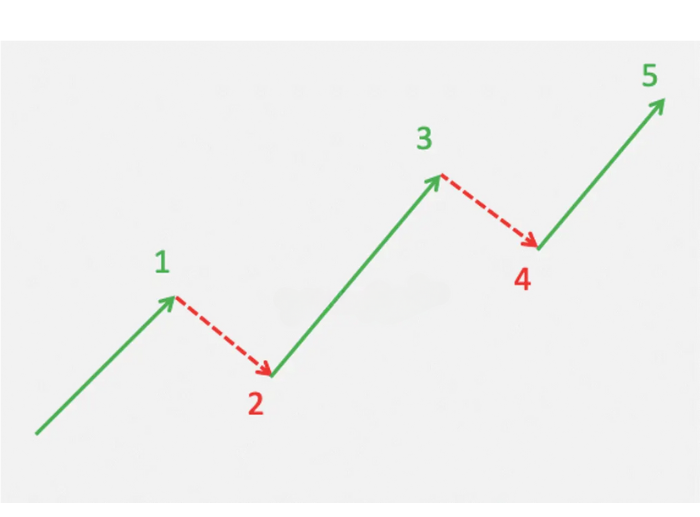
Looking at the illustration, we can see that three sub-waves (1, 3, and 5) in the impulse wave move upward, while the other two sub-waves (2 and 4) move downward. Waves 2 and 4 are also considered short corrective waves, moving in the opposite direction of the primary trend.
Motive waves tend to move relatively easily in the direction of the larger trend, making them easier to identify and interpret.
An interesting aspect of motive wave patterns is that they are not limited to a specific time frame. This allows some waves to last for several hours, days, weeks, or even years.
Motive waves are divided into two main types: impulse waves and diagonal waves. Within the motive wave, there are also further subdivisions of motive wave types.
2. IMPULSE WAVE (MOTIVE WAVE)
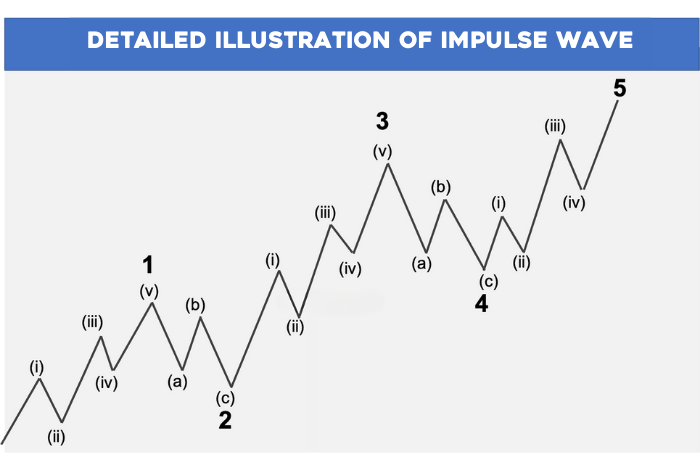
Principles of Elliott Wave Motive Wave:
- The motive wave is divided into 5 waves. In the illustration above, smaller wave levels are labeled as wave 1, 2, 3, 4, and 5.
- Waves 1, 3, and 5 are considered smaller momentum waves.
- Wave 2 cannot retrace more than the starting level of wave 1.
- Among waves 1, 3, and 5, wave 3 cannot be the shortest wave. Typically, wave 3 is the longest wave.
- Wave 4 cannot retrace below or equal to the ending level of wave 1.
- Wave 5 does not necessarily have to end with momentum divergence.
According to the principles of Elliott Wave Theory, the last three rules must not be violated. If any of these rules are violated, the structure is not a motive wave.
The relationship with Fibonacci retracement and Elliott Waves was discussed in detail in the previous article, so this article will not repeat it.
2.1. Extended Motive Wave
If we consider the smaller waves within the sub-motive waves, the Elliott Wave momentum model is seen as an expanded version of the typical momentum wave.
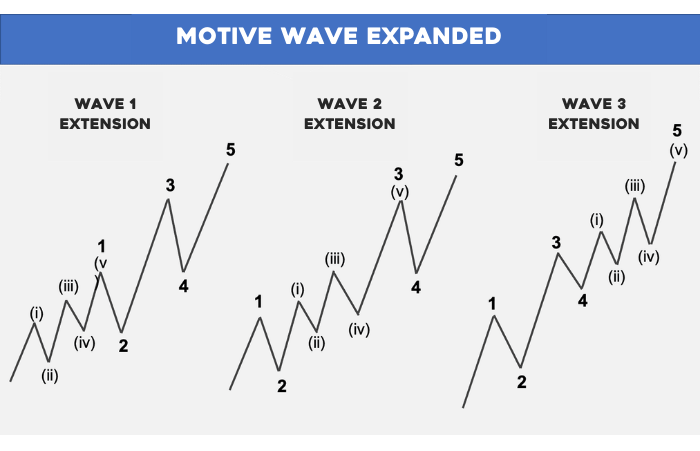
Even for the extended motive wave, the principles of Elliott Wave theory must still be followed. The characteristics of an Elliott Wave extended motive wave are as follows:
- Typically, the extension occurs in waves 1, 3, and 5.
- The extension often occurs during the third wave in the stock and forex markets. In the commodities market, extensions tend to develop in the fifth wave.
2.2. Diagonal Waves
Another type of impulse wave is the diagonal wave. Like a regular motive wave, it also consists of five sub-waves and moves in the direction of the dominant trend.
Diagonal waves resemble either an expanding or contracting wedge pattern. Additionally, the sub-waves of a diagonal wave may not contain five waves, depending on the type of diagonal wave being observed. Diagonal waves are divided into two types: Leading Diagonal and Ending Diagonal.
2.2.1. Leading Diagonal
The structure of a leading diagonal wave typically looks like a 3-3-3-3-3 pattern, but it can also appear in the form of a 5-3-5-3-5 structure. The 3-3-3-3-3 pattern means that each sub-wave consists of three smaller waves. The same rule applies to the 5-3-5-3-5 structure.
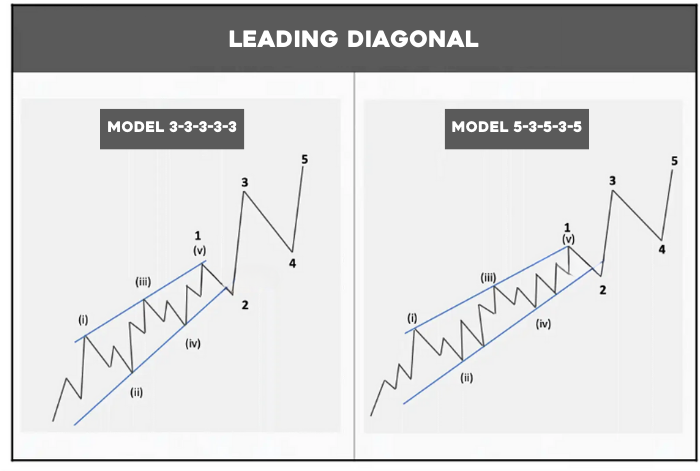
The reason it is called a “leading diagonal” is because the diagonal waves form at the beginning of the motive wave pattern. According to Elliott Wave theory, wave 4 cannot retrace back to the end point of wave 1. However, for the formation of a diagonal wave pattern, this rule will be violated.
The other two rules of Elliott Wave theory are not violated. Wave 2 cannot retrace below the starting point of wave 1, and wave 3 cannot be the shortest wave. In most cases, the first wave of a leading diagonal is the longest, and wave 3 will be smaller than wave 1.
The series of in-depth lessons on Elliott Waves:
https://www.youtube.com/watch?v=BElkk7hIpRM
In practice, you should not identify a leading diagonal pattern on a real-time chart. It should almost always be considered a last resort when analyzing a chart. The leading diagonal pattern should only be used on past charts when no other wave counts fit.
2.2.2. Ending Diagonal
In contrast to the Leading Diagonal, the Ending Diagonal pattern forms at the end of a motive wave structure. The ending diagonal pattern is formed by either a 3-3-3-3-3 wave structure or a 5-3-5-3-5 wave structure. These structures can appear in both uptrend and downtrend markets across all time frames. However, wave 4 retracing to the same level as wave 1’s end point is not a mandatory condition.
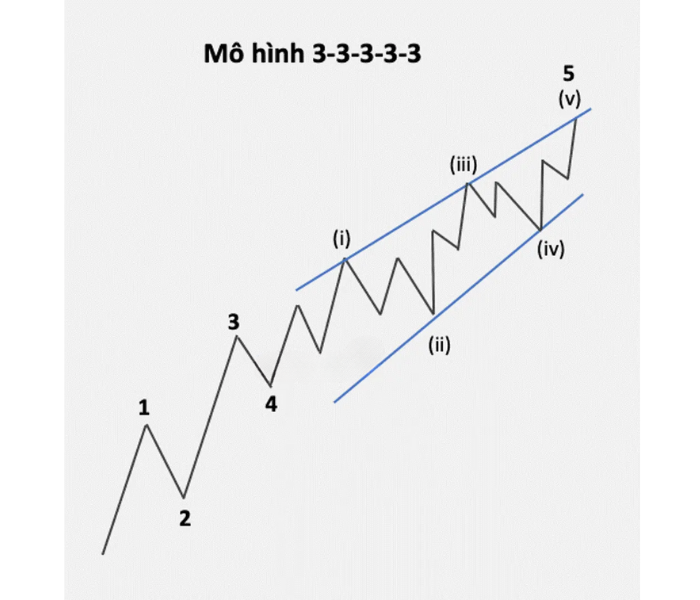
There are several conditions that the Ending Diagonal wave must still adhere to. First, the entire wave structure must consist of five larger waves to form a motive wave. As mentioned, the smaller waves can either follow a 3-3-3-3-3 structure or a 5-3-5-3-5 structure. Second, wave 3 must not be the shortest wave among the five moving waves; thus, wave 1 or wave 5 will be shorter than wave 3.
Finally, the fifth wave of an uptrend diagonal that ends a bullish market will have lower momentum. This can be measured using the RSI indicator. Similarly, in a downtrend, wave 3 will have lower momentum than wave 5.
3. SUMMARY
The motive wave impulse is one of the useful tools in technical analysis for market analysis. Within the five major impulse waves, there will be smaller waves.
Looking at an illustration, traders may find identifying impulse waves not particularly difficult. However, when opening a real-time chart, you might feel differently.
- t.me/finance_solutes
- Website: https://finance-solutes.com
- Hotline: +1 929 5636 439 ( Hotline )
- 26 Broadway, Suite 934, New York, 10004, US
