
 XM
XM Bybit
Bybit Binance
 Robinhood
 Webull
 IC Markets
 Pepperstone
 OKX
OKX Vantage
 VT Markets
 BingX
BingX Gate.io
 Kucoin
 MEXC
MEXC Exness
 Bitget
If you are learning about Exness, you probably shouldn’t ignore the information related to Exness Spread. This is considered a management fee regulated by the floor that investors need to pay to maintain an account or make transactions. So how exactly is Exness Spread fee regulated? Let’s find out the specific content below with Forex.
What is the concept of Spread Exness?
First of all, when delving into specific costs, you need to understand what Spread is and what excessive spread means. A price spread is the trading difference, meaning the difference between the bid price and the ask price. This price is expressed in pips. Therefore, it is one of the most important factors affecting traders when choosing a trading platform. This is because most forex brokers today charge a Spread fee rather than a fee for each transaction. Thus, the Exness Spread is the spread fee of the Exness trading platform.
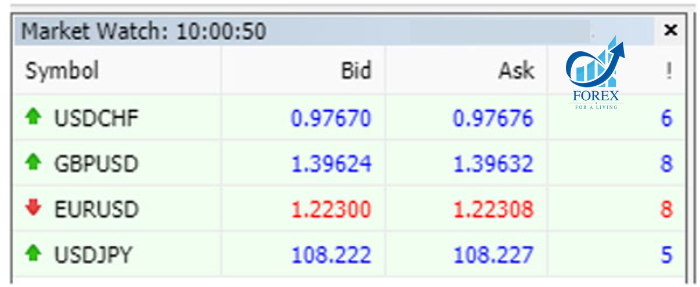
Example 1
In a hypothetical case, suppose you are viewing the USD / VND exchange rate on VCB. You will notice that the ask price is always higher than the bid price, and the difference between these two prices is the spread. The spread is considered one of the main sources of income for most forex brokers, except for some brokers who charge fees from their customers.
Example 2
When you open a buy order for EUR / USD on Exness, MT4 will display the Ask and Bid prices. Specifically, the ask = 1.12468 USD, bid = 1.12467. Therefore, the spread is calculated as follows: Ask – Bid = 0.00001 = 0.1 pip. This 0.1 pip is the commission you need to pay to open a buy order on the forex platform. So, if you want to buy 1 million EUR / USD, you need to pay the forex broker the following amount: 1,000,000 x 0.1 x 0.0001 = 10 USD. If you buy one lot, you only have to pay a Spread of 1 USD. This is the lowest figure ever.
Types of Exness Spread currently offered
Exness provides users with a healthy trading environment with all the necessary features for floating instruments. The spread levels provided by the platform are quite stable, but they are only available with certain specific currency pairs.

Floating Spread
A floating spread in forex refers to a spread level that fluctuates and changes continuously. This change comes from market fluctuations, making the spread larger or smaller than the average level. Therefore, the term “floating” refers to the continuous increase and decrease of the spread.
Stable Spread
Unlike the floating spread, a stable spread is a spread that remains stable in value during most trading hours. Therefore, brokers can predict the trading cost. The stable spread is calculated using the weighted average of price fluctuations and spreads over a period of time.
In practice, except for periods of strong market volatility, the spread for some items reaches up to 90% of the time. Specifically, for currency pairs such as: XAUUSD, USDJPY, EURGBP, EURUSD, AUDUSD, GBPUSD, USDCHF, USDJPY, EURJPY, USDCAD.
Details of Exness Spread Quote Table
Here is an example of the EUR / USD quote from the broker with an integrated ask price for EUR USD:
- Buy price (bid): $1.1250
- Sell price (ask): $1.1200
The spread may be narrower or wider depending on the currency type. In the example above, the spread between the buy and sell prices is 50 pips. This is an atypical distribution and quite common. Typically, a 1-5 pip spread is common. However, depending on market conditions, this spread can change at certain times.
![Đánh giá sàn Exness [Thông tin chi tiết, Ưu và nhược điểm]](http://finance-solutes.com/wp-content/uploads/2025/01/677bd67799626c4167939f68_AD_4nXfssf_weBkTccd-reUdiwKJdx3k7__RW9ZACXjCczmCBMo6iILyWiISYu5YDtCA4i8c5jukoh3gNvgTutNmtf9mio1OEzt-5PuMg2fDQ1Q85W95bqtfS8BJ1PErqRrUu4cUhQUqbw.png)
Speculative trading aims to generate enough profit or hedge risks to offset the spread, demonstrating that monitoring a broker’s spread is essential for investors.
Additionally, brokers can increase profits per transaction by widening the spread. If the spread is large, customers pay more at the time of purchase and receive less at the time of sale. In other words, the spread depends on the broker’s calculations, so the spread varies between different brokers, which slightly increases the transaction cost.
Why do brokers in forex need to calculate the Spread?
The answer to this question is that brokers need to calculate the spread based on the type of forex transaction. Brokers allow customers to both buy and sell, rather than simply buying at a store as in regular transactions. To understand this better, let’s look at the buy orders and related trading information below.

Trading Pair: EURUSD
- Buy rate: 1.1400
- Sell rate: 1.1300
- Forex Spread (buy/sell): 0.0100
In this hypothetical case, suppose you want to buy this currency pair and agree to the terms of the agreement to buy euros at the current exchange rate and sell at a future rate. The trading terms will change in a few days as follows:
Trading Pair: EURUSD
- Buy rate: 1.1600
- Sell rate: 1.1500
If you have the option to sell or terminate the CFD, you decide to cancel the contract. You will then receive $115 based on the sell rate. At this point, you’ve made a profit because your initial order to buy this currency pair was at 1.1400. Even with large trading volumes and relatively high leverage, you can still make significant profits.
How to check detailed Spread fees for each suitable tool
At Exness, customers are offered spreads that can change from the trading platform by using various types of products. This is stated in Exness’ Terms and Conditions. In which, Exness only defines an average spread level. It is difficult to determine the maximum spread because market power influences the floating spread. If you want to view the exact real-time spread, you can enable the spread column in the frontend-backend trading. Follow the steps below.
Log in to the MT4 or MT5 platform => Select the “Market Watch” panel => Right-click anywhere to display the list in the interface, then click on “Spread.” => A new column will appear showing the exact spread for each tool.
How Brokers Can Easily Make Profits Based on Spread
So, you may be wondering how a broker can generate profits for investors. The answer is not a secret; you’ll see it clearly on your trading platform.
The sell rate is always higher than the buy rate and there are no fees or printing fees. If you buy EURUSD within 10 seconds of buying or selling, you will immediately lose money. If the spread is 0.01, the market price must increase by at least 0.02 to become profitable.
Key Factors Determining Spread in Forex
Although many trading platforms set a fixed spread fee, there are cases where it fluctuates depending on the market and the price trend. Below are some factors that can determine this cost in forex.
Market Volatility
Market volatility is the first factor that can affect the spread. For example, the spread is also affected because currency pairs can move up and down under the influence of economic indicators. Currency pairs can also fluctuate in price and become less liquid, leading to wider price spreads during volatile market conditions.
Economic Calendar
Checking the economic calendar can help you determine whether the price spread will fluctuate and widen. This helps predict the likelihood of increased volatility. It forecasts spread changes based on event announcements that may weaken the activity of currency pairs.
However, it is also difficult to predict when unexpected news or unusual economic data will emerge. In London, New York, Sydney, or other major forex markets, the price spread tends to be smaller during trading sessions, especially if there is overlap. The likelihood of tighter spreads can be predicted if the New York session starts when the London session ends.
Currency Supply and Demand
This is another factor affecting the spread. For example, if the demand for trading the euro is high, its value will increase.
Exogenous Events That Can Affect the Spread
In addition to the aforementioned factors, there are also exogenous events that can directly or indirectly affect the spread level set by trading platforms. What are they?

Time Issues
This is one of the crucial factors that can directly impact spread costs. For example, 12:03 AM is the time when the European trading session opens for U.S. investors. Meanwhile, both U.S. and European investors will participate in the Asian trading session until late at night. If the euro is traded during the Asian session, the spread will be higher. In other words, it will be more expensive compared to trades conducted during the European session.

Additionally, a lack of liquidity occurs when very few traders are interested in trading a particular currency compared to its usual trading session. Trading a currency can be very challenging if the market does not have a safe and reasonable level of liquidity due to a lack of buyers participating in the market. Therefore, if a forex broker cannot close a trade, they may compensate for the risk of loss by increasing the spread due to market fluctuations and events.
Spread Levels
This widening spread can also be caused by political or economic news or events. For example, if U.S. unemployment rates increase rapidly, the U.S. dollar will soon depreciate and lose value against other currencies in the market. During such events, sudden market fluctuations can easily be found, even though they are volatile. This is why spreads can be quite large if forex prices are subject to risks from news and events causing volatility.
Events that cause volatility prove to be the biggest challenge for forex brokers in reducing actual exchange rates. You will have to brainstorm ways to manage risks and losses by calculating a larger spread.
How Investors Can Manage and Minimize Spread at Exness
Now that you have a clear understanding of the nature of Exness Spread, how can you minimize and manage this spread fee at Exness? Here are some useful tips you can apply:
Trade in Favorable Timeframes
You should trade during favorable timeframes. When there are more buyers and sellers in the market, the supply and demand for a specific currency pair increases, leading to more competition between companies. Market makers then try to take advantage of the opportunity by narrowing the spread.
Limit Trading Low-Volume Currencies
If the trading volume of a specific currency is low, avoid buying or selling it. This is because competition between market makers typically occurs only with popular currency pairs like GBP/USD. As a result, very few market makers accept trades with smaller currency pairs, and because of the low competition, the spread widens.
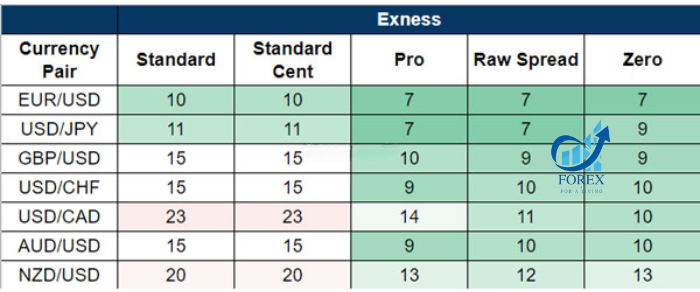
Learn About the Spread Fees for Different Exness Account Types
Exness allows you to trade in five types of accounts: Standard Cent, Pro, Zero, Low, and Standard. Trading conditions differ for each account type.
Default Account
This account is available to all traders. The spread on Exness is highly competitive, and there are no additional fees. It is the top choice for beginners since this account type doesn’t require a minimum deposit. The standard leverage can go up to 1:2000. This account comes equipped with commodities, indices, cryptocurrencies, and of course, currency pairs.
Exness publishes the standards for this account. It’s a version without any room fees and equivalent to an Islamic account. The Standard account makes it easy to access both MT4 and MT5, and there are no trading restrictions. That is, you can browse and accept risk freely. For international clients, Exness MT4 offers unlimited leverage (theoretically up to 1:2000).
Standard Cent Account
If you are new to Exness Spread and are just learning about it, this is the ideal account type. The Standard Cent account is only available on the MT4 platform, where one lot is worth $1,000 (about 23,000,000 VND) instead of $100,000 (about 23,000,000 VND). Here, you can open a total of 1,000 positions at once and only trade the currency pairs offered. Trading conditions for cents are similar to the standard account above.
Raw Spread Account
Exness offers reduced spread for this account type. However, each lot and direction comes with a commission of up to $3.5 (80,500 VND), and there’s a $7 (161,000 VND) commission for each open and close order. Leverage is also unlimited for each trade and can go up to 1:12000. Raw Spread also offers the option for swap-free trading, which is ideal for opening large positions.
Zero Account
This is a highly competitive account type. For the most traded Forex currency pairs, the spread is 0. Each lot and direction maintains commission fees similar to those of the Raw Spread account.
Pro Account
The Pro account is for customers who need faster execution. Exness has mentioned that this account offers “instant execution” with low spreads. It doesn’t differ much from other accounts and is quite similar to the Standard account.
Forex hopes that the information provided above will give you a comprehensive understanding of Exness Spread and the other regulations regarding Exness spreads. Best of luck to all traders for successful trades!
- t.me/finance_solutes
- Website: https://finance-solutes.com
- Hotline: +1 929 5636 439 ( Hotline )
- 26 Broadway, Suite 934, New York, 10004, US
