
 XM
XM Bybit
Bybit Binance
 Robinhood
 Webull
 IC Markets
 Pepperstone
 OKX
OKX Vantage
 VT Markets
 BingX
BingX Gate.io
 Kucoin
 MEXC
MEXC Exness
 Bitget
Until now, Ethereum has been considered an irreplaceable platform network for decentralized financial applications (dApps). However, in the past few years, the name Polkadot has emerged as a new wave and is considered the “Ethereum Killer” in the expansion of the DeFi ecosystem. So what is Polka Dot? What are the characteristics of the Polkadot project? What is the potential of this ecosystem? All will be answered in today’s article by Finance Solutes.
Let’s follow along!
1. OVERVIEW OF POLKADOT: WHAT IS IT?
Polkadot is known as a multi-chain, heterogeneous, and scalable blockchain technology. It enables the connection of individual blockchains, allowing seamless cross-chain data exchange to maximize the resources of the entire ecosystem.
Simply put, Polkadot is a blockchain of blockchains. This project helps users easily build their own blockchains within the Polkadot ecosystem.
1.1. What problems does Polkadot solve?
- Fast Transaction Processing: With its Parachain structure, Polkadot can handle up to 1,000 transactions per second, which is 10 times faster than Ethereum.
- Scalability: Polkadot connects multiple blockchains, providing the foundation for network expansion in the future.
- Network Reliability: New blockchain networks often struggle to build a large community and trust among participants. Polkadot solves this issue by connecting resources from multiple chains through its Relay Chain mechanism.
1.2. What are the key components of the Polkadot system?
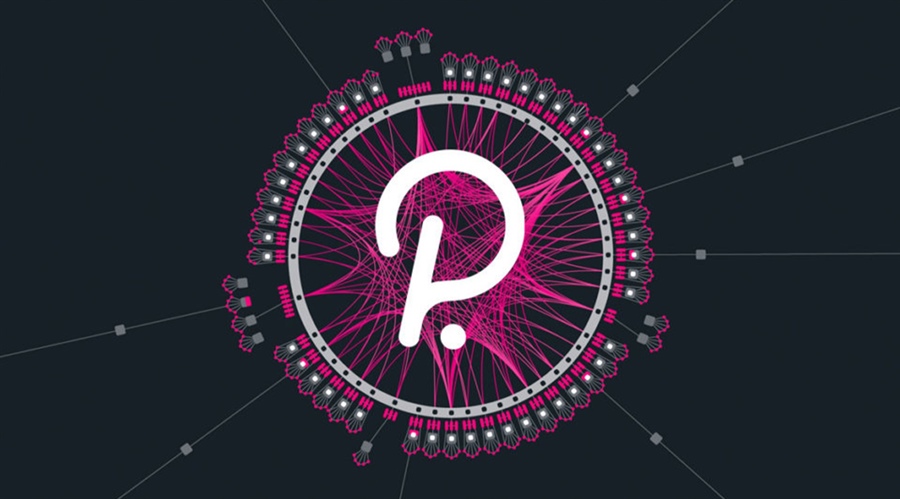
The Polkadot system consists of four important components:
- Relay Chain: A governance system that ensures consensus and flexible chain connectivity within the network. It is visually represented as a gray circle in the center, linking various blockchains.
- Polkadot Parachain: These are sub-chains within the main Polkadot ecosystem. Multiple projects can build Parachains and connect to the Relay Chain, leveraging Polkadot’s network effects. This significantly accelerates the development of applications. Parachains are typically illustrated as pink dots in network diagrams.
- Parathread: Similar to Parachains, but not permanently connected to the main chain. This is a cost-effective solution for projects that do not require continuous connectivity.
- Bridge: A cross-chain bridge that connects Polkadot to other networks, such as Bitcoin and Ethereum.
2. WHAT ARE THE OUTSTANDING FEATURES OF POLKADOT?
Some notable features of the Polkadot ecosystem include:
- Flexible Interoperability: Polkadot enables cross-chain connectivity for data, tokens, and assets. This supports parallel blockchain transactions and helps solve Ethereum’s scalability issues.
- Forkless Upgrades: When implementing new features or bug fixes, Polkadot does not require a Hard Fork, unlike many traditional networks.
- Substrate Framework: Allows users to create new blockchains within minutes effortlessly.
- Security: While each network is independent in governance, security is fully ensured. Traditional PoS and PoW mechanisms require a large community to guarantee security, which is difficult for smaller projects. Polkadot acts as a bridge, enabling smaller chains to operate securely from the start.
- Decentralized Governance: Anyone participating in the network can contribute to and help build the system.
3. COMPARISON: POLKADOT VS. ETHEREUM
Polkadot was built on Ethereum’s foundation but has enhanced key features to overcome Ethereum’s limitations. Here’s a side-by-side comparison of Polkadot (DOT) and Ethereum (ETH):
| Polkadot (DOT) | Ethereum (ETH) |
|---|---|
| Still under development, future remains uncertain | Pioneer in smart contract technology, has been running stably for years |
| Manages assets across multiple chains, forming a unified system | Can only manage assets on a single chain |
| Can connect any smart contracts or blockchains | Can only interact with smart contracts on Ethereum |
| Low transaction fees | High transaction fees |
| Upgrades without Hard Forks | Requires Hard Forks for upgrades |
| Uses on-chain governance with a multi-channel system | Ethereum 2.0 governance is still unresolved |
4. DETAILED INFORMATION ABOUT DOT COIN
Next, let’s dive into the DOT token, the native currency of the Polkadot ecosystem.

4.1. Information you need to know about Polka Dot Coin
- Token Name: Polkadot
- Ticker: DOT
- Blockchain: Polkadot
- Contract: 0xa2c49cee16a5e5bdefde931107dc1fae9f7773e3
- Token Type: Utility, Governance
- Total Supply: 1.103.303.471 DOT
4.2. Allocation of DOT Coin
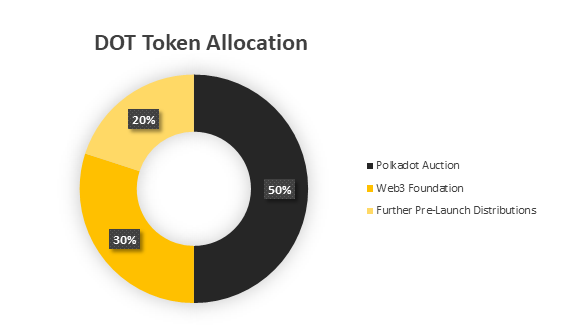
The Polkadot project’s DOT Coin is distributed as follows:
- Polkadot Auction: 50%
- Web3 Foundation: 30%
- Further Pre-Launch Distributions: 20%
4.3. Purpose of use and how to own DOT Coin
DOT serves four main functions within the Polkadot ecosystem:
- Governance: Allows holders to participate in the management and development of the network.
- Staking: Helps maintain network security and establish a consensus mechanism.
- Rewards: Incentivizes contributors who support the ecosystem.
- Bonding: A Proof-of-Stake (PoS) mechanism used to link DOT tokens and create new Parachains.
How can investors own DOT Coins?
There are two primary ways to obtain DOT tokens:
- Buying directly on listed exchanges, such as Binance, Huobi, KuCoin, PancakeSwap, FTX, Gate.io, etc.
- Participating in the Polkadot network through Staking, where users stake DOT and receive DOT rewards in return.
5. POLKADOT DEVELOPMENT TEAM AND PARTNERS
5.1. Who is behind the Polkadot project?
The project’s team consists of many members who all have many years of experience in the technology field, including Gavin Wood – former Co-Founder and CTO of Ethereum, and Peter Czaban – Chief Technology Officer of the Web3 Foundation.
5.2. Polkadot’s partners
Polkadot collaborates with various partners in different areas:
- Ecosystem Development: Supported by Web3 Foundation, open-source communities, and projects like Chainlink, ChainX, etc.
- Technology Development: Backed by Parity, Web3 Foundation, and open-source contributors.
- Major Investment Funds: Includes Kosmos Capital, zk Capital, BlockAsset Ventures, and KR1.
5.3. Polkadot project roadmap
- July 2020: Successful launch of Polkadot Mainnet.
- December 2020: Release of the Parachain Rococo V2 Testnet.
- Upcoming Milestones: The team has not yet disclosed specific dates for future developments, but investors can stay updated on major events [HERE].

6. ADVANTAGES AND DISADVANTAGES OF THE POLKADOT PROJECT FOR INVESTORS
In this section, let’s summarize the strengths and weaknesses of the Polkadot project from an investor’s perspective.
6.1. Strengths of Polkadot
Here are some of the key strengths of Polkadot:
- Ability to process multiple transactions simultaneously
- High specialization for specific use cases
- Cross-chain data sharing, interaction, and transfer
- Self-governance mechanisms that allow independent management
- High adaptability, enabling seamless upgrades
- Diverse applications in gaming, finance, social networks, cloud technology, digital identity, etc.
- Fast connectivity and enhanced security powered by Substrate.

6.2. What are the limitations of Polkadot?
Besides the advantages mentioned above, this ecosystem still has some certain limitations, such as:
- Being a relatively new name in the market, Polkadot has not yet achieved strong competitiveness.
- The Sharding feature may reduce security in exchange for scalability.
- There are potential risks and losses if the network is compromised.
7. FAQS ABOUT WHAT IS THE POLKA DOT PROJECT FOR NEW INVESTORS
Below are some common questions about the Polkadot project for investors:
7.1. What is a DOT token storage wallet?
Investors can store DOT tokens in the following types of wallets:
- Popular storage wallets such as Trust Wallet, MetaMask, Coin98 Wallet, PolkaWallet, Binance Smart Chain, etc.
- Wallets on exchanges that support DOT tokens, including Binance, FTX, Coinbase, KuCoin, Gate.io, etc.
- Hardware wallets such as Trezor, Ledger Nano, etc.
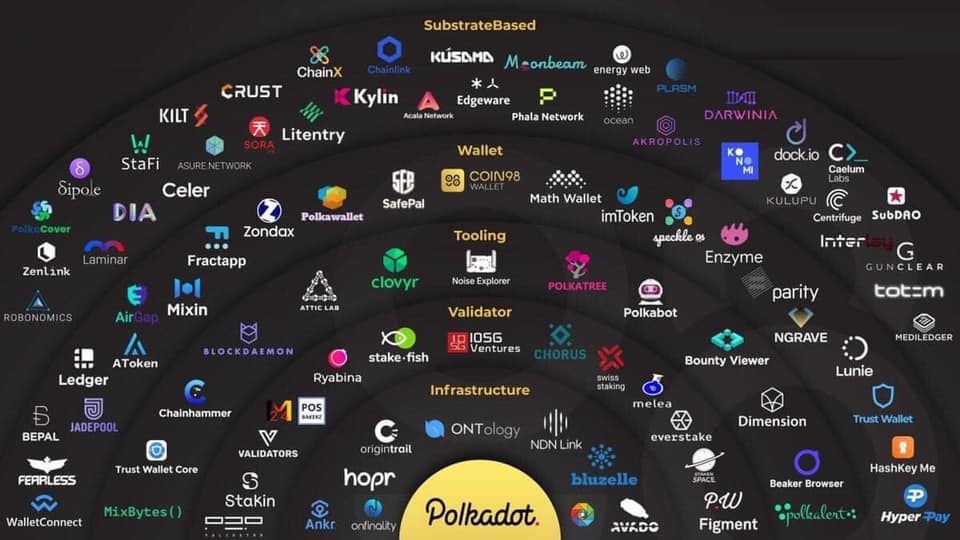
7.2. What coins are included in the Polkadot ecosystem?
There are over 100 coins created within the Polkadot Ecosystem. Some of the most notable tokens include DOT, LINK, COMP, ANKR, REN, ONT, MOVR, TRAC, ZRX, OCEAN, REEF, EWT, and more.
7.3. Does DOT coin have Potential? (Future of DOT)
The potential of DOT Coin in the future is highly recognized and valued by many investors. Currently, an increasing number of projects are seeking to connect with the Polkadot network due to its relatively simple and widely adopted model. As a result, the demand for using the coin within the Polkadot ecosystem is also on the rise, driving the value of DOT to grow rapidly. However, in the short term, the price of DOT coin may still be influenced by market expectations and investor sentiment toward the project.
8. SUMMARY
In conclusion, it is evident that the Polkadot ecosystem is on a strong growth trajectory as development teams recognize the many benefits of launching projects on Polkadot. Its unique design provides projects with the flexibility to innovate, iterate, and improve compared to previous platforms. We hope that through this article, you now have a clear understanding of what Polkadot is, its key features, and the potential of this project in the future.
To stay updated on financial investment knowledge and other essential cryptocurrency-related terms, be sure to follow Finnance Solutes Coin section regularly!
Wishing you success!!!
- t.me/finance_solutes
- Website: https://finance-solutes.com
- Hotline: +1 929 5636 439 ( Hotline )
- 26 Broadway, Suite 934, New York, 10004, US
