
 XM
XM Bybit
Bybit Binance
 Robinhood
 Webull
 IC Markets
 Pepperstone
 OKX
OKX Vantage
 VT Markets
 BingX
BingX Gate.io
 Kucoin
 MEXC
MEXC Exness
 Bitget
The Nikkei 225 Index is an index introduced by the Tokyo Stock Exchange (TSE) to assess the economic development. If you are interested in investing in the stock market, you need to be familiar with the indices of different exchanges to determine which stocks to buy and which to avoid. If you choose the Asian market, pay attention to the Japanese stock index—one of the leading economies in the world.
So, what is the Nikkei 225 Index? How can you trade with this index? Let’s explore these topics with Finance Solutes in the following trading knowledge article.
1. WHAT IS THE NIKKEI 225 INDEX?
The Nikkei Index, or the Nikkei 225 Index, is one of the key stock market indices that lists the 225 largest companies by price-weighted average on the Tokyo Stock Exchange (TSE). The scale of Japan’s economy makes this index a primary measure of stock market performance in Asia. Nihon Keizai Shimbun (Nikkei) has been calculating this index daily since 1950.
1.1. History of the Nikkei index
The Nikkei 225 Index was established at a base level of 100 points in May 1949.
Historically, the index reached its highest level of 40,000 points in 1989 but dropped to 15,000 points in 1992 due to the bursting of a financial bubble.
In 2013, the Nikkei Index surged by 57%, marking the highest increase since 1972, following a new presidential election and the implementation of economic reforms aimed at revitalizing Japan’s economy. Subsequently, the index continued to rise, reaching 20,000 points in April 2015.
Today, the Nikkei Index attracts significant attention from investors due to its high volatility and the numerous microeconomic factors that drive its movements.
1.2. Factors affecting the Nikkei 225 index
The Nikkei 225 Index fluctuates based on the stock prices of its constituent companies. Some of the key factors influencing this index include:
- Currency Exchange Rates: Since Japan’s economy heavily relies on exports, the strength of the Japanese Yen (JPY) is a crucial determinant of stock prices. A stronger Yen makes Japanese products less competitive globally, potentially leading to lower stock prices. Conversely, a weaker Yen can boost foreign demand, increasing revenue and driving the Nikkei 225 upward. Thus, the JPY and the Nikkei Index have an inverse correlation.
- Economic Events: Like many other indices, any event affecting the political, economic, or social landscape can influence the Nikkei 225. A notable example is the release of the U.S. Nonfarm Payrolls report, which also indicates a correlation between the Nikkei Index and the Dow Jones Index.
- Natural Disasters: Japan’s susceptibility to natural disasters can impact the Nikkei Index. For instance, the 2011 earthquake and tsunami triggered massive stock sell-offs, causing the index to drop by 7% in the following days.
- Policies of the Bank of Japan: Central bank policies influence borrowing costs and spending patterns of businesses and consumers, ultimately affecting corporate revenues and stock prices.
1.3. Components of the Nikkei 225 index
The Nikkei 225 includes globally renowned corporations such as Toyota, Honda, and major tech giants like Sony and Panasonic.
As of February 2020, the 15 most valuable companies by market capitalization listed by Finance solutes are:
| Company (Ticker) | Market Cap (USD) | % YTD Growth | PE Ratio | Trailing PE | EPS |
|---|---|---|---|---|---|
| Toyota Motor Corp (7203) | $243.837B | 21.78% | 11.58 | 12.19 | 794.67 |
| Sony Corp (6758) | $121.995B | 6.37% | 23.5 | 11.68 | 936.9 |
| Nippon Tel & Tel Corp (9432) | $70.353B | 8.86% | 6.14 | 11.61 | 248.2 |
| Recruit Holdings Co (6098) | $80.91B | 27.31% | 49.08 | 69.02 | 79.7 |
| Shin-Etsu Chemical Co (4063) | $70.353B | 4.35% | 25.05 | 26.65 | 706.26 |
| KDDI Corp (9433) | $70.1B | 12.56% | 13.14 | 12.16 | 283.91 |
| Mitsubishi UFJ Financial Group (8306) | $69.507B | 31.53% | 8.06 | 9.96 | 60.25 |
| Tokyo Electron (8035) | $67.11B | 24.84% | 36.7 | 30.86 | 1553.29 |
| Chugai Pharmaceutical Co (4519) | $64.845B | -20.35% | 21.53 | 34.24 | 128 |
| SoftBank Corp (9434) | $61.119B | 12.06% | 0 | 14.11 | 102.66 |
| Honda Motor Co (7267) | $55.34B | 23.75% | 8.26 | 9.35 | 380.75 |
| Hitachi (6501) | $55.25B | 56.14% | 14.11 | 12.22 | 519.29 |
| Daikin Industries (6367) | $55.089B | -8.73% | 28.85 | 39.2 | 533.66 |
| Takeda Pharmaceutical Co (4502) | $53.037B | -0.45% | 289.54 | 15.64 | 238.96 |
| Denso Corp (6902) | $52.884B | 23.62% | 17.6 | 46.99 | 161.39 |
2. HOW IS THE NIKKEI ASIAN INDEX CALCULATED?
Similar to the Dow Jones Index, the Nikkei 225 is a price-weighted average index representing the 225 largest publicly traded companies on the Tokyo Stock Exchange, measured in Japanese Yen.
The index is updated every 5 seconds on electronic boards during Tokyo Stock Exchange trading hours.
Simply put, the Nikkei 225 is a composite index that reflects the performance of the top 225 companies listed on the Tokyo Stock Exchange, which together account for the largest market capitalization in Japan.
Real-World Example:
If the Tokyo Stock Market Index is at 20,000 points, with a total market capitalization of 10,000 trillion JPY, and the total market cap of the 225 largest listed companies is 8,000 trillion JPY, the Nikkei 225 Index is calculated as:
(Market capitalization of 225 listed companies – 8,000 billion Japanese Yen) / (Total market capitalization – 10,000 billion Japanese Yen) * Total market index is 20,000 points = 16,000 points of Nikkei 225 index.
3. THE IMPORTANCE OF THE NIKKEI 225 INDEX FOR TRADERS
As mentioned earlier, the Nikkei 225 serves as Japan’s national benchmark index and a key indicator of the country’s stock market performance.
It is the most frequently cited index for Japan’s stock market. Evaluated once a year in early October, the Nikkei 225 includes 225 domestic companies across various sectors such as technology, finance, consumer goods, materials, and transportation.

Investors prefer to track this index because it can provide significant market price volatility. Furthermore, the Nikkei 225 also serves as the underlying asset for a range of financial derivatives.
The Nikkei 225 index is also known for its higher volume and volatility compared to other indices, making it highly attractive to day traders looking to profit from short-term price movements.
4. TRADING THE NIKKEI 225 INDEX
The Nikkei 225 index offers a way to access the Japanese stock market without analyzing individual company performance. It provides traders with high liquidity, extended trading hours, and tight spreads.
4.1. Why trade the Nikkei index?
- Liquidity: The Nikkei index is a highly liquid market with large trading volumes. This means traders can generally enter and exit trades with minimal slippage.
- Volatility: The Nikkei 225 index is known as one of the most volatile stock indices. Macroeconomic events and factors influencing the JPY price can cause rapid movements in the Nikkei 225 price. Therefore, traders have numerous opportunities to trade the Nikkei 225 index.
- Asset Correlation: This index is believed to reflect the behavior of other markets, such as the Dow Jones, while also showing an inverse correlation with the JPY. This allows traders to diversify their investment portfolios.
4.2. Nikkei 225 trading hours
Companies included in the Nikkei index are listed on the Tokyo Stock Exchange. The main trading hours for the Nikkei index are from 9:00 – 11:30 and 12:30 – 15:00 (GMT + 9) across five trading days per week.
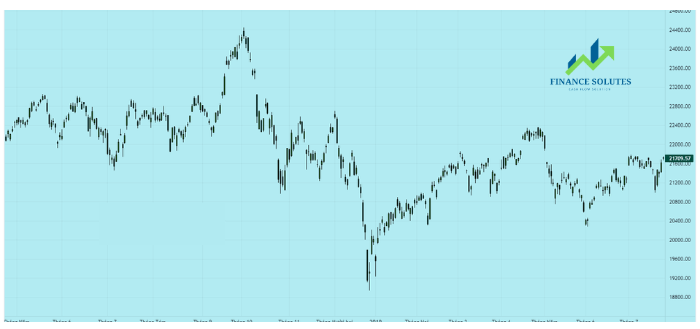
Below is the actual image of the Nikkei 225 index on the price chart:
4.3. How to trade the Nikkei 225 index
One of the easiest and most common ways to trade the Nikkei index is through Contracts for Difference (CFDs). This is a type of contract between a trader and a broker that allows profit to be made from the difference between the opening and closing prices.
Using CFDs to trade the Nikkei index enables you to buy or sell without going through traditional exchanges. Instead, you trade directly with your CFD broker.
Regardless of whether you have a positive or negative outlook on the Nikkei 225 index price, you can still profit from future price fluctuations, whether the market moves up or down.
5. SUMMARY
In this article, Finance Solutes has introduced you to the Nikkei 225 index, its significance to traders, and effective trading methods for this index. We hope that what we have shared will help you gain a better understanding of this crucial index and successfully apply it in your trading career.
Wishing you success!!!
- t.me/finance_solutes
- Website: https://finance-solutes.com
- Hotline: +1 929 5636 439 ( Hotline )
- 26 Broadway, Suite 934, New York, 10004, US
