
 XM
XM Bybit
Bybit Binance
 Robinhood
 Webull
 IC Markets
 Pepperstone
 OKX
OKX Vantage
 VT Markets
 BingX
BingX Gate.io
 Kucoin
 MEXC
MEXC Exness
 Bitget
Today’s article will help forex traders gain a better understanding of the concepts of leverage, margin, and margin call in trading. Additionally, the article provides guidance on how to use and calculate them to trade successfully.
1. LEVERAGE
Many people are drawn to Forex trading due to the amount of leverage offered by brokers. Leverage allows traders to access the financial markets with a larger position than what they are required to pay upfront. Traders at all levels need to grasp this concept thoroughly and know how to use leverage responsibly. This article delves deeply into leverage in forex trading, highlighting its differences from leverage in stocks and the importance of risk management.
1.1. What is Leverage in Forex?
Leverage in forex is a useful financial tool that allows traders to increase their market exposure beyond their initial investment (deposit). This means a trader can enter a position worth $10,000 with only $1,000 — in this case, the leverage is 10:1. However, it’s important to understand that both profits and losses are magnified when using leverage. In unfavorable market situations, a leveraged trader can even lose more money than they initially deposited.
A 10:1 leverage means traders can access a notional value or trade size ten times the margin required to fund the trade. This can be likened to putting down a 10% deposit on a house — you gain access to the entire house while only funding 10% of its full value.
1.1.1. Typical Leverage Ratios
Leverage is usually expressed as a ratio:
| Leverage | Ratio Form |
|---|---|
| Ten-to-One | 10:1 |
| Thirty-to-One | 30:1 |
| Fifty-to-One | 50:1 |
The amount of leverage available in forex trading is typically offered through your broker. The leverage amount varies depending on regulatory standards in different regions.
1.1.2. Forex Leverage vs. Stock Leverage
Leverage in forex differs from the amount of leverage offered when trading stocks. This is because major forex pairs are highly liquid and generally less volatile than frequently traded stocks. As a result, hedging and risk management while entering and exiting trades are easier in the forex market, with liquidity reaching up to $5.1 trillion a day.
1.2. How to Calculate Leverage in Forex Trading
Traders need the following to calculate leverage:
- The notional value of the trade (trade size)
- Margin ratio
Brokers often provide traders with a margin percentage to calculate the minimum equity required to fund the trade. Margin and account deposit can be used interchangeably. Once you have the margin ratio, simply multiply this ratio by the trade size to find the amount of equity required to execute the trade:
Equity = Margin Percentage × Trade Size
To calculate leverage, divide the trade size by the required equity:
Leverage = Trade Size / Equity
1.3. Example of Leverage in Forex Trading
Here’s a classic example of how to calculate leverage using the formulas above:
- Trade size: 10,000 currency units (a mini lot on USD/JPY with a trade size of $10,000)
- Margin ratio: 10%
Equity = Margin Percentage × Trade Size
0.1 × $10,000 = $1,000
Leverage = Trade Size / Equity
$10,000 / $1,000 = 10 times or 10:1
The example above highlights the basics of using leverage in forex trading when entering a trade. However, traders should note that they shouldn’t simply calculate the minimum amount required to enter a trade and then fund their account with that exact amount. Traders must consider margin calls if the position moves against them, pushing the account equity below the acceptable level determined by the broker.

1.4. Risk Management with Leverage in Forex Trading
Leverage can be described as a double-edged sword. It brings both positive and negative outcomes for forex traders. This is why it is essential to determine the appropriate effective leverage and incorporate proper risk management.
Top traders utilize stop-loss orders to limit their downside risk when trading forex. We recommend risking no more than 1% of your account equity on any single trade and no more than 5% of your account equity on all open trades at any given time.
Furthermore, successful traders use a positive risk-reward ratio to aim for higher probability trades over time.
1.5. Tips for Trading with Leverage
– Stay updated on forex fundamentals; Finance Solutes website offers comprehensive articles from basic to advanced levels.
– You must use stop-loss points when trading with leverage. Guaranteed stop-loss points eliminate the risk of negative slippage during high market volatility.
– Keep leverage at a minimum. I recommend using leverage of 10% or less.
– Understand the margin policies of trading platforms to avoid margin calls.
2. MARGIN
Margin trading in the forex market is the process of making a good-faith deposit with a broker to open and maintain positions in one or more currencies. Margin is not a cost or a fee but rather a portion of the client’s account balance set aside to trade according to the order.
2.1. What is Margin in Forex?
Margin in forex is a good-faith deposit that a trader places as collateral to initiate a trade. Essentially, it is the minimum amount a trader needs in their trading account to open a new position. This is typically expressed as a percentage of the notional value (trade size) of the forex trade. The difference between the margin and the total value of the trade is “borrowed” from the broker.
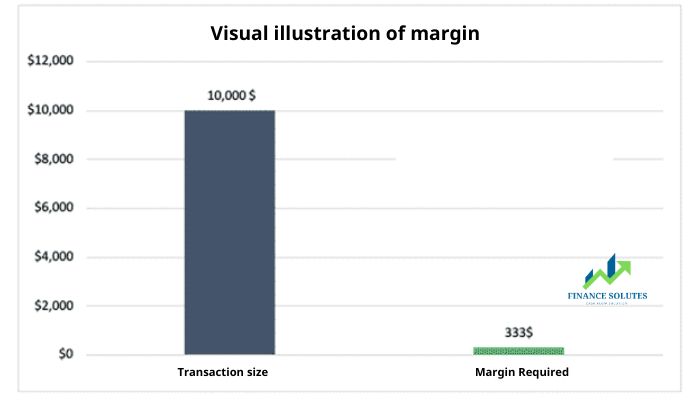
2.2. Example of Forex Margin
Here is a description of forex margin requirements compared to the full trade size:
- Trade Size: $10,000
- Margin Requirement: 3.33%
2.3. The relationship between Margin and Leverage
Before moving forward, it is crucial to understand the concept of leverage. Leverage and margin are closely connected because the larger the margin required, the less leverage a trader can use. This is because the trader has to put more of their own money into the trade, thereby borrowing less from the broker.
Leverage has the potential to generate both large profits and large losses, which is why traders must use it responsibly. Note that leverage can vary between brokers and across different jurisdictions — in line with regulatory requirements. Typical margin requirements and their corresponding leverage are shown below:
| Required Margin | Maximum Leverage |
|---|---|
| 50% | 2:1 |
| 3.33% | 30:1 |
| 2.00% | 50:1 |
| 0.5% | 200:1 |
2.4. Margin Requirements in Forex Trading
Forex margin requirements are set by brokers and depend on the level of risk they are willing to accept (default risk), while also adhering to regulatory restrictions.
Below is an example of margin requirements for the GBP/USD pair under the “Margin Requirements” section.
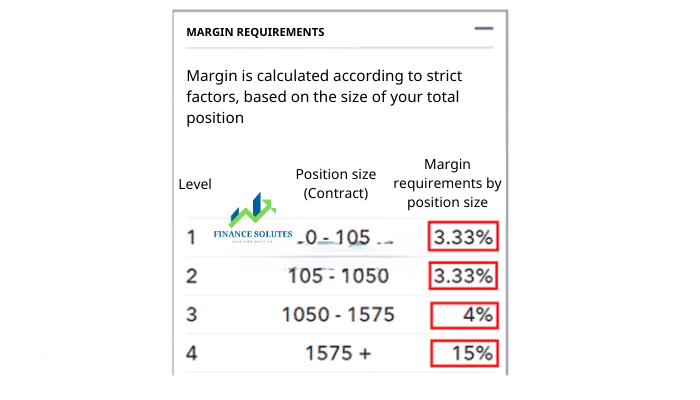
Forex margin requirements are set by brokers and are based on the level of risk they are willing to take (default risk), while complying with regulatory restrictions.
Below is an example of a margin requirement for the GBP/USD pair under “Margin Requirements”.
When trading with forex margin, it’s essential to remember that the margin required to maintain an open position is ultimately determined by trade size. As the trade size increases, traders move to the next tier, where margin requirements also rise.
Margin requirements may temporarily increase during periods of high volatility or when news releases are likely to contribute to greater-than-normal market swings.
The first two tiers maintain the same margin requirement at 3.33%, but this increases to 4% and 15% in the following tiers.
After understanding margin requirements, traders need to ensure their trading accounts are sufficiently funded to avoid a margin call. An easy way to track the status of their trading account is through the margin level, calculated as:
Margin Level = (Equity / Used Margin) x 100
Let’s say a trader has deposited $10,000 into the account; and currently has $8,000 used as margin. The margin level would be 125 and above 100. If the margin level falls below 100; the broker is usually prohibited from opening new trades and may place you on a margin call.
It is essential that traders understand the margin closeout rules set by the broker to avoid liquidation of existing positions. When an account is placed on margin call; the account needs to be funded immediately to avoid liquidation of existing open positions. Brokers do this to bring the account equity back to an acceptable level.
2.5. Key Forex Margin Terms
Equity: The balance of the trading account after adding current profits and subtracting current losses from the cash balance.
Margin Requirement: The amount of money (margin) needed to perform a leveraged trade.
Used Margin: The portion of account equity allocated to maintaining open trades.
Free Margin: The equity in the account after subtracting the used margin.
Margin Call: Occurs when a trader’s account equity falls below the acceptable level set by the broker, triggering the immediate liquidation of open positions to bring equity back to an acceptable level.
Margin Level: A measure of the account’s funding status, calculated by dividing equity by used margin and multiplying by 100.
Leverage: In forex, leverage is a financial tool that allows traders to amplify their market exposure beyond their initial investment by using a small amount of capital and borrowing the rest from the broker. Traders should note that leverage can lead to both significant profits and losses.
2.6. What is Free Margin in Forex?
Free margin is the equity in a trader’s account that is not tied up in margin for current open positions. Another way to understand this concept is the amount of cash in the account that traders can use for new positions.
This can be explained with an example:
- Equity: $10,000
- Margin Used for Current Positions: $8,000
Free Margin = Equity – Margin Used
Free Margin = $10,000 – $8,000
Free Margin = $2,000
2.7. Risk Management in Margin Trading
When trading on a margin account, it’s crucial for traders to understand how to calculate the margin required for each position if this information isn’t clearly displayed on the trading platform. Traders must understand the relationship between margin and leverage, and how increasing margin requirements reduces the amount of leverage available.
Monitoring important news releases with the help of an economic calendar can help traders avoid trading during such volatile periods.
Having a large amount of account equity as unused margin is considered prudent. This helps traders avoid margin calls and ensures the account is sufficiently funded to enter high-probability trades as soon as they arise.
3. MARGIN CALL
To fully understand margin calls in forex trading, you must first ensure you have a solid understanding of leverage and margin.
3.1. What is a Margin Call?
A margin call is usually an indicator that one or more securities held in a margin account have decreased in value. When a margin call occurs, the investor must choose to deposit additional funds into the account or sell some of the assets they hold.
3.2. Causes of Margin Calls
A margin call occurs when a trader no longer has any free margin. In other words, the account needs to be funded with additional capital. This typically happens when trading losses reduce the free margin below the level required by the broker.
Margin calls arise when traders use most of their margin while leaving very little free margin to cover losses. From the broker’s perspective, this is a necessary mechanism to effectively manage and mitigate their risk.
Here are the main causes of margin calls:
- Holding a losing trade for too long depletes the free margin.
- Using excessive leverage combined with the first reason.
- An underfunded account forces traders to overtrade with very little free margin.
- Trading without a stop-loss and experiencing a strong price movement in the opposite direction.
3.3. What happens when a Margin call occurs?
When a margin call occurs, trades are forcibly closed by the broker. This means the trader no longer has enough funds in the account to maintain the losing trades, putting the broker at risk of covering the losses. In some cases, leveraged trading can result in traders owing the broker more than their initial margin.
Let’s look at an example of an account with a high risk of a margin call:
Deposit: $10,000
Volume (100k per trading lot): 4 standard lots
Margin Requirement: 2%
Used Margin: $9,000
Free Margin: $1,000
The used margin is calculated as follows with EUR/USD at a price of 1.125:
= Trade size x exchange rate x margin requirement x number of lots
= $100,000 x 1.125 x 2% x 4 lots = $9,000
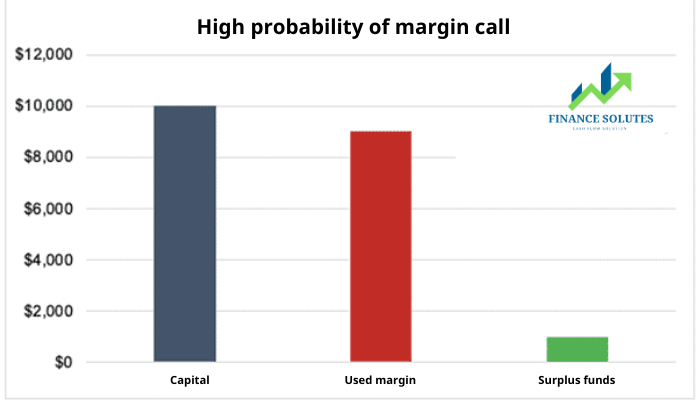
The only open position may have taken up the entire used margin. Clearly, the margin required to maintain the open position utilizes most of the account’s capital. This leaves a remaining margin of only $1,000.
Traders may operate under the false assumption that the account is in good standing. However, using leverage means that the account is less resilient to large movements against the trader’s expectations. In this example, if the market moves more than 25 pips (excluding the spread), the trader will receive a margin call, equivalent to $1,000 (= $40/pip x 25 pips).
3.4. How to avoid a Margin Call
Leverage is often compared to a double-edged sword. Why? Because the greater the leverage a trader uses — relative to the margin — the less free margin remains, making the trader more susceptible to losses. Leverage amplifies your profits; but it also magnifies your losses, and those losses can quickly wipe out your account.
When the free margin percentage reaches 0%, the trader will receive a margin call. Therefore, using stop-loss orders is essential to minimize losses.
To further illustrate the impact of leverage on a trader’s account, consider the following example where leverage is the only differentiating factor for these trades:
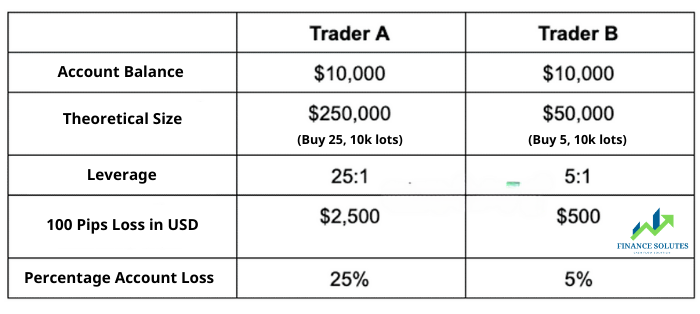
You cannot predict how price behavior will change tomorrow; therefore, carefully consider the appropriate leverage to use in trading.
3.4. Four Ways to Avoid a Margin Call in Forex Trading
– Don’t over-leverage your trading account and reduce your leverage. We recommend using leverage of 10:1 or less.
– Manage risk by limiting your losses with stop-loss points.
– Maintain a reasonable amount of free margin in your account to keep participating in trades. You should not use more than 1% of your account capital on any single trade, and no more than 5% of your capital across all trades at any given time.
– Trade smaller positions and approach each trade as if it were one of a thousand small trades.
4. SUMMARY
We hope that the article on Margin, Leverage, and Margin Calls in Forex Trading has been helpful in learning and understanding the market, as well as serving as a stepping stone for your future trading success.
Wishing you successful trades!
- t.me/finance_solutes
- Website: https://finance-solutes.com
- Hotline: +1 929 5636 439 ( Hotline )
- 26 Broadway, Suite 934, New York, 10004, US
