
 XM
XM Bybit
Bybit Binance
 Robinhood
 Webull
 IC Markets
 Pepperstone
 OKX
OKX Vantage
 VT Markets
 BingX
BingX Gate.io
 Kucoin
 MEXC
MEXC Exness
 Bitget
If you want to learn about prominent cryptocurrency projects, EOS coin is definitely one that you won’t want to miss.
You may not know that EOS is a smart contract platform for decentralized applications (DApps) and is considered a strong competitor to the Ethereum empire.
Let’s explore with Finance Solutes what the EOS coin project is all about and whether EOS coin has potential, as its ICO campaign is considered the most successful in the crypto market to date, raising over $4 billion in funds.
1. WHAT IS THE EOS COIN PROJECT?
So, what is the EOS coin project? EOS is a high-performance blockchain that provides a fast, secure, and cost-effective environment for decentralized applications (DApps) on a commercial scale. The EOS blockchain is known as a competitor to the Ethereum platform, built for both public and private use cases.
The structure of EOS allows users to perform transactions quickly and at reasonable costs, with the ability to store and execute smart contracts in a robust execution environment. EOS has an incredibly fast block creation time of just 0.5 seconds, while the block creation time on average for other blockchains ranges from 2–10 minutes.
EOS introduced the EOS VM WASM tool as part of the EOSIO 1.0 release, boosting transaction speeds by up to 12 times. It also stores the network’s state in multi-index tables, making it respond much faster than other blockchains, where users often experience delays while performing daily activities on decentralized applications (DApps).

The EOS blockchain is not only powerful but also designed for high flexibility. What sets EOS apart from some other blockchain platforms is that developers can easily upgrade the smart contracts deployed on EOS and add extensions to enhance their scope and functionality.
Network behavior on the EOS platform is determined by highly configurable system contracts, making it easy to perform system upgrades without needing to make changes to the core consensus.
The smart contracts on the EOS blockchain are written in the industry-standard C++, with a variety of software development kits (SDKs) and many other development tools provided by the EOSIO library. These tools and SDKs facilitate developers in building and launching their DApps on the EOS blockchain with ease.
The EOS coin ecosystem consists of three components:
EOS.IO
The core software, similar to an operating system that runs and manages the EOS blockchain network. It provides a set of tools for developers to simplify the development of decentralized applications (DApps).
EOS Blockchain
The main EOS blockchain, governed by the Delegated Proof-of-Stake (DPoS) consensus algorithm, which is responsible for storing and running decentralized applications (DApps).
EOS Token
EOS Token is the native currency of the EOS blockchain, responsible for staking on the chain, governance, and other economic activities within the network.
2. HOW DOES EOS WORK?
EOS brings a paradigm shift in the programmable blockchain space with a unique approach to solve one of the most fundamental issues in the cryptocurrency ecosystem—scalability.
To achieve the necessary scalability, it uses a custom variant of the Proof-of-Stake consensus algorithm called Delegated Proof-of-Stake (DPoS). The DPoS consensus algorithm is the intellectual property of Dan Larimer, the CTO of the EOS project and the founder of Bitshares and Steem.
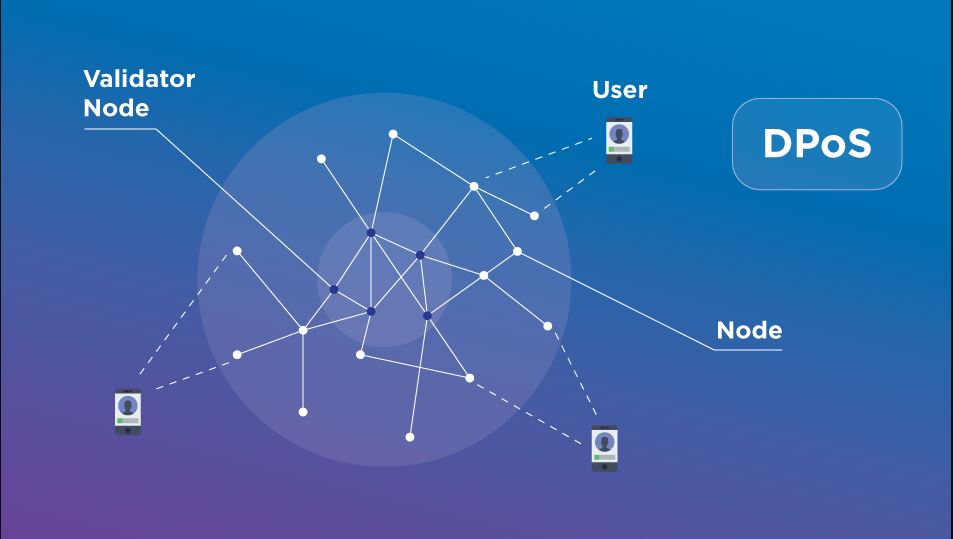
Before understanding the mechanism of the DPoS consensus algorithm, we first need to understand the concept of “Block Producers.” In any PoS-based network, there are validators (or verifiers) responsible for producing blocks and securing the overall network.
In the EOS blockchain, block producers are the network overseers, chosen through a community voting process. The top 21 block producers are called Delegates. They validate all transactions on the network, build blocks, execute various processes for smart contracts, and secure the network.
Block producers stake their EOS tokens on the network to ensure the security and smooth operation of the ecosystem. If they engage in malicious actions, they will lose their stake, and a replacement block producer will take over. The community’s vote also selects replacement block producers, with a total of 84 replacement block producers chosen to be on standby. If a delegate cannot process tasks due to machine failure, the standby block producers will take over.
The EOS mainnet has achieved an all-time high throughput of 4,000 transactions per second to date. However, the network can handle up to 10,000 transactions per second with EOSIO 1.0, and more updates are expected in future development roadmaps.
Another interesting aspect of the EOS blockchain is free transactions. Unlike other smart contract platforms like Ethereum, users are not charged fees when using DApps or interacting with smart contracts. These free transactions are made possible because the available network resources are pre-paid by developers who pay for them when deploying smart contracts on the EOS blockchain.
In the traditional Web 2.0 world, developers pay for the necessary resources for their applications, such as servers, network bandwidth, and domains, to deploy and run their apps. Users can access these applications for free through their browsers.

A similar model is applied here on the EOS blockchain, where developers stake EOS tokens to secure an equivalent amount of resources for their DApp. There are three resources that developers can use on EOS:
CPU – The amount of CPU time required to process transactions.
NET – The network bandwidth required for transactions (data transmission).
RAM – Used by smart contracts to store data on the blockchain.
Based on the scale of their stake, developers can secure an equivalent amount of resources from the EOS network to store and run their DApp. Users can interact with DApps without paying any transaction fees. Since developers can remove their tokens from the network, the EOS protocol compensates for inflation through transaction fees.
3. THE HISTORY OF EOS
The EOS blockchain was developed by Block.one, a company based in the Cayman Islands. The project’s white paper was released in May 2017. Block.one distributed 1 billion EOS tokens in a year-long ICO campaign that began in June 2017, shortly after the release of the initial white paper.
The ICO campaign was highly successful, with the company raising over $4 billion from ICO investors.
4. NOTABLE PROJECTS
The EOS coin ecosystem is gradually developing. In the current DeFi boom, we are seeing many DeFi projects being deployed on EOS rather than Ethereum. Some promising projects in the EOS coin ecosystem include:
- WhaleEx – The largest decentralized exchange on the EOS blockchain.
- Vigor – A DeFi project running on the EOS blockchain, focusing on decentralized and fully automated lending, borrowing, and saving.
- Equilibrium – The first decentralized and interoperable money market that offers cross-chain liquidity access.
- BetHash – A decentralized cryptocurrency casino built on the EOS blockchain.
- Alcor Exchange – A versatile decentralized exchange offering AMM swaps and spot trading.
5. SUMMARY
From this article, you likely have the answer to what the EOS coin project is and whether EOS coin has potential. It can be said that the EOS coin project had a successful launch, but over the years, it has experienced a fairly turbulent journey. One of the reasons is the limitations in building decentralized applications and the lack of a strong developer community.
- t.me/finance_solutes
- Website: https://finance-solutes.com
- Hotline: +1 929 5636 439 ( Hotline )
- 26 Broadway, Suite 934, New York, 10004, US
