
 XM
XM Bybit
Bybit Binance
 Robinhood
 Webull
 IC Markets
 Pepperstone
 OKX
OKX Vantage
 VT Markets
 BingX
BingX Gate.io
 Kucoin
 MEXC
MEXC Exness
 Bitget
If you are looking for stability when using cryptocurrency, the LUNA (Terra) coin project could be the perfect solution for you. In today’s article, let’s dive into the details of the Terra project with the coin LUNA and how it maintains the stability of Cryptocurrencies!
1. TERRA PROJECT (LUNA)
Terra (LUNA) is a blockchain protocol built on Cosmos, created with the goal of developing Stablecoins, transparent financial infrastructure, payment solutions, and smart contracts. Specifically, Terra (LUNA) focuses on replacing traditional payment systems, including banks, payment gateways, and credit card networks.
In the cryptocurrency market, a coin can increase or decrease by 20%, or even more, in just one day. Price volatility can be considered one of the main barriers preventing the widespread adoption of cryptocurrency.
The Terra project is attempting to solve this problem by creating cryptocurrency tokens with stable prices linked to fiat currencies. It uses a stablecoin algorithm that adjusts the money supply of an asset to restore its value. This could enable lower fees, increased stability, and cross-border exchanges.
1.1 Activity history
The Terra project was developed by Terraform Labs (a blockchain company based in South Korea) and is one of 15 e-commerce companies under the Terra Alliance group. The co-founders, Daniel Shin and Do Kwon, who are also the CEO of the company, aim to create a new type of cryptocurrency that reflects the flexible nature of the digital economy.
The history of the Terra protocol began when Terraform Labs was founded in January 2018. Below are some key milestones of the LUNA coin project that you may find useful:
- August 2018: A private sale of LUNA coins was held, raising around $32 million for the project.
- April 2019: The Terra mainnet was officially launched to the public.
- September 2020: The Terra UST stablecoin was first minted.
- December 2020: The Terra Mirror protocol was launched.
- February 2021: Terra Station Mobile was released on Android and iOS, allowing users to manage LUNA coins via their smartphones.
- March 2021: The Anchor protocol was released. Terra Bridge (a web interface for transferring assets between Terra, Ethereum, and Binance Smart Chain) became operational.
1.2 Terra Ecosystem
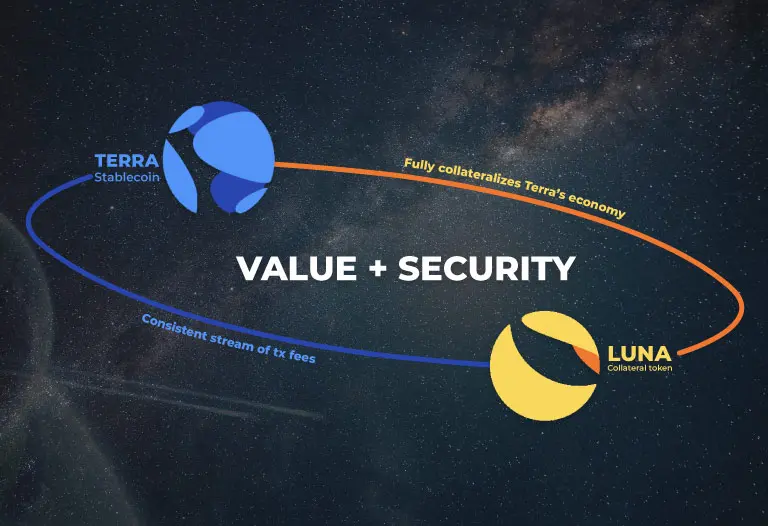
The Terra ecosystem includes stablecoins, the Anchor protocol, the native token of the Terra network (LUNA coin), and the Mirror protocol.
Stablecoin
Terra stablecoins are pegged to major fiat currencies around the world. Users can access stablecoins such as TerraUSD (UST) pegged to the US dollar and TerraKRW (KRT) pegged to the South Korean won. To address price volatility, the protocol uses an elastic money supply mechanism. New LUNA coins are minted to stabilize the price of Terra stablecoins.
Anchor Protocol
Anchor is a decentralized money market and savings protocol built on the Terra blockchain. It combines three financial principles: payments, investments, and savings. It allows holders of Terra stablecoins to earn a stable 20% APY. Additionally, it offers instant deposits and withdrawals, short-term loans, and margin trading of LUNA.
Mirror Protocol
Mirror enables trading of non-digital assets through Mirrored Assets (mAssets), which are issued by the protocol and reflect their exchange rates. To mint an mAsset, more than 150% of the real asset’s value must be locked in Terra stablecoins or mAssets as collateral.
2. WHAT IS LUNA COIN?
LUNA coin is the native token of the Terra network and serves as the foundation of the Terra ecosystem. Its primary goal is to bring blockchain technologies to the masses, focusing more on utility than just trading. LUNA coin is a stablecoin that uses an algorithmic self-adjusting mechanism by minting (converting into tokens) or burning (destroying coins) based on the current exchange rate of Terra.
The total supply of LUNA coins is 1 billion tokens, and the network is designed to burn coins if the total number exceeds 1 billion. The distribution of LUNA coins is as follows: 26% allocated to project supporters through a private sale, 20% for price stabilization reserves, 20% for Terra Alliance, 20% for employees and contributors, 10% reserved for Terraform Labs, and 4% for Genesis Liquidity offerings on exchanges.
LUNA coin serves as a staking token that secures the entire network. It can be used for staking, trading, and collateral purposes. To hold LUNA coins, users can store their assets in Terra wallets on personal computers, cold wallets, or mobile wallets. LUNA coins can be bought or traded on several cryptocurrency exchanges, including Bitfinex and Binance.
LUNA coins are used for a variety of purposes, including:
- Staking: The primary function of LUNA is to secure the network by locking in value through staking.
- Rewards: Users who validate transactions and add blocks to the blockchain will receive rewards in LUNA.
- Governance: Terra is a community-governed protocol. LUNA stakeholders have the right to submit proposals and vote on software upgrades, technical modifications, fee structure changes, and monetary policy adjustments.
- Collateral: LUNA coin holders can stake their coins as collateral to validate transactions and earn rewards based on the amount of LUNA they have staked.
Current LUNA Coin Price on CoinMarketCap as of April 24, 2022:

3. HOW IT WORKS
The stablecoins on the Terra (LUNA) network are not backed by collateral in themselves. Instead, the LUNA coin is used as collateral to help stabilize their price. To mint stablecoins, miners need to burn LUNA coins in an amount equivalent to the dollar value.
For example, when LUNA is swapped with TerraUSD (UST), a certain amount of LUNA coins is burned, and the remaining portion is stored in the Terra Community Treasury. Meanwhile, a new UST is minted.
The capital accumulated by the community group will be reinvested to build more applications that use UST. If the demand for UST is low, Terra’s algorithm automatically increases the fees. In this way, validators are always rewarded with a stable cash flow from UST.
To become a validator and mine transaction blocks, users need to stake (deposit) LUNA coins and be among the top 100 holders of LUNA. Those who do not meet the criteria can delegate their staked coins to a validator, who can approve transactions and generate passive income on their behalf.
Users who stake LUNA coins receive staking rewards based on the size of their stake. These rewards come from three sources:
- Gas Fees: Terra uses gas fees to prevent spam when executing smart contracts. Validators determine the minimum gas price and reject transactions with higher fees.
- Transaction Fees: Users are charged fees ranging from 0.1% to 1%, capped at 1 TerraSDR, and can be paid with any Terra currency.
- Seigniorage Rewards: Seigniorage rewards are available for validators when they vote to exchange LUNA coins for Terra’s stablecoins.
4. SUMMARY
By reading this article, you should have a good understanding of the basic information about the LUNA coin project. While LUNA itself is not a stablecoin, it plays a crucial role in maintaining the overall stability of the protocol.
- t.me/finance_solutes
- Website: https://finance-solutes.com
- Hotline: +1 929 5636 439 ( Hotline )
- 26 Broadway, Suite 934, New York, 10004, US
