
 XM
XM Bybit
Bybit Binance
 Robinhood
 Webull
 IC Markets
 Pepperstone
 OKX
OKX Vantage
 VT Markets
 BingX
BingX Gate.io
 Kucoin
 MEXC
MEXC Exness
 Bitget
The GDP (Gross Domestic Product) indicator is very important in the foreign exchange market. GDP data is used as a benchmark to assess the overall growth and development potential of a country. As a result, significant fluctuations in the forex market are closely monitored when the GDP index is released.
1. WHAT IS GDP?
Developed in 1934 by Simon Kuznets, Gross Domestic Product (GDP) measures the output of a country’s economy. Typically, GDP is defined at three different intervals: monthly, quarterly, and annually. This allows economists and traders to gain an accurate snapshot of the health of a country’s economy.
There are various ways to calculate GDP, but the U.S. Bureau of Economic Analysis uses the “Expenditure Approach” with the formula:
GDP = Consumption (C) + Investment (I) + Government Spending (G) + (Exports (X) – Imports (M))
1.1 The Relationship Between GDP and the Forex Market
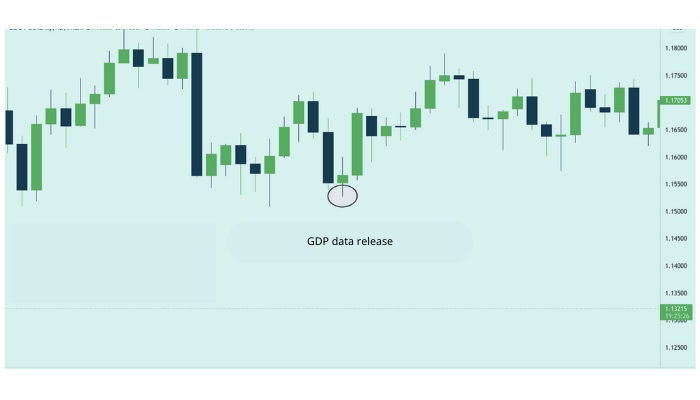
The general principle when examining GDP data is to see whether the numbers exceed or fall short of estimates (see the relevant charts below):
– GDP below estimate: This may lead to the domestic currency being sold off against other currencies (e.g., USD depreciating against EUR).
Example chart for the EUR/USD pair:
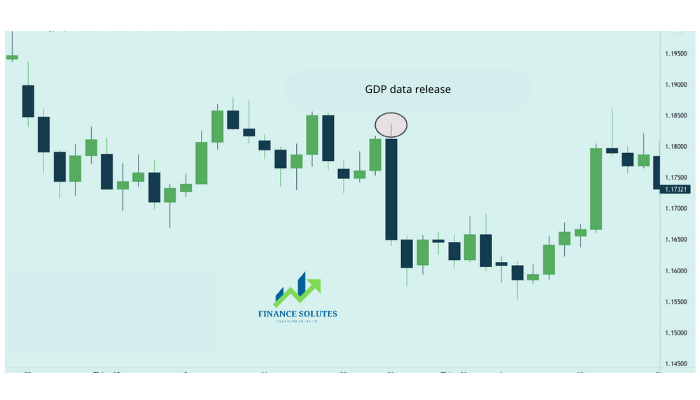
– GDP higher than estimate: This tends to strengthen the currency against others (e.g., USD appreciating against EUR).
Example chart for EUR/USD: Release of higher-than-expected GDP data
GDP reports do not always affect currencies in the same way or as expected. This is an important point to remember before committing to a trade. The data is often fully or partially priced in by the market. This means the market may not react as predicted when GDP is released.
Periodic reports of related economic data allow the market to form more accurate estimates. Necessary data includes:
- Supply Management Data (ISM)
- Producer Price Index (PPI)
2. GDP DATA ANALYSIS, INFLATION, AND INTEREST RATES
GDP data is typically released about 4 weeks after the last quarter of the year ends, while the final release is published 3 months after the end of the last quarter. Both are released by the U.S. Bureau of Economic Analysis (BEA) at 08:30 ET. Typically, investors expect U.S. GDP to grow between 2.5% and 3.5% per year.
If there is no high inflation in a moderately growing economy, interest rates may remain around 3%. However, a GDP above 6% signals the risk of the U.S. economy overheating. This could raise concerns about inflation.
As a result, the Federal Reserve may have to raise interest rates to control inflation and “cool down” an overheating economy. Maintaining price stability is one of the main tasks of the Federal Reserve. GDP should be at a “Goldilocks” level: growth that is neither too hot nor too cold.
GDP should not be too high, as it can lead to inflation, nor too low, as it can lead to a recession. A recession is defined by two consecutive quarters of negative GDP growth. The attractive economic differences between countries, such as China, which has a GDP at a double-digit level, are also notable.
Forex traders are most interested in GDP. This is because it provides a comprehensive report on a country’s economic situation. A country is “rewarded” for a high GDP with an increase in the value of its currency. There is typically positive expectation for future interest rates. This is because large economies tend to be stronger, leading to higher inflation, which causes the central bank to raise interest rates to slow down growth and prevent rising inflation.
On the other hand, a country with low GDP will likely expect significant interest rate cuts. In fact, the central bank of a country with negative GDP growth for two consecutive quarters may even choose to stimulate the economy by cutting interest rates.
3. CURRENCY TRADING USING GDP DATA
Quarterly data tends to create varying changes in the overall trend. For example, if the current quarter’s GDP estimate is more optimistic than the previous one, it may only be temporary when considering the year-on-year (YoY) data. The YoY data offers a broader perspective and can highlight potential long-term trends.
The following chart shows a longer time frame for EUR/USD (as seen in chart 2 above). The chart displays short-term QoQ data changes compared to the long-term YoY trend.
4. USEFUL ADVICE FOR FOREX TRADERS
-
CPI (Consumer Price Index) is released monthly. This is because most major economies use it to provide timely insights into current growth and inflation levels.
-
Fundamental traders monitor the release of economic data, and many do so with the purpose of trading based on news. It is essential for traders to implement proper risk management. The reason is that volatility can spike immediately following major data releases.
- t.me/finance_solutes
- Website: https://finance-solutes.com
- Hotline: +1 929 5636 439 ( Hotline )
- 26 Broadway, Suite 934, New York, 10004, US
