
 XM
XM Bybit
Bybit Binance
 Robinhood
 Webull
 IC Markets
 Pepperstone
 OKX
OKX Vantage
 VT Markets
 BingX
BingX Gate.io
 Kucoin
 MEXC
MEXC Exness
 Bitget
For investors—especially stock market investors—the Nasdaq index is probably no stranger. However, for newcomers, you may have come across this term somewhere but still don’t fully understand what it means.
In today’s trading knowledge series, Finance Solutes will guide you through a detailed exploration of the Nasdaq index. We’ll also help you distinguish between related terms such as the Nasdaq-100 and the Nasdaq Composite Index.
1. WHAT IS NASDAQ?
The Nasdaq Index is a global electronic platform and market for buying and selling securities. The Nasdaq exchange was established by the National Association of Securities Dealers (NASD) in 1971.
Nasdaq is considered the second-largest stock exchange in the world. This U.S.-based exchange is also recognized as the first electronic stock market in the world.

In fact, when traders or investors mention Nasdaq, they are usually referring to the Nasdaq index rather than the stock exchange itself.
1.1. The history of the Nasdaq stock exchange
The world’s first electronic stock exchange, Nasdaq, was launched in 1971. Nasdaq stands for National Association of Securities Dealers Automated Quotations.
Initially, it was established as a wholly owned subsidiary of the Financial Industry Regulatory Authority (FINRA), which was previously known as NASD.
At first, Nasdaq provided automated price quotations and later began offering stock trading. The core idea behind Nasdaq was to integrate technology in order to make electronic trading as widespread and efficient as possible.
Nasdaq quickly became a competitor to the New York Stock Exchange (NYSE) as it increasingly focused on technology as its key differentiator.

When technology companies wanted to go public through an IPO, Nasdaq’s commitment to technology attracted many tech giants such as Microsoft and Oracle.
Nasdaq continued expanding its stock market operations through partnerships and acquisitions. It acquired the Philadelphia Stock Exchange and later formed the first intercontinental linkage with the London Stock Exchange in 1992.
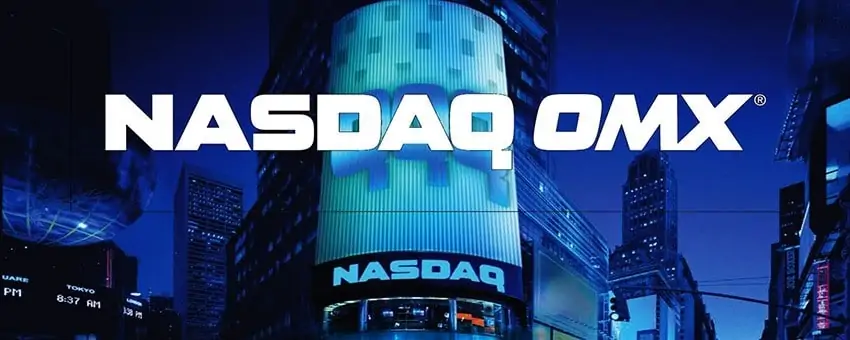
In 2006, Nasdaq separated from its original founding partner—NASD—and began operating as a national stock exchange. One year later, Nasdaq merged with Scandinavian OMX and became known as the Nasdaq OMX Group.
1.2. How does the Nasdaq Operate?
Originally, the Nasdaq electronic trading system was created as an alternative to the inefficient specialist system that had been the dominant model for nearly a century.
The Nasdaq U.S. stock exchange does not have a physical trading floor. Everything happens directly between investors looking to buy or sell and market makers.
Nasdaq was designed to provide automated price quotations. In its early years, it often facilitated over-the-counter (OTC) trading, to the extent that Nasdaq was frequently referred to as the OTC market in media and trade publications.
Later on, it added automated trading systems that could generate volume and trade reports, and became the first exchange to offer online trading.
If you follow global stock market news, you may be familiar with TV financial reporters broadcasting live updates in front of a large price display board. These boards are located in the Market Site Studio. Essentially, the Market Site consists of:
– Interface: Where dealers, brokers, and market makers access the system.
– Order Matching Engine: A computer system that connects buyers and sellers when their prices match.
– Quotation Service: Provides bid and ask price data from Nasdaq.

Of course, many other services are offered within the exchange, including broadcasting, record storage, and MarketSite backup services. However, the three services described above are the most essential.
2. NASDAQ U.S. STOCK EXCHANGE TRADING HOURS
The Nasdaq Exchange is typically open on weekdays from Monday to Friday, and closed on Saturdays and Sundays. Trading starts at 9:30 AM (ET). A standard trading session lasts approximately 6.5 hours and ends at 4:00 PM (ET).
However, Nasdaq also provides opportunities for investors to participate in special sessions both before and after the regular trading hours.
These special sessions, called “Pre Market trading hours,” run from 4:00 AM – 9:30 AM (ET) and 4:00 PM – 8:00 PM (ET) on weekdays.
In addition, the Nasdaq also closes early at 1:00 PM (ET) on the Friday after Thanksgiving (November 25) and on Christmas Eve if it falls on a weekday.
3. WHAT IS THE NASDAQ INDEX?
As mentioned earlier, when people refer to “Nasdaq,” traders and investors often mean the Nasdaq index—a stock market index listed on the Nasdaq Exchange.
As of April 2021, there were approximately 3,097 securities listed on Nasdaq.
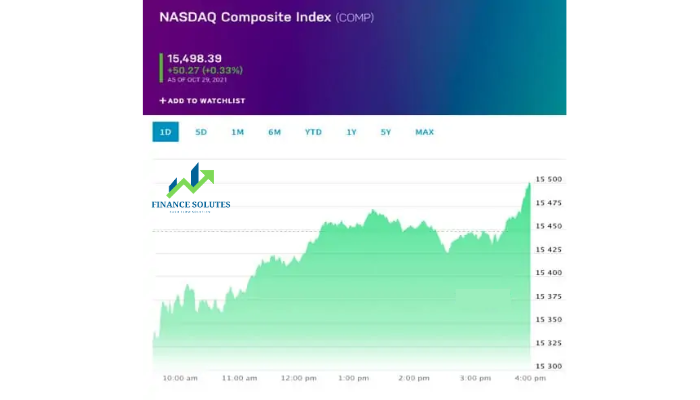
Dubbed the “second largest stock exchange in the world”, Nasdaq also operates two major stock indexes depending on the companies trading on the exchange including: Nasdaq Composite Index and Nas100 Index (Nasdaq 100 Index).
3.1. What is the Nasdaq Composite Index?
The Nasdaq Composite Index is one of the most widely used stock indices. Its ticker symbol is IXIC.
The Nasdaq Composite is calculated based on the market capitalization of its constituent stocks. This means that price movements in larger companies have a greater impact on the index compared to price changes in smaller companies.
Because some of the world’s largest companies are listed on the Nasdaq exchange, this index has significant influence. In fact, the top 10 stocks in the Nasdaq Composite account for one-third of the index’s performance.
Some of the leading companies in the Nasdaq Composite Index include:
- Apple (NASDAQ:AAPL)
- Microsoft (NASDAQ:MSFT)
- Amazon (NASDAQ:AMZN)
- Facebook (NASDAQ:FB)
- Tesla (NASDAQ:TSLA)
Due to the high concentration of technology companies listed on the Nasdaq stock exchange, the Nasdaq Composite is often regarded as the benchmark indicator for the overall performance of the tech industry.
The Nasdaq Composite is one of the most widely followed stock indexes in the U.S. and is often cited by market commentators along with the Dow Jones and S&P 500 indexes.
3.2. What is the Nasdaq 100 Index?
The Nas100 or Nasdaq 100 Index (Ticker Symbol: NDX) is also widely followed but is often confused with the Nasdaq Composite. However, there are some distinct differences between the Nasdaq 100 and the Nasdaq Composite.
The Nasdaq Composite includes all domestic and international Nasdaq-listed stocks on the Nasdaq exchange. In contrast, the Nas100 is a large-cap growth index and includes only 100 non-financial domestic and international companies based on market capitalization.
Moreover, the stocks in the Nas100 Index have historically had no exposure to any financial stocks.\\
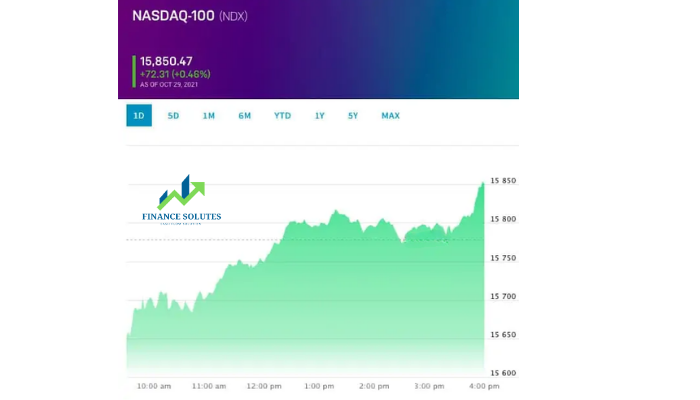
The weighting of technology stocks in the Nasdaq 100 and Nasdaq Composite indices differs. Some of the top U.S. stocks may not even appear in the top rankings.
The Nas100 index includes multiple sectors such as technology, retail, industrials, telecommunications, healthcare, transportation, and media.
The Nasdaq 100 is weighted according to the total market value of the outstanding shares. When the value of a company changes, the value of this stock index also changes accordingly.
Being listed in the Nas100 index can significantly impact a company’s financial success and media coverage. Companies ranked from 101 to 125 will remain only if they were in the top 100 the previous year. However, if they fail to return to the top 100 in the current year, they will be removed.
4. HOW TO INVEST IN THE NASDAQ INDEX
There are many ways (such as options, futures contracts, or annuities) for investors to gain exposure to the Nasdaq 100 index. The simplest way to invest in companies within the Nasdaq index is through ETFs and index funds.
When you purchase shares of ETFs and index funds, you are buying a portfolio of securities. These can include hundreds or thousands of company stocks, depending on the index you choose, and will immediately diversify your investment portfolio.
4.1. How to invest in the Nas100 Index
QQQ and QQEW are considered two reliable and well-known ETFs recommended by Nasdaq itself for investors looking to invest in the Nas100 index.
– Invesco QQQ Trust Series 1, the “20-year-old” ETF, is one of the most popular and long-standing ways to invest in the Nasdaq 100. It is the fifth-largest ETF with $76.96 billion in assets under management, has an expense ratio of 0.20%, and is one of the most liquid ETFs in the United States.
Investors should keep in mind that QQQ has the same weighting as the Nasdaq 100. Therefore, companies with higher market capitalizations will have greater weightings in the index.
– First Trust Nasdaq-100 Equal Weighted Index Fund (QQEW) provides investors with the opportunity to hold stocks in the Nasdaq 100 index with equal weighting. Launched in April 2006, this ETF has approximately $604.86 million in assets under management and an expense ratio of 0.6%.
4.2. How to Invest in the Nasdaq Composite Index
In fact, you cannot directly invest in the Nasdaq Composite Index. However, similar to the Nasdaq 100 index, you can invest through mutual funds or ETFs with very low costs.
Here are two funds with performance similar to the Nasdaq Composite Index that investors can consider:
– Fidelity Nasdaq Composite Index Fund (FNCMX) – The goal of this index fund is to closely mirror the price and performance of the Nasdaq Composite.
– Fidelity Nasdaq Composite Index ETF (ONEQ) – This ETF invests 80% of its assets in companies listed in the Nasdaq Composite Index.
- t.me/finance_solutes
- Website: https://finance-solutes.com
- Hotline: +1 929 5636 439 ( Hotline )
- 26 Broadway, Suite 934, New York, 10004, US
