
 XM
XM Bybit
Bybit Binance
 Robinhood
 Webull
 IC Markets
 Pepperstone
 OKX
OKX Vantage
 VT Markets
 BingX
BingX Gate.io
 Kucoin
 MEXC
MEXC Exness
 Bitget
Weekend Effect is a fairly common phenomenon that has been tested in many developed markets such as the US, UK, Australia, Japan, etc. It is mainly recognized in the international stock markets. However, in recent years, this phenomenon has also appeared across most financial markets in Vietnam. So what exactly is the Weekend Effect? How is this effect applied in finance? Let’s explore the details in today’s article with Finance Solutes!
Let’s get started!!!
1. WHAT IS THE WEEKEND EFFECT?
In this section, let’s join Finance Solutes in clarifying the concept of the Weekend Effect in finance!
1.1. The Weekend Effect in Finance
The Weekend Effect is a term used to describe a phenomenon in financial markets where stocks traded on Mondays tend to open at significantly lower prices compared to their levels on the previous Friday.
This phenomenon has been a notable feature in many technical analysis models of stock trading over the years. Numerous studies have been conducted to explain this market behavior.
Some research suggests that the reason for the Weekend Effect is that many companies tend to release bad news on Fridays after the market has closed; thus, stock prices tend to drop significantly by Monday.
Other studies argue that the Weekend Effect could be linked to short selling. The act of short selling can impact stock prices, especially as short (sell) positions have the potential to yield high profits. Alternatively, the effect may simply result from a decline in investor optimism between Friday and Monday, particularly among short-term traders.
1.2. The Reverse Weekend Effect
Some analysts have researched the so-called “Reverse Weekend Effect.” According to these studies, Monday returns are actually higher than those on other weekdays.
Many studies have shown a variety of weekend effect patterns. These depend on company size—small firms may experience lower Monday returns, while large firms may show higher Monday gains.
The Reverse Weekend Effect has also been observed in the U.S. stock market.
2. EXPLAINING THE WEEKEND EFFECT IN STOCK MARKETS
One explanation for the Weekend Effect in stock markets is the irrational behavioral tendencies of humans. The trading behavior of individual investors seems to be a contributing factor to this phenomenon. When faced with uncertainty, people often make inaccurate and emotional decisions—especially investment decisions that can be influenced by external (and sometimes subconscious) factors.

In 1973, Frank Cross was the first to report anomalies in Monday returns in his paper titled “The Behavior of Stock Prices on Fridays and Mondays”, published in the Financial Analysts Journal. In this report, he pointed out that average returns on Fridays were significantly higher than those on Mondays, and that there were noticeable differences in price patterns between these two days. Specifically, stock prices tended to decline on Mondays following gains on the previous trading day (typically Friday).
As mentioned earlier, several theories have been proposed to explain this phenomenon. One theory suggests that many companies have a tendency to release negative news on Fridays after the market has closed. Another explanation ties the effect to short selling. Additionally, it may simply reflect a gradual build-up of optimism among traders from Monday to Friday.
3. EXPLAINING THE WEEKEND EFFECT IN THE CRYPTO MARKET
The Weekend Effect is also a term used to describe sensitive periods of price volatility in the cryptocurrency market, particularly in Bitcoin.
If you’ve observed Bitcoin price movements over the past year, you may have noticed some common patterns:
- Bitcoin rises steadily during the week, then drops sharply on the weekend.
- Bitcoin moves sideways all week, then still experiences a steep drop over the weekend.
The “weekend” referred to by Finance Solutes includes both Saturday and Sunday. The occurrence of sharp declines in Bitcoin prices over the weekend is fairly frequent. You can observe this pattern more clearly in the illustration below:
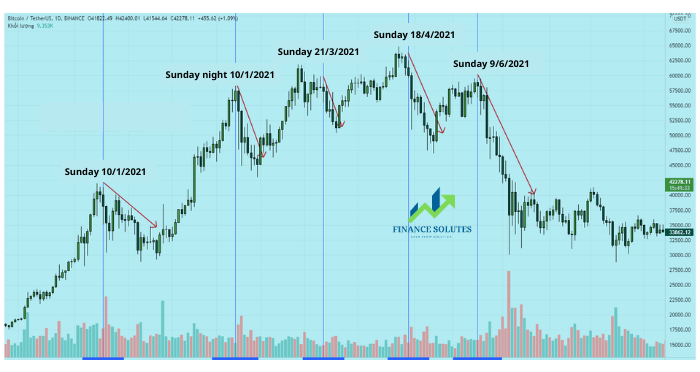
So why does the Weekend Effect occur with Bitcoin?
Although there have been many discussions trying to explain this phenomenon, they all ultimately point back to the basic law of supply and demand. A sharp decline in Bitcoin usually happens due to a large volume of sell orders being liquidated, regardless of the buy prices in the market—orders are matched and executed. Therefore, it’s not necessarily tied to the weekend. If you pay attention, sharp drops can also occur on Mondays, Tuesdays, or any other day. What we’re really interested in here is: why do these “dumps” often occur on weekends?
Here are a few reasons worth considering:
- Lower trading volume on weekends: This is largely due to the “resting mindset” of many traders over the weekend. As a result, any sell order executed in a low-volume environment tends to create wider price swings.
- “Closing the books” mentality: Traders who have earned profits during the week may tend to sell at the weekend to lock in those gains. Keep in mind that long-term holders are the minority—most participants in the market are retail traders.
- Margin Calls: Margin traders may face liquidation and therefore tend to close their positions by selling off their crypto holdings over the weekend to cover losses.
In addition, some attribute it to market manipulation and other speculative factors. However, it’s important to understand that the Weekend Effect is not a guaranteed rule.
4. SUGGESTIONS FOR INVESTORS
Based on the insights provided by Finance Solutes about the Weekend Effect, how should investors apply this knowledge and take steps to limit risks associated with this phenomenon?

4.1. Diversify Your Investment Portfolio
Investors should diversify their investments across various asset classes and reasonable portfolios.
Every investor should possess the necessary knowledge and expertise to demonstrate professionalism in the financial investment sector. They must also cultivate an investment mindset aimed at achieving future profit expectations—goals that traders can realistically attain.
4.2. Stay Updated on Market Patterns and Reassess Personal Experience
Keeping up with market patterns and reevaluating your own experience is absolutely essential. The reason is simple: markets are constantly evolving. In fact, the Weekend Effect has already been disappearing in some global markets as those markets become increasingly efficient.
4.3. Avoid Herd Mentality and Crowd Psychology
Investors must steer clear of herd mentality and irrational psychological behaviors. To do this, one needs a long-term process of learning, expanding knowledge, and accumulating personal experience. When necessary, it’s important to detach yourself from the crowd’s emotional bias.
5. SUMMARY
Through today’s article, Finance Solutes has shared with you insights into what the Weekend Effect is, why it happens, how it applies in financial investment, and provided practical investment advice for traders.
We hope the information we’ve discussed proves helpful in your trading and financial investment journey.
Wishing you success in your trading career!!!
- t.me/finance_solutes
- Website: https://finance-solutes.com
- Hotline: +1 929 5636 439 ( Hotline )
- 26 Broadway, Suite 934, New York, 10004, US
