

What is the Dow Jones Index? Revealing How to Invest in the DJI Index Successfully

As a stock trader or simply someone interested in the global economy, you cannot ignore the Dow Jones index. This is one of the most popular and important indices of the U.S. stock market. It reflects the health of the American economy, so whenever any major economic or political event occurs, people pay close attention to changes in this index.

So, what is the DJI index? How can you invest in the Dow Jones? How important is it to the economy? Let’s dive into the details with Finance Solutes in today’s article.

Stay tuned!!!

1. OVERVIEW OF WHAT THE DJI INDEX IS

In the first part of this article, let’s join Finance Solutes to explore the history, definition, as well as the classification of the Dow Jones index!

1.1. What is the history of the Dow Jones index?

Charles H. Dow – the father of Dow Theory, author of The Wall Street Journal, and founder of Dow Jones & Company – created the Dow Jones index with the goal of monitoring the health of the U.S. economy through companies considered key players in the economy.

This index first appeared in The Wall Street Journal on May 26, 1896. Dow Jones was calculated by taking the closing prices of the 12 largest companies in the American industrial sector and averaging those prices. The first published price on The Wall Street Journal was $40.94, which was also the first value of the index.

By 1916, the number of stocks used to calculate the DJI index had changed to 20, then continued to 30 in 1928, and has maintained this number ever since.
1.2. Definition of the Dow Jones Index
The Dow Jones Index, fully called the Dow Jones Industrial Average or DJI (Dow Jones Index), is one of the most important stock market indices in the U.S. stock market.

Dow Jones is calculated based on the closing prices of 30 Blue Chip stocks listed on the New York Stock Exchange and Nasdaq. These 30 stocks belong to various industries such as technology, retail, finance, entertainment, consumer goods, and more.

On the stock market, the Dow Jones is represented by several different symbols such as DJI, DJIA, Dow 30, DJ30, etc.

Below is the list of companies currently composing the DJI index:

  • 3M

  • American Express

  • Apple

  • Boeing

  • Caterpillar

  • Chevron

  • Cisco

  • Coca-Cola

  • The Walt Disney Company

  • DowDuPont

  • ExxonMobil

  • General Electric

  • Goldman Sachs

  • The Home Depot

  • IBM

  • Intel

  • Johnson & Johnson

  • JPMorgan Chase

  • McDonald’s

  • Merck

  • Microsoft

  • Nike

  • Pfizer

  • Procter & Gamble

  • Travelers & Companies, Inc.

  • United Technologies

  • UnitedHealth

  • Verizon

  • Visa

  • Wal-Mart

The above list is not fixed and may change over time. If any stock no longer meets the criteria of a Blue Chip stock in the U.S. stock market, it will be removed from this list. These companies are chosen based on their reputation, sustainable growth, and investor interest in their stocks to make decisions, and there is no specific set of rules governing these companies.

1.3. Classification of the Dow Jones Index

Besides the Dow Jones Industrial Average (DJIA), there are three other indices developed by Charles Dow, which are:

  • Dow Jones Utility Average (DJUA): includes the 15 largest companies in the U.S. gas and electric utilities sector

  • Dow Jones Transportation Average (DJTA): includes 20 stocks representing companies in the railroad, water transportation, and airline sectors, listed on the New York Stock Exchange

  • Dow Jones Composite Average: a combined index of 65 stocks from all three Dow Jones indices mentioned above.


Among the 4 Dow Jones indices mentioned by Finance Solutes above, the DJIA is the most commonly used index and also serves as the benchmark for the U.S. stock market. Therefore, when referring to the Dow Jones index, investors typically mean the Dow Jones Industrial Average (DJI).

2. HOW TO CALCULATE THE DOW JONES INDEX FOR INVESTORS

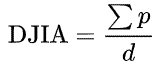
This index is calculated using a simple average method, by taking the total value of the stocks divided by the number of stocks in the calculation list. Thus, the formula for calculating the Dow Jones index is as follows:

Cách tính DJI 1

Where:

  • p: price of each stock
  • d: total number of stocks included in the calculation (in this case, d = 30)

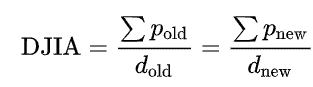
In reality, stock prices fluctuate in cases such as new stock issuance, stock splits, shareholder transfers, etc. Therefore, to accurately calculate the DJI index to reflect the overall stock market, the value of d will always change.

In that case, the formula for calculating the Dow Jones index becomes:

Cách tính DJI 2

Practical example: The DJI index is calculated based on 30 stock symbols. However, to simplify, TradaFX will illustrate using 2 stocks to calculate this index.

Stock Day 1 Day 2 Day 3
A 20 25 30
B 80 75 85
  • On Day 1, the DJI = (20 + 80) / 2 = 50
    On Day 2, the DJI = (25 + 75) / 2 = 50
  • On Day 3, the DJI = (30 + 85) / 2 = 57.5
  • On Day 4, stock C (with a value of 10) is added to the Dow Jones stock list, increasing the number of stocks from 2 to 3. At that point, the DJI index will change.

3. WHAT IS THE IMPORTANCE OF THE DJI INDEX?

Although calculated based on price data from 30 companies among the many stocks listed on the New York Stock Exchange, these companies are the largest in the U.S. in terms of market capitalization, as well as the interest of investors worldwide.

Moreover, these 30 companies are not concentrated in a single sector but encompass many different sectors such as technology, commerce, entertainment, consumer goods… almost covering all the backbone sectors of the current U.S. economy.

The Dow Jones Index is highly sensitive to major economic and political impacts such as war, natural disasters, political instability, interest rate policies, inflation, and other economic indicators like unemployment rates, import/export data, and GDP. Any significant change in these factors can directly influence the value of the DJI.

Therefore, it can be said that the economic and political situation in the United States has a direct impact on the Dow Jones Index. Simply put, by observing the DJI, one can visualize the overall picture of the U.S. economy. Furthermore, since the U.S. holds significant influence over the global economy, the Dow Jones Index can also partially reflect the overall health of the world economy.

Studying this index is extremely important, as large fluctuations in the Dow Jones can have a considerable effect on investor sentiment worldwide. This, in turn, can influence their behavior in stock and forex markets.

Limitations of the Dow Jones Index

Despite its importance, the Dow Jones still has several limitations:

  • Limited number of stocks: The index includes only 30 companies, which may be too small to represent the vast U.S. stock market. Moreover, the focus is primarily on industrial companies, which may not accurately reflect the performance of other vital sectors.

  • Price-weighted calculation: Since the Dow Jones is calculated based on stock prices rather than market capitalization, it may not represent the true intrinsic value of the component companies—let alone the entire economy.

  • Susceptibility to individual stock price changes: A significant change in the price of a single stock can affect the overall index, but this does not necessarily indicate a broad market movement.

Given these limitations, investors should exercise caution when trading based on the Dow Jones. More importantly, they should monitor and analyze market conditions both broadly and specifically to avoid unnecessary mistakes.

4. HOW TO INVEST IN THE DOW JONES INDEX

There are two main ways to invest in the Dow Jones:

  • Option 1: Purchase shares of companies included in the DJI index
  • Option 2: Invest in ETFs (Exchange-Traded Funds) that track the Dow Jones Index

With both methods, you would be trading U.S.-listed securities. However, in order to trade directly on U.S. stock exchanges, you are typically required to have a U.S. passport or residency. Therefore, retail investors from other countries often turn to derivatives to access the U.S. stock market.

Some popular and widely used derivative trading platforms include Exness, FXPro, XTB, Mitrade, among others. The two most commonly used derivatives for this purpose are ETFs and CFDs (Contracts for Difference).

🌍 Finance Solutes
  • t.me/finance_solutes
  • Website: https://finance-solutes.com
  • Hotline: +1 929 5636 439 ( Hotline )
  • 26 Broadway, Suite 934, New York, 10004, US