
 XM
XM Bybit
Bybit Binance
 Robinhood
 Webull
 IC Markets
 Pepperstone
 OKX
OKX Vantage
 VT Markets
 BingX
BingX Gate.io
 Kucoin
 MEXC
MEXC Exness
 Bitget
S&P 500 is one of the most prominent indices in the U.S. stock market, second only to the Dow Jones Index in terms of market representation and investor interest. So, what is the S\&P 500 Index? How does the S\&P 500 Index work? How is this index calculated in investment activities? Let’s dive into the details with Finance Solutes in today’s article.
Let’s get started!!!
1.OVERVIEW: WHAT IS THE S&P 500 INDEX?
S&P 500 stands for the Standard & Poor’s 500 Stock Index. This index was first introduced on March 4, 1957 by Standard & Poor’s – the world’s largest credit rating company. However, in 1966, McGraw-Hill Cos acquired this company and officially became the largest owner of the S&P 500.
The S&P 500 is a market-capitalization-weighted index of 500 publicly traded companies in the U.S. stock market. Additionally, it serves as a barometer for the overall performance of the stock market. Therefore, investors can grasp the current state of equities quickly and accurately.
1.1. Criteria for Company Selection in the S&P 500 Index

Similar to the Dow Jones Index, the 500 constituent companies of the S&P 500 are selected by a committee consisting of economists and analysts from Standard & Poor’s. This committee reviews and evaluates companies based on a defined set of criteria. Below are some important mandatory criteria that companies must meet:
- Market capitalization must be at least $4 billion USD
- The company must be headquartered in the U.S. (this criterion has become less important since 2013)
- Regarding liquidity, the ratio of USD trading volume to adjusted float market capitalization must be greater than 1
- More than 50% of the company’s total shares must be publicly available (held by investors)
- These companies must belong to one of the industry sectors such as industrials, healthcare, real estate, finance, information technology, consumer products, media services, etc., according to the Global Industry Classification Standard (GICS). However, the information technology sector holds the largest weighting.
- Financially, the company must have strong financial results in recent periods such as the most recent quarter or the last four quarters
- Additionally, other criteria include stock listing status, length of listing, etc.
The list of constituent companies is not fixed and changes regularly. However, some large and well-known companies are always included in this index, such as Microsoft, Apple, Google, Facebook, AT&T, General Electric, Johnson & Johnson, and more.
Below is the top 10 leading companies included in the S&P 500 Index:
| No. | Company | Ticker | Market Capitalization (Billion USD) | Weighting |
|---|---|---|---|---|
| 1 | Apple Inc. | AAPL | 1,966.4 | 5.5% |
| 2 | Microsoft Corp. | MSFT | 1,883.1 | 5.3% |
| 3 | Amazon.com, Inc. | AMZN | 1,379.6 | 3.9% |
| 4 | Facebook, Inc. | FB | 790.7 | 2.2% |
| 5 | Alphabet Inc. Class A | 708.8 | 2.0% | |
| 6 | Alphabet Inc. Class C | GOOG | 695.1 | 2.0% |
| 7 | Berkshire Hathaway Inc. | BRK.B | 551.9 | 1.6% |
| 8 | JPMorgan Chase & Co. | JPM | 501.2 | 1.4% |
| 9 | Tesla, Inc. | TSLA | 480.1 | 1.4% |
| 10 | Johnson & Johnson | JNJ | 444.9 | 1.3% |
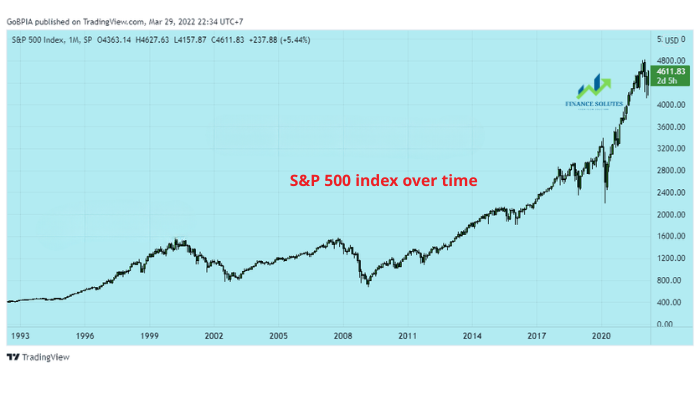
1.2. S&P 500 Index Chart Over Time
Below is the historical fluctuation of the S&P 500 Index over the years:
2. WHAT IS THE SIGNIFICANCE OF THE S&P 500 INDEX?
The S&P 500 Index not only helps investors easily assess the state of the U.S. stock market, but it also carries several important meanings, including:
- Since this index is calculated based on 500 different companies, all of which are leading firms in various sectors of the U.S. economy and together represent over 70% of the stock market’s total value, investors can use the S&P 500 to gauge how the overall economy is performing.
- The S&P 500 is also highly sensitive to major economic events. Changes in domestic and foreign policies, as well as economic or financial conditions, can directly impact the index’s value.
- Additionally, the value of the S&P 500 is constantly fluctuating. Therefore, it serves as a key reference for investors to gain a comprehensive view of the market and develop the most suitable investment strategies.
The biggest limitation of this index is that it does not reflect the fluctuations of all publicly listed companies, especially those with small market capitalizations.
3. HOW DOES THE S&P 500 WORK?
As mentioned earlier, the S&P 500 Index reflects the health of the global economy. As of November 29, 2019, the sector breakdown within the index is as follows:
- Information Technology: 22.8%
- Healthcare: 14.1%
- Financials: 13.1%
- Communication Services: 1.5%
- Consumer Discretionary: 9.8%
- Industrials: 9.3%
- Consumer Staples: 7.2%
- Energy: 4.2%
- Utilities: 3.3%
- Real Estate: 3.0%
- Materials: 2.7%
4. FACTORS AFFECTING THE S&P 500 INDEX
The S&P 500 depends on the constituent companies that make up the index. Therefore, when factors affect these constituent companies, they simultaneously impact the index’s value. Below are some factors that can influence the S&P 500 Index, which investors should be aware of:
- Central Bank Policies: Expansionary or contractionary monetary policies by the Federal Reserve (FED) directly affect corporate investments and consumer spending.
- Economic Performance: During periods of economic growth, employment rises, leading to increased income and productivity among workers. This drives up many stock prices due to higher consumer spending across the economy.
- Commodity Prices: Commodities are the fundamental building blocks of the global economy. Therefore, it is no surprise that stock values can be heavily influenced by commodity price fluctuations.
- Currency Valuation: When the USD appreciates, imported goods become cheaper. Conversely, if the USD depreciates, exported goods become more competitive in the international market.
5. HOW TO CALCULATE THE S&P 500 INDEX?
In this section, let’s explore how the S&P 500 index is calculated with Finance Solutes!
What is the formula for calculating the S&P 500?
As mentioned, the S&P 500 consists of 500 companies; therefore, you simply take the total market capitalization of these 500 companies and divide it by a divisor.
This divisor is a proprietary number created by Standard & Poor’s. It can be adjusted when stock splits or dividends affect the index’s value. Additionally, the divisor ensures that non-economic factors do not impact the index.
The formula for calculating the S&P 500 is as follows:
S&P500 Index = (Total market capitalization of 500 companies)/(Divisor)
Real-life example: If the total market capitalization of the 500 constituent companies is 14 trillion USD and the current divisor is 8.933 trillion, then the S&P 500 index will be 1,567. An obvious fact about this calculation is that the weighting will lean toward companies with larger market capitalization.
How to calculate the weighting of constituent companies
The weighting of each constituent company is calculated as follows:
Component company weight=(Market capitalization of 1 component company)/(Total market capitalization of 500 companies in S&P 500)
.jpg)
Real-life example: On January 24, 2019, Apple’s market capitalization was 9.870 trillion USD, while Amazon’s market capitalization was only 1.400 trillion USD. The total market capitalization of all 500 companies at that time was 650 trillion USD.
Thus, the weighting of each constituent company would be calculated as:
- Apple’s Weight = = 9.870/650.000 = 1,5%
- Amazon’s weight = 1,400/650,000 = 0.2%
As you can see, companies with larger market capitalization have a greater influence on the index. This inadvertently causes smaller-cap companies to be overshadowed.
6. HOW TO INVEST IN THE S&P 500
If you want to invest in the S&P 500 like other indices in the US stock market, you cannot invest directly but need to go through contracts or funds. Accordingly, Vietnamese traders often invest in this index through mutual funds or ETFs.
In Vietnam, to trade the S&P 500 or any other US stock index, you need to choose a reputable broker to “place your trust.” Some of the leading and most popular brokers today include Exness, FXTM, FBS, etc.
Investing in the S&P 500 is similar to other financial products, and the most important thing is that you equip yourself with sufficient market knowledge, patience, and risk tolerance.
Besides, whether you are a US stock investor or a trader in the financial market, regularly monitoring and updating news about the S&P 500 index is extremely important because it reflects the economy of one of the world’s largest powers. Remember, understanding the fluctuations of the S&P 500, the Dow Jones Index, or any stock index can open up excellent investment opportunities for you.
Therefore, make it a habit to track market movements and analyze stock indices daily. This practice will help you accumulate knowledge and analytical skills, enabling smoother transactions and helping you avoid unnecessary risks.
7. SUMMARY
In today’s article, Finance Solutes has introduced you to what the S&P 500 index is, how it works, and effective methods for investing in this index. We hope that with the knowledge we shared, you now have a clear understanding of the S&P 500 concept and can consider including it to diversify your investment portfolio.
If you have any questions about this index, please leave a comment below the article, and Finance Solutes will answer you promptly.
Wishing you success!
- t.me/finance_solutes
- Website: https://finance-solutes.com
- Hotline: +1 929 5636 439 ( Hotline )
- 26 Broadway, Suite 934, New York, 10004, US
