
 XM
XM Bybit
Bybit Binance
 Robinhood
 Webull
 IC Markets
 Pepperstone
 OKX
OKX Vantage
 VT Markets
 BingX
BingX Gate.io
 Kucoin
 MEXC
MEXC Exness
 Bitget
Arbitrage trading – a form of business that makes profit from price differences is quite popular today. It is important for traders to monitor market activities; and note the price fluctuations of different assets.
Today’s article from Finance Solutes will discuss the definition of arbitrage, how it works, arbitrage trading in forex and the risks of arbitrage trading.
1. WHAT IS ARBITRAGE TRADING?
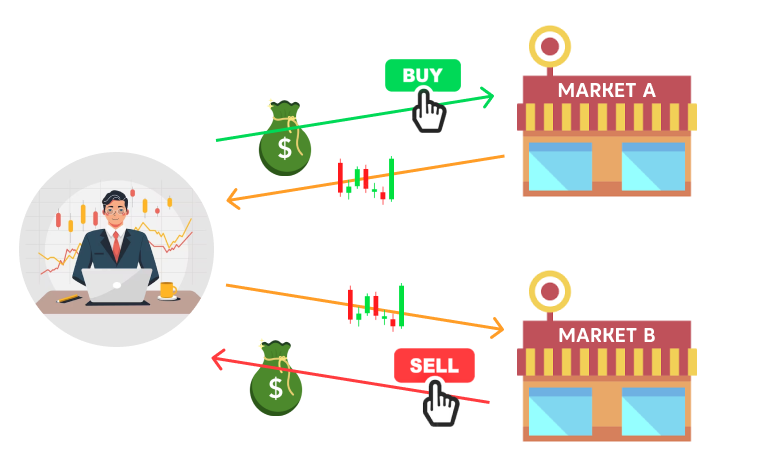
Arbitrage refers to the practice of profiting from price differences across markets. It is the process of simultaneously buying and selling a financial instrument in different markets to capitalize on price discrepancies.
Arbitrage trading involves the simultaneous purchase and sale of the same asset in different markets to profit from small differences in its listed prices. This strategy exploits short-term price fluctuations of identical or similar financial instruments across different markets or in different forms.
Arbitrage opportunities can arise in various financial instruments, including options, stocks, forex, commodities, or derivatives.
Arbitrage trading is typically exploited by large institutions and enterprises, as it requires substantial resources to identify opportunities and execute trades.
Arbitrage transactions are often carried out using complex financial instruments, such as derivatives contracts and other synthetic instruments, to find equivalent assets.
1.1. Arbitrage Pricing Theory (APT) – What is the APT Model?
Arbitrage Pricing Theory (APT) is a multi-factor asset pricing model based on the idea that an asset’s return can be predicted by leveraging the linear relationship between its expected return and several macroeconomic risk factors.
The APT model is a valuable tool for portfolio analysis from a value-investing perspective, helping to identify mispriced assets.
Arbitrage Pricing Theory (APT) was developed by economist Stephen Ross in 1976. The APT model serves as an alternative to the Capital Asset Pricing Model (CAPM).

1.2. APT model formula
E(R)i=E(R)z + (E(I) − E(R)z) × βn
Where:
E(R)i = Expected return on asset
Rz = Risk-free rate of return
βn = Price sensitivity to factor n
Ei = Risk premium for factor i
2. CLASSIFICATION OF ARBITRAGE STRATEGIES
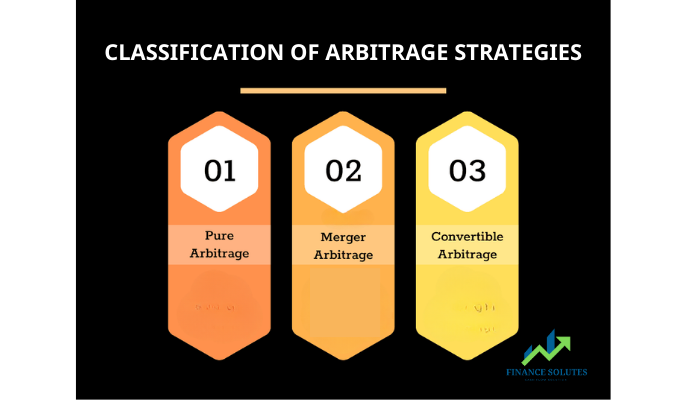
There are several types of arbitrage strategies including: Pure Arbitrage; Merger Arbitrage; and Convertible Arbitrage.
| Arbitrage Strategies | Description |
|---|---|
| Pure Arbitrage | Involves simultaneously buying and selling an asset in different markets to take advantage of price discrepancies.
Example: A multinational company may list its shares on multiple stock exchanges. Since the stock is traded across various markets, temporary price mismatches can occur. For instance, BP PLC is traded on LSE (London Stock Exchange), NYSE (New York Stock Exchange), and other exchanges worldwide. Pure arbitrage can also apply to exchange rate differences, often referred to as currency arbitrage. |
| Merger Arbitrage | This arbitrage strategy involves trading stocks during mergers and acquisitions. Hedge funds and businesses commonly use merger arbitrage by purchasing the target company’s shares and selling those of the acquiring firm. |
| Convertible Arbitrage | This type of arbitrage involves convertible bonds or convertible debt. The key difference between convertible bonds and regular bonds is that convertible bondholders have the option to convert them into stocks at a discounted price. Investors engaged in convertible arbitrage seek to profit from the difference between the bond’s conversion price and the current stock price of the issuing company. |
2.1. Example of Arbitrage Trading
Warren Buffett, at just six years old, recognized an arbitrage opportunity. He purchased a six-pack of Coca-Cola for 25 cents and sold each can individually for 5 cents, making a total profit of 5 cents.
Buffett identified a price discrepancy between the bulk purchase price of a six-pack and the price people were willing to pay for individual cans.
3. RISKS IN ARBITRAGE TRADING
As an investor, you must consider not only potential profits but also the risks associated with arbitrage trading. Below are some key risks:
- Competition Risk: Market competition can impact the success of arbitrage trades. If multiple traders engage in the same arbitrage opportunity, only one may ultimately benefit. Investors must also compete with firms specializing in market inefficiencies and price discrepancies.
- Cost Risk: Occurs when traders overvalue an asset, assuming it has a higher price than it actually does. In such cases, investors may not only miss out on expected profits but may also have to sell the asset at a loss.
- Liquidity Risk: Investors face the possibility of not being able to resell the assets they acquire. This can result in missing expected profits. A lack of market liquidity can hinder arbitrage trading, especially during financial or economic crises.
4. CONCLUSION
In summary, arbitrage exists due to market inefficiencies. In trading knowledge, there are various types of arbitrage strategies, and to maximize profits, traders need to understand how each market operates and the nature of the underlying assets.
While arbitrage trading can generate profits, traders should also be aware of potential risks.
5. FAQ ABOUT ARBITRAGE

5.1. What is Triangular Arbitrage?
Triangular arbitrage is an arbitrage opportunity that arises due to differences in cross-exchange rates between three currencies. It occurs when the exchange rates of the three currencies do not perfectly align, allowing traders to profit from the discrepancy.
5.2. What is Uncovered Interest Arbitrage?
Uncovered interest arbitrage is a trading strategy where investors convert deposits from a lower-interest-rate domestic currency to a higher-interest-rate foreign currency. This strategy does not use hedging instruments, leaving the investor exposed to exchange rate fluctuations.
5.3. What is Covered Interest Arbitrage?
Opposite to Uncovered Interest Arbitrage, Covered Interest Arbitrage occurs when investors exploit interest rate differences between two countries while eliminating exchange rate risk. This is achieved by using forward contracts to hedge against currency fluctuations.
5.4. What is Index Arbitrage?
Index arbitrage is a type of arbitrage trading where investors attempt to profit from price discrepancies between two or more market indices. It typically involves simultaneous buying and selling of index-based assets to capitalize on temporary price inefficiencies.
5.5. What is Regulatory Arbitrage?
Regulatory arbitrage is a less common form of arbitrage. It refers to the practice of businesses taking advantage of differences in regulations between jurisdictions. Companies exploit looser regulations in one area to minimize risks or costs that would be higher in more strictly regulated regions.
5.6. What is Tax Arbitrage?
Tax arbitrage is the practice of benefiting from differences in taxation policies. Investors and businesses capitalize on variations in tax treatment of different income types, capital gains, and transactions to optimize financial returns.
- t.me/finance_solutes
- Website: https://finance-solutes.com
- Hotline: +1 929 5636 439 ( Hotline )
- 26 Broadway, Suite 934, New York, 10004, US
