
 XM
XM Bybit
Bybit Binance
 Robinhood
 Webull
 IC Markets
 Pepperstone
 OKX
OKX Vantage
 VT Markets
 BingX
BingX Gate.io
 Kucoin
 MEXC
MEXC Exness
 Bitget
Corrective Wave – The Second Wave Structure in Elliott Wave Theory The Corrective Wave is the second wave structure that forms Elliott Waves. It is much more complex than the Motive Wave. After learning about the Motive Wave in the previous article, let’s explore the Corrective Wave in more detail in this Forex knowledge article.
1. WHAT IS A CORRECTIVE WAVE?
In Elliott Wave Theory, market price movements are divided into two types: Motive Waves and Corrective Waves. Motive Waves represent price movements in the direction of the main trend, while Corrective Waves move in the opposite direction.
The Corrective Wave is one of the two key components of Elliott Wave Theory, developed by Ralph Nelson Elliott in the 1930s. This theory provides valuable insights into market trends and price patterns in financial markets.
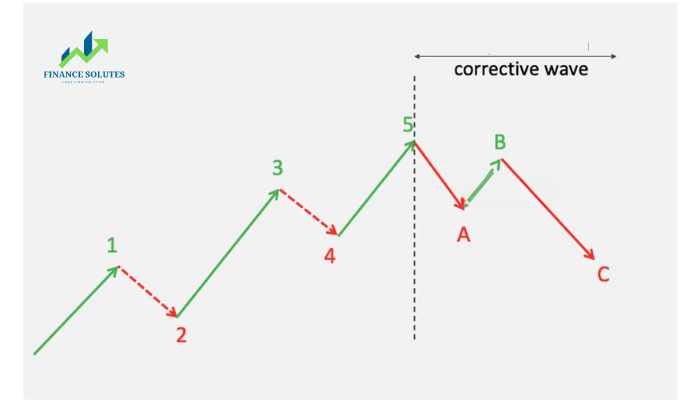
Corrective waves come in more varieties and are less clearly identifiable than motive waves. Sometimes, it can be quite challenging to recognize corrective wave patterns until they are fully completed. Corrective wave patterns consist of three sub-waves and are labeled A, B, and C.
2. TYPES OF CORRECTIVE WAVE PATTERNS
In a trend formation, motive and corrective waves alternate. While the Motive Wave acts as a progression in the market trend, the Corrective Wave serves as a retracement in the opposite direction.
Corrective wave patterns are classified into: Zigzag pattern, Flat pattern, Triangle pattern, Double Three pattern, Triple Three pattern
In this article, Finance Solutes will illustrate using an uptrend to explain these patterns. However, the opposite also applies to a downtrend. All rules for corrective wave patterns apply to both bullish and bearish markets.
2.1. Zigzag Pattern
The zigzag pattern is considered the simplest corrective pattern. It consists of three waves labeled A, B, and C, moving sharply upward or downward. Waves A and C are impulse waves, while wave B is a corrective wave (usually containing three sub-waves).
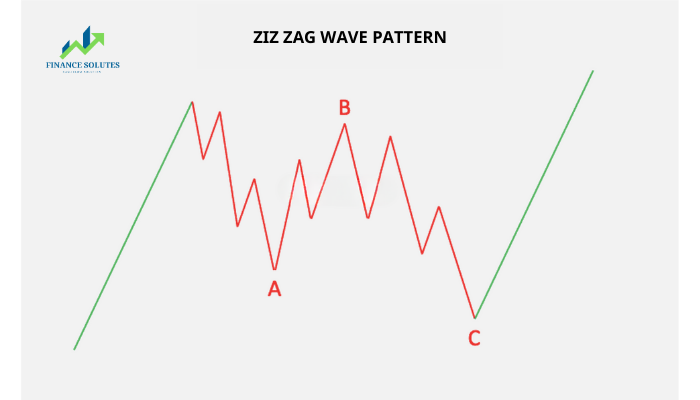
Waves A and C can be further divided into five smaller waves, either as impulse waves or diagonal waves. Wave B can take the form of any corrective wave structure.
2.1.1. Rules of Zigzag Wave Patterns
– The sub-waves of a zigzag ABC pattern follow a 5-3-5 structure (as illustrated above). Therefore, wave C cannot be shorter than wave B.
– Wave B in a zigzag pattern must not retrace 100% of wave A in Fibonacci terms. This means that in an uptrend, the peak of wave B must not exceed the peak of wave A (and vice versa in a downtrend).
2.1.2. Relationship with Fibonacci
- Wave B usually retraces 50%, 61.8%, 76.4%, or 85.4% of wave A according to Fibonacci levels.
- Wave C typically extends 61.8%, 100%, or 123.6% of wave A.
- A zigzag wave pattern often completes at 61.8% or 161.8% of wave A. If wave C ends anywhere between these levels, it is considered a standard zigzag pattern.
From there, two other cases open up with the ending point of the zigzag wave pattern:
First, when wave C ends shorter than 61.8% of wave A, the Zigzag wave pattern is now considered a short Zigzag wave pattern. This is an important wave pattern because the price action that follows retraces at least 80% and often 100% of the entire pattern.
The second case is when the length of wave C exceeds 161.8% of wave A, it is an expanding zigzag pattern.
In addition, people also discovered other variations of the zigzag wave pattern, which are the double zigzag model and the triple zigzag model.
2.2. Flat Wave Pattern
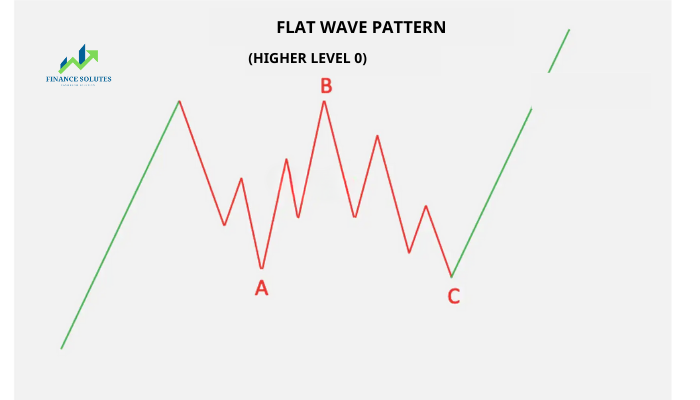
Flat is also a simple corrective wave pattern. This pattern is also subdivided into three sub-waves denoted as A, B, C. Although the wave pattern is denoted the same; but the wave structure of the Flat pattern is not the same as the zig zag pattern.
While the zigzag pattern has a 5-3-5 structure, the Flat pattern has a 3-3-5 wave structure, different from the A wave structure. In terms of characteristics, the flat wave pattern is generally a sideways correction, not a strong correction like the zigzag pattern.
In the flat wave structure, waves A and B are corrective waves and wave C is a motive wave momentum with 5 sub-waves. On forex charts, most flat wave patterns are often unclear because there are variations on this structure.
The Flat wave pattern is divided into three types: the regular Flat pattern, the Expanded Flat pattern, and the Running Flat pattern.
2.2.1. Regular Flat Pattern
In the regular Flat pattern, wave B has a 3-3-3 structure similar to wave A, so wave B will typically retrace wave A completely. This means that wave B has a length similar to the preceding wave A.
The regular Flat wave pattern must follow these rules:
- In the Flat wave pattern, waves A and B are divided into three smaller waves. Wave C consists of five shorter waves.
- Wave C must not move beyond the endpoint of the previous wave A.
- The final point of wave B is usually at or near the starting point of wave A.
- Wave C should show momentum divergence and have a length equivalent to wave B.
2.2.2. Expanded Flat Pattern
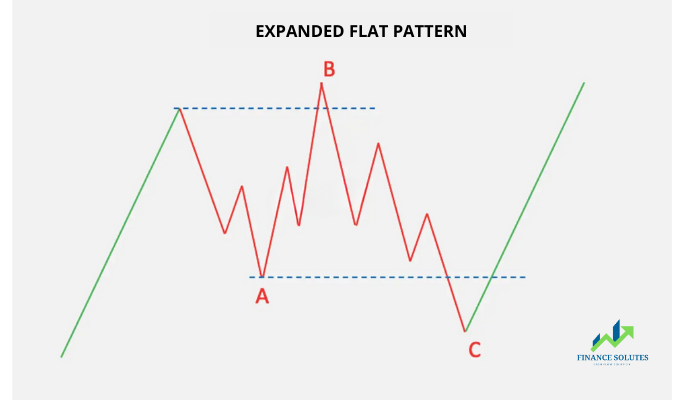
Similar to the regular Flat pattern, the structure of the Expanded Flat pattern differs in that wave B surpasses the starting point of wave A, and wave C exceeds the endpoint of wave A. This causes the initial range of the Flat pattern to expand. Below are the rules for the Expanded Flat pattern:
- The wave structure forming the pattern follows a 3-3-5 structure. However, wave B surpasses the starting point of wave A.
- Wave C is typically 162% of the length of wave A. Therefore, wave C usually extends beyond the endpoint of wave A.
- Lastly, wave C must also show momentum divergence.
2.2.3. Running Flat Pattern
Similar to other Flat wave patterns, the Running Flat pattern, also known as the Running Flat, follows a 3-3-5 structure. The key difference in the Running Flat pattern is that wave B ends higher than the starting point of wave A. Additionally, wave C retraces less than 100% of wave B, meaning wave C is shorter than wave B.
This is perhaps the least common Flat wave pattern, yet it is a classic example when discussing Elliott Wave Theory. Notably, it has a direct connection to breakout trading strategies. In trading, it can even act as a “trap” for traders.
2.3. Triangle Wave Pattern
The Triangle pattern, also known as the triangular wave pattern, is a corrective wave pattern consisting of five waves. This pattern represents a decline in trading volume and volatility. It is often observed when the market is moving sideways.
The Triangle wave pattern consists of five corrective waves with a 3-3-3-3-3 structure and is labeled with the letters A, B, C, D, and E. It is a continuation pattern that breaks out in the direction of the preceding trend.
It can occur in wave B of a zigzag pattern, wave X in the Double Three and Triple Three patterns. Additionally, it can appear in wave Y of the WXY structure when marking the end of a corrective phase.
In Elliott Wave theory, the Triangle pattern is categorized into ascending, descending, expanding, and contracting triangles.
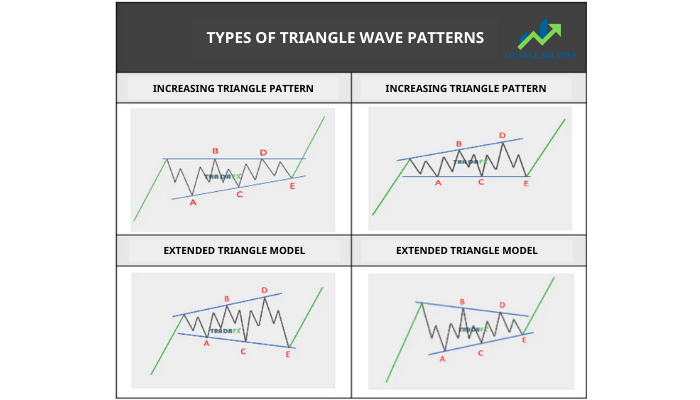
Principles of the Triangle Pattern
- The pattern structure must follow a 3-3-3-3-3 formation.
- The sub-waves take the form of a zigzag, double zigzag, or another triangle wave pattern.
- Wave C must not exceed the endpoint of wave A.
- Similarly, wave D must not surpass the endpoint of wave B.
- Finally, the endpoint of wave E must not go beyond the endpoint of wave C.
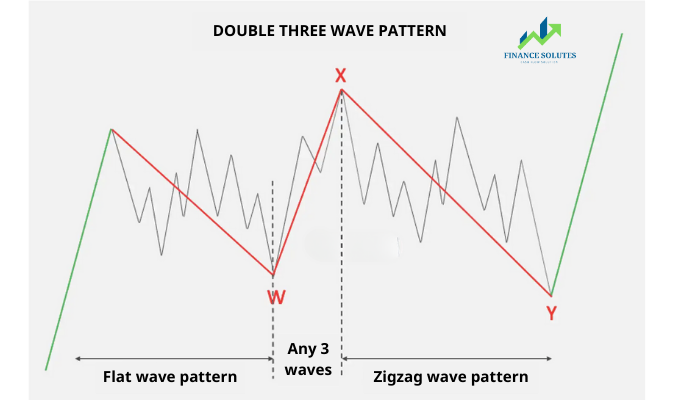
2.4. Double Three Wave Pattern
Double Three and Triple Three are the two most complex and challenging corrective wave patterns. These patterns combine two of the three corrective patterns mentioned earlier, such as a combination of a Flat pattern with a Zigzag pattern or a Flat pattern with a Triangle pattern.
Principles of the Double Three Wave Pattern:
- The Double Three wave pattern consists of three waves, labeled W, X, and Y.
- Wave W can be any corrective wave pattern except for a triangle.
- The Double Three pattern forms in a sideways movement or with only a slight decline compared to the main trend.
- In most cases, the Double Three pattern does not involve deep retracements.
A corrective wave structure can only be identified as a Double Three pattern when it is near completion. In other words, this pattern cannot be predicted at the beginning of a correction. Only when a structure aligns with the rules of the Double Three pattern can it be classified as such.
Below is an illustration of a Double Three pattern combining a Flat pattern and a Zigzag pattern:
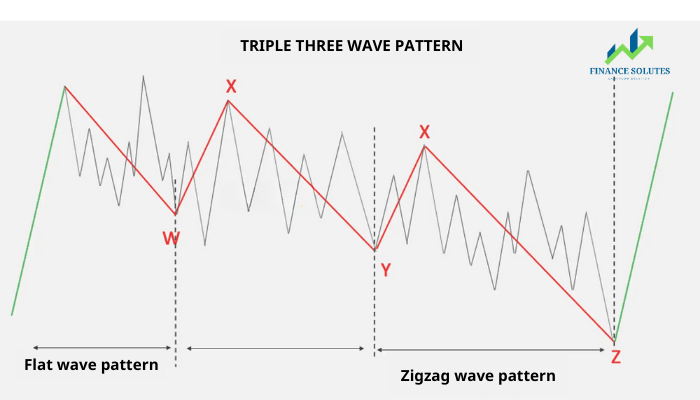
2.5. Triple Three Wave Pattern
The Triple Three pattern is a longer corrective wave formation compared to the Double Three pattern. It consists of five sub-waves labeled W, X, Y, X, and Z. The Triple Three pattern moves sideways and counter to the main market trend.
Key Rules of the Triple Three Wave Pattern:
- The corrective wave pattern consists of five waves.
- Waves W and Z can be any corrective wave pattern except for a Triangle.
- Similar to the Double Three pattern, the Triple Three forms in a sideways movement or with only a slight decline compared to the main trend.
The Triple Three pattern is relatively rare in the market. Below is an illustration of the Triple Three wave pattern:
3. SUMMARY
Compared to motive waves, corrective waves are much more difficult to identify and master. This is the primary reason why traders often lose a significant portion of their profits gained from impulse waves.
Corrective patterns represent price retracements following a strong preceding trend. When trading with the trend, understanding corrective patterns can help you maintain trend-following positions for a longer duration.
Looking at illustrations, corrective wave patterns may seem straightforward. However, when applied to real charts, the process becomes much more complex. You can find practical guidance on corrective wave patterns here.
- t.me/finance_solutes
- Website: https://finance-solutes.com
- Hotline: +1 929 5636 439 ( Hotline )
- 26 Broadway, Suite 934, New York, 10004, US
