
 XM
XM Bybit
Bybit Binance
 Robinhood
 Webull
 IC Markets
 Pepperstone
 OKX
OKX Vantage
 VT Markets
 BingX
BingX Gate.io
 Kucoin
 MEXC
MEXC Exness
 Bitget
Crude oil is a primary energy source worldwide. It is also a commodity that is widely traded. In this section, we will explore the origins and history of crude oil, the key factors influencing its price, and the main reasons to trade this asset based on solid trading knowledge.
MAIN CONTENT:
- What is crude oil and what is it used for?
- The key players in the crude oil market
- Factors affecting oil prices
1. WHAT IS CRUDE OIL AND WHAT IS IT USED FOR?
Crude oil, or petroleum, is a raw fuel found in nature. It is the primary energy source for the world today. It is made from ancient organic material and can be refined into component fuels such as gasoline, diesel, and lubricants. Each of these has countless applications in industry.
This commodity is typically extracted from underground reservoirs through drilling activities. The largest crude oil producers as of 2019 are the United States, Russia, and Saudi Arabia.
2. EXPLAINING BRENT & WTI CRUDE OIL
The composition of crude oil varies depending on its source. There are two types commonly used to determine global prices: West Texas Intermediate (WTI) crude oil from the United States and Brent crude oil from the United Kingdom.
The differences between them are based on factors such as composition, location of extraction, and pricing. For more details on how to trade each asset, check out our comparison of WTI and Brent.
3. THE POWERFUL PLAYERS IN THE OIL MARKET
The Organization of the Petroleum Exporting Countries (OPEC) was established in 1960. This organization sets production quotas for its members with the goal of reducing competition and maintaining favorable prices. OPEC is dominated by Kuwait, Qatar, Saudi Arabia (which controls the Strait of Hormuz), and the United Arab Emirates. OPEC usually controls a significant share of the oil supply. However, as of 2019, the United States is the largest oil producer in the world.
Global oil suppliers include international oil companies (IOCs) such as ExxonMobil, BP, and Royal Dutch Shell. These are investor-owned companies that aim to increase shareholder value through private interests. However, national oil companies (NOCs) such as Saudi Aramco and Gazprom are wholly or majority-owned by government entities.
4. HISTORY OF CRUDE OIL
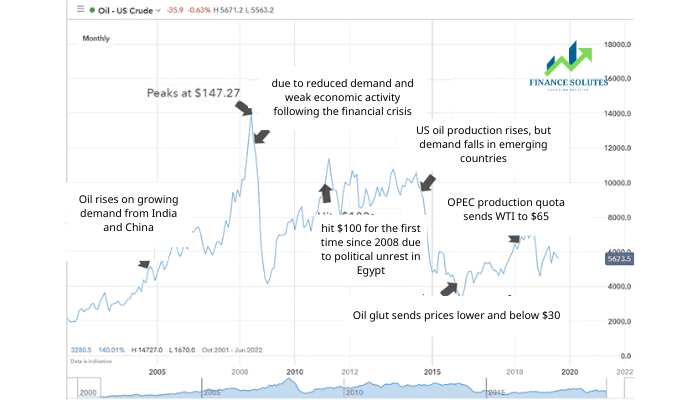
The history of crude oil has seen many changes since the beginning of this century. While global supply is largely controlled by OPEC, demand has been driven by the United States. With OPEC calling for price reductions and rapidly increasing demand from Asia, prices rose from $25 per barrel for Brent oil and $27 per barrel for WTI in March 2001 to $140 for both types in June 2008, indicating a price bubble.
However, the past decade has seen technological advancements and regulatory rollbacks that facilitated the rise of U.S. shale oil production. This has led to a shift in power from OPEC to the U.S. Prices dropped from $112 for Brent oil and $105 for WTI in June 2014 to below $36 for both in January 2016.
OPEC responded by colluding with several countries—including Russia—to implement a “production quota” designed to stabilize prices. These measures pushed prices back above $70 for Brent and $65 for WTI in April 2018.
The chart below shows key milestones in U.S. crude oil prices.
WTI Crude Oil (2000-2019)
5. FACTORS AFFECTING CRUDE OIL PRICES
Historically, the U.S. dollar and crude oil prices have had an inverse relationship. When the USD weakens, oil prices tend to be higher in USD terms. Since the U.S. has been a net importer for a long time, rising oil prices have meant an increase in the U.S. trade deficit, as more dollars are sent abroad. However, some argue that this relationship is no longer reliable in modern times.
There is a more predictable relationship between the Canadian Dollar (CAD) and oil prices. For example, as of 2019, Canada exports about three million barrels of oil and oil products daily to the U.S. This creates significant demand for Canadian dollars. If U.S. demand increases and more oil is needed, this means oil prices rise and could lead to a decrease in USD/CAD. Conversely, if U.S. demand drops, oil prices may fall, which could also reduce demand for CAD.
Reasons to Trade Oil:
Oil is a dynamic market. It is highly volatile and has high liquidity, making it one of the most traded commodities in the world. Here are some additional benefits of buying or selling this asset.
- The inherent volatility of trading this asset makes it a favorite among day traders, especially those reacting to the latest oil price news. While trading can be risky, some see the oil market as an opportunity in its purest form.
- Crude oil is an extremely liquid market, traded in large volumes. This means that trades can be opened and closed at the prices you want, with lower transaction costs.
- Oil can be traded as part of a risk-hedging strategy to mitigate the impact of volatility in other assets.
- Trading oil can be part of a diversified portfolio of commodities, stocks, and bonds.
- t.me/finance_solutes
- Website: https://finance-solutes.com
- Hotline: +1 929 5636 439 ( Hotline )
- 26 Broadway, Suite 934, New York, 10004, US
