
 XM
XM Bybit
Bybit Binance
 Robinhood
 Webull
 IC Markets
 Pepperstone
 OKX
OKX Vantage
 VT Markets
 BingX
BingX Gate.io
 Kucoin
 MEXC
MEXC Exness
 Bitget
The Forex Trading Journal Excel File is a record of your trades; it can help you adjust your strategies based on lessons learned from previous experiences. Keeping a Forex journal is similar to how a business owner tracks inventory—just as a trader should track their closed positions.
As a trader, you’ve probably heard of a “Trading Journal.” Typically, Forex brokers provide clients with a transaction history, including entry time, order size, profits, and losses, etc. However, setting up a personal Forex trading journal can significantly improve your chances of successful trades, thanks to these basic trading tips.
In addition to the basic information provided in the trading history from your broker, a personal trading journal records other details that allow you to adjust your trading methods. In this article, TradaFX will guide you on how to set up your trading journal and explain its role in Forex trading.
Let’s get started!
1. WHAT IS A TRADING JOURNAL?
A trading journal is a place where you can record your trades. Traders use trading journals to review their past trades. This allows them to self-assess, and you should do the same! You can use a journal to evaluate where you can improve your trading. They are a useful form of record-keeping.
So, what is the importance of a trading journal?
2. THE IMPORTANCE OF A TRADING JOURNAL
The main reasons for keeping a trading journal include:
– They help you identify strengths and weaknesses in your trading style
– A journal can increase consistency in trading
– It makes you accountable for your trades
– It can help you choose the best trading strategy.

Writing a journal is a simple yet extremely effective way to improve your trading plan. A trading plan is a set of rules and guidelines that you will follow. It includes strategies, risk management, and trader psychology.
3. HOW TO CREATE A TRADING JOURNAL
Creating a trading journal is very simple; you can adjust it to fit your goals and trading style. The steps below are a basic guide and will be explained further below:
Step 1: Choose a notebook or a spreadsheet
We recommend using a spreadsheet because it comes with built-in analytical functions. This can help you reflect on your trades, which we explain in Step 4.
Step 2: Identify the information to record
The standard format of a trading journal will include the following key criteria:
Here’s how the table would look:
| Currency Pair | USD/JPY |
| Position Size | 1 lot |
| Buy/Sell | Buy |
| Date | 30/01/2019 |
| Confidence | High |
| Strategy Used | Fundamental |
| Points | 100 |
| Success or Not | Success |
The standard format is a simple example of a trading journal. This can help you reflect on your trades. However, with a few additional criteria, we can improve the journal to provide more useful information.
Useful information to consider adding includes:
- Reason for Trade: The reason could be based on technical analysis, fundamental analysis, or a combination of both. After making a few trades, you can reflect on this information to see whether your trade reasons lead to clear results. This can also help you identify which type of analysis works best for you.
- Confidence: Confidence is how you feel about the trade. If you are trading based on a technical pattern, and that pattern “confirms” certain principles, then you can list confidence as “high.” However, if the pattern is not entirely clear, confidence could be “medium” or “low,” depending on the foundational trading factors. By writing down your confidence level, you can calculate the number of successful trades you had with each confidence level. This can help you determine whether you should only trade when you are highly confident.
- Other Information: You can add any information you feel is necessary to record in your trading journal. Some traders include emotional criteria when placing trades. Anything you think will help you, write it down.
Step 3: Record trades immediately after executing them
Make it a habit to record the details of the trade immediately after it is made. This way, you won’t forget the reasons for the trade. Do this after setting your stop loss and take profit orders.
Step 4: Compile information and reflect on your trades
After a certain period, you can compile the information in your trading journal. It’s best to do this after a few months, so you have enough data.
If you have the confidence criterion in your journal, count the number of successful trades when your confidence was high, medium, and low. When you have this data, you can decide whether it’s worth only trading when confidence is high.
For example, if you had confidence in 10 trades and 8 of them were successful (met the profit target), your success rate is 80% for trades with high confidence. If your confidence was low, and only 2 out of 10 trades were successful, your success rate would be 20%. Therefore, you would conclude that it’s only valuable to trade when confidence is high.
Do the same for other criteria.
4. FOREX TRADING JOURNAL EXCEL TEMPLATE
The Excel file – Forex Trading Journal records your trades; it can help you adjust your strategies based on the lessons learned from past experiences. Keeping a forex journal is similar to a business owner tracking inventory—traders should also track their closed positions. Therefore, in this section, TradaFX will show you how to write an effective and optimized Forex trading journal.
Although journaling may seem difficult at first, recording your trades can help answer key questions about your trading techniques. It can increase trading consistency, make you more accountable, and improve your techniques overall.
Screenshot of a Forex Trading Journal Template
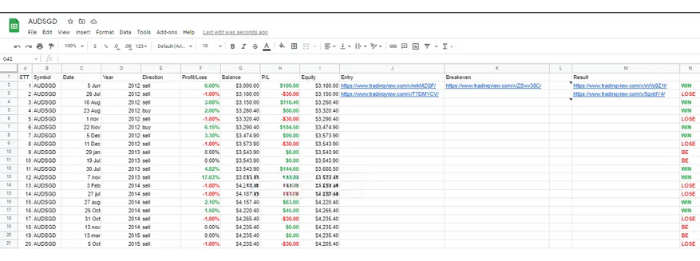
You can refer to the Forex trading journal template above. Your journal may include information such as the currency pair traded, the trade size, whether it’s a buy or sell position, the time of the trade, your confidence level, whether you used a fundamental or technical analysis strategy, the profit/loss ratio, movement points, and whether the trade was successful.
Additionally, you can download a sample trading journal file from Forex using the link below:

You may want to include elements such as entry/stop-loss prices, pending prices, and the number of lots traded. The more data you keep, the easier it will be to evaluate past trades.
Additionally, ensure there is space for notes in your journal. Traders who use specific entry techniques will want to track things like time frame charts, indicators used, market conditions (range, trend, breakout), or any other information that influences trading decisions.
Through journals like the one above, you can apply the same concept to a stock trading journal. By maintaining disciplined records over time, traders will be able to identify the characteristics of profitable or unprofitable trades.
5. APPROACHES TO TRADING JOURNALS FROM ANALYSIS EXPERTS
5.1. Tyler Yell, Currency Strategist
Tyler has been trading since 2008, focusing on forex, options, ETFs, and Commodity Futures.

The first section of Tyler’s trading journal includes a few lines:
- Evaluation of the risk management strategy/position sizing strategy used.
- The underlying environment (trend or range, and volatility data).
He also includes notes on why he should place an order and a stop order at points that minimize capital drawdown, and the reasons when he changes his technical outlook.
“I usually reduce the size of my trades. This helps you stay in the market longer; or at least until the technical trend no longer holds,” he adds. “The next section focuses on currency pairs that are reacting well to the strategy being used.”
5.2. James Stanley, Currency Strategist
James started trading in 1999, mainly focusing on stock indices, ETFs, and foreign exchange.

James keeps a ledger rather than a journal. He tries to update it each time/week with trades set up since the last update. “I keep everything in percentage format. This helps me compare similar things, from stocks to options to forex,” he says.
“When filling in this information, I can spot trends as they happen (or have happened). Most of the focus is on P&L (Profit and Loss), and if something is wrong, I usually just think about it for a day or two while I figure out a few solutions.”
Regarding considerations for improving capital withdrawal times, James thinks about the level of risk he wants to take, whether high or cautious. “If I get into a bad situation, the answer is usually to scale down with a smaller size, less leverage, fewer trades but more selective.”
“The flip side of that is being too cautious. I can usually catch that when it happens, so I don’t often encourage myself to be overly cautious.”
This brief insight into the journaling and trading processes of analysts may or may not suit you. There is no one-size-fits-all method. However, there is a range of approaches listed below that you can try.
6. FIND A JOURNALING METHOD THAT WORKS FOR YOU
To find the right Forex journaling method and the best way to journal your stock trades, you’ll have to experiment. Of course, there will be mistakes, but this helps you discover different approaches. You can keep your trading journal private and review it on your own, or you can allow other traders to see it and provide feedback. Both methods are effective and will help you stay accountable.

If you follow a personal journaling path, perhaps the easiest method to record your thoughts and screenshots is in a Word Doc file; although a notebook can also capture your thoughts simply.
For a public journal, you may want to record trades and thoughts on a blog or an online forum. This will allow traders from anywhere in the world to view your profitable, losing, or break-even trades.
You know that you will have to face decisions later in your journal. Or you may also have to face others when you make your journal public. This will help you become more aware of moments when your emotions drive your decisions rather than strategic thinking, or when you decide to “get creative” – making a trade without a solid foundation.
Being accountable is a very good thing. Many traders can deceive themselves into thinking they are making rational trading decisions only to later realize that they did not stick to their strategy.
7. TRADING TIPS: JOURNALING PROCESS
A trader’s workflow should consist of a combination of reviewing charts and news, engaging with and managing trades, as well as journaling when a trade concludes (and possibly begins) the process.
7.1. Reviewing the Charts
Look at the opportunities available in the market, whether that’s identifying technical patterns or acting based on fundamental factors like news releases. At this stage, you might want to journal potential pairs to trade or your thought process in selecting them.
7.2. Searching for Opportunities
Identify entry points, mark the chart, and note the reasons for choosing that entry point.
7.3. Entering the Trade
When you place a trade, include profit targets and exit points. At this point, you might be busy journaling.
7.4. Managing the Trade
Managing the trade at this stage could include pyramid building or multiple profit targets. Trade management requires your focus, so journaling might be limited to screenshots.
7.5. Reviewing and Journaling the Trade
When closing a trade, you might prepare to journal, reviewing screenshots and any notes you made to analyze the trades, identify where you might have made mistakes, and consider what you need to improve.
8. SUMMARY
Maintaining a Forex journal and managing trades from a Forex Trading Journal Excel file for each trade is crucial. In addition to writing down your vision, profit goals, plans, and strategies, journaling your trades serves as visual evidence to record a trader’s activities. This allows investors to reflect on and refine their trading plans.
Good luck in your trading career!
- t.me/finance_solutes
- Website: https://finance-solutes.com
- Hotline: +1 929 5636 439 ( Hotline )
- 26 Broadway, Suite 934, New York, 10004, US
