
 XM
XM Bybit
Bybit Binance
 Robinhood
 Webull
 IC Markets
 Pepperstone
 OKX
OKX Vantage
 VT Markets
 BingX
BingX Gate.io
 Kucoin
 MEXC
MEXC Exness
 Bitget
Each investor when deciding to invest in the market needs to have different strategies and approaches, in order to achieve their ultimate goal of bringing the highest profit. Fundamental analysis and technical analysis are the two main methods that any amateur investor needs to know by heart, each method has its own advantages. However, it is necessary to clearly understand their nature so that investors can apply them appropriately to the analysis in investing in securities and stocks.
Definition of technical analysis and fundamental analysis

Fundamental Analysis
Fundamental analysis refers to evaluating the factors that influence a business’s operations and long-term growth potential by measuring the intrinsic value of securities. Analysts use various factors that impact the value of stocks, such as the current economic condition or the company’s management effectiveness, to analyze and study.
Technical Analysis
Technical analysis relies on charts and graphs that show the volume and price fluctuations of stocks. This helps investors decide when to buy, hold, or sell stocks by analyzing supply-demand dynamics in the market.
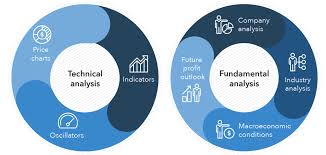
Comparison Between Fundamental Analysis and Technical Analysis
| Factor | Technical Analysis | Fundamental Analysis |
|---|---|---|
| Goal | Determine when to buy and sell stocks | Determine the intrinsic value of stocks |
| Purpose | Short-term investment | Long-term investment |
| Data | Trading volume and stock prices | Financial reports, business results, industry news, economic events |
| Analysis Method | Based on price action or indicators | Qualitative analysis: industry situation, growth potential, macroeconomic policies; Quantitative analysis: financial reports, business results |
| Stock Holding Duration | Usually held for seconds, minutes, hours, or days; although can hold long-term | Stocks are typically held for days, weeks, or months |
Fundamental and technical analysis differ in many aspects, such as the main goal, tools, duration, and nature of participation. However, both approaches aim for safe strategies and focus on market movements to minimize losses and seek opportunities for income growth.
The Relationship Between Fundamental and Technical Analysis
It is not possible to definitively say which method is better in investment, as both fundamental and technical analysis have their own advantages and disadvantages. The method you choose depends on your knowledge, goals, strategy, and capabilities.
Fundamental Analysis – This is a foundational method, so it generally does not conflict with technical analysis.
Moreover, technical analysis can help overcome some of the shortcomings of fundamental analysis, such as:
- Overlooking the psychological factors of market participants.
- Inaccuracies from the information that investors use.

Both methods can complement each other, with fundamental analysis providing a deeper understanding of the intrinsic value of a stock and technical analysis helping investors identify optimal entry and exit points based on market behavior.
Using a combination of both methods can help them complement each other and overcome the weaknesses of each approach. Technical analysis helps determine the right timing for buying and selling, while fundamental analysis helps you make investment decisions. Therefore, when these two methods are combined, they create a much more comprehensive investment strategy with a broader perspective.
Suitable audiences for each method
In reality, both fundamental analysis and technical analysis have their own advantages and disadvantages, and they are suitable choices for all types of investors, depending on their goals and strategies.
If you want to invest in the short term, using technical analysis may be a better choice to determine the right time to buy or sell.
On the other hand, if you have a long-term investment strategy, fundamental analysis can help you identify stocks with high value and growth potential.
Furthermore, despite their differences, combining fundamental and technical analysis provides investors with a powerful decision-making tool. A few specific methods investors can refer to include:
- Create a detailed list of stocks to track based on fundamental analysis, making it easier to purchase. Then, use technical analysis to make specific decisions about whether to buy and when to buy.
- Fundamental analysis helps investors clearly identify which part of the business cycle during the trading process will bring the highest profit to their account. After that, investors can perform additional technical analysis to look at predicted trends.
- Technical analysis can be used by investors to identify the most competitive entry points for growth stocks in an upward trend. Companies with high growth potential that are trading at high valuations often experience significant adjustments. In such cases, technical analysis can help investors identify overbought levels, which are often great opportunities for buying growth stocks.
In conclusion, both fundamental analysis and technical analysis have their own arguments and definitions, and it’s not possible to say that one is better than the other. These two approaches can coexist, so the choice of method largely depends on the investor’s investment goals and current situation.
When investing in the market, we need both methods to verify the data, ensuring that our choice is correct, as well as determining the right time to buy or sell. Ultimately, whether the theories fit your plan depends largely on how accurately, consistently, and effectively you apply them in practice.
- t.me/finance_solutes
- Website: https://finance-solutes.com
- Hotline: +1 929 5636 439 ( Hotline )
- 26 Broadway, Suite 934, New York, 10004, US
