
 XM
XM Bybit
Bybit Binance
 Robinhood
 Webull
 IC Markets
 Pepperstone
 OKX
OKX Vantage
 VT Markets
 BingX
BingX Gate.io
 Kucoin
 MEXC
MEXC Exness
 Bitget
Continuing the series of articles on the Inside Bar candlestick pattern, today Finance Solutes will introduce another effective technique for spotting market tops and bottoms that traders may find highly appealing. It is the perfect combination of the Inside Bar and Bollinger Bands.
1. INSIDE BAR AND BOLLINGER BANDS
1.1. Bollinger Bands – An Effective Tool for Spotting Tops and Bottoms
Bollinger Bands are one of the leading technical indicators in forex trading. Bollinger Bands were developed by John Bollinger – a billionaire and a brilliant investor. The indicator is also named after its creator.
The Bollinger Bands consist of three main components:
– The Upper Bollinger Band and Lower Bollinger Band – Green color
– Middle Band (The center Bollinger Band) – Orange color. The middle band is the 20-period SMA.
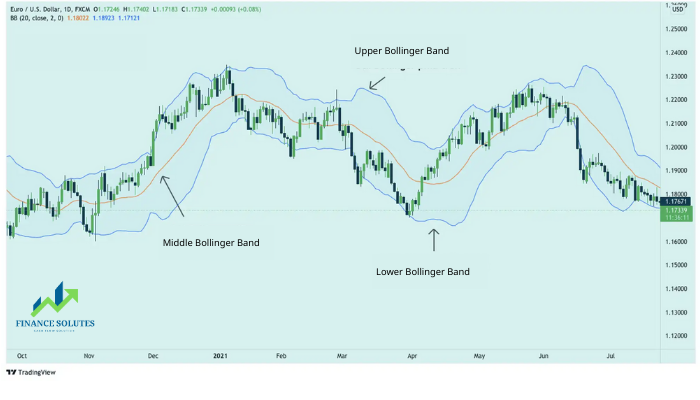
Traders use Bollinger Bands for various purposes. However, in general, they provide two key signals: trend signals and reversal signals. Essentially, price usually fluctuates within the range formed by the upper and lower Bollinger Bands.
From this, traders can easily identify potential reversal points where the price is likely to turn. This is part of the reason why this indicator is considered an effective tool for spotting tops and bottoms in forex. If you observe closely, when the price touches the lower Bollinger Band, it often bounces upward. Conversely, when the price touches the upper Bollinger Band, it tends to bounce downward.
However, traders often use this indicator in combination with other tools such as support and resistance levels, or other indicators like RSI, or with Japanese candlestick patterns like the pin bar…
1.2. Inside Bar Candlestick Pattern
The Inside Bar is a Japanese candlestick pattern that usually consists of two candles. The second candle (the inside bar) is completely contained within the range of the previous candle (the mother bar). The range of the Inside Bar can indicate market momentum. At the same time, it also signals a shift in market sentiment, a consolidation phase, or weakness in the market.
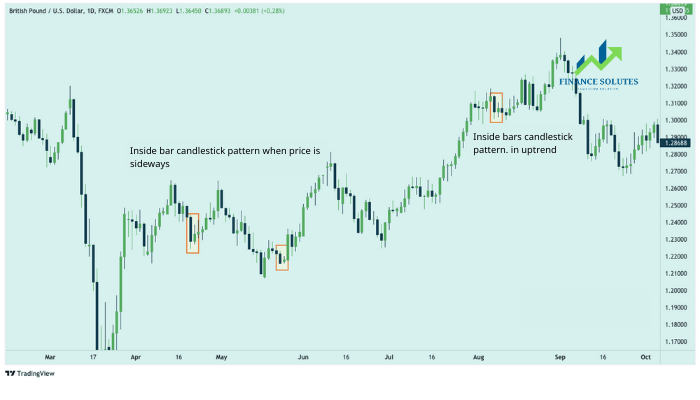
The chart above shows the positions where the Inside Bar pattern forms. This Japanese candlestick pattern can appear both in sideways markets and in markets with a clear trend. It can act as either a continuation signal or a reversal signal. And if you look closely at the example chart, the inside bar in the Inside Bar pattern can also be a pin bar.
2. TECHNIQUE FOR SPOTTING TOPS AND BOTTOMS WITH INSIDE BAR AND BOLLINGER BANDS
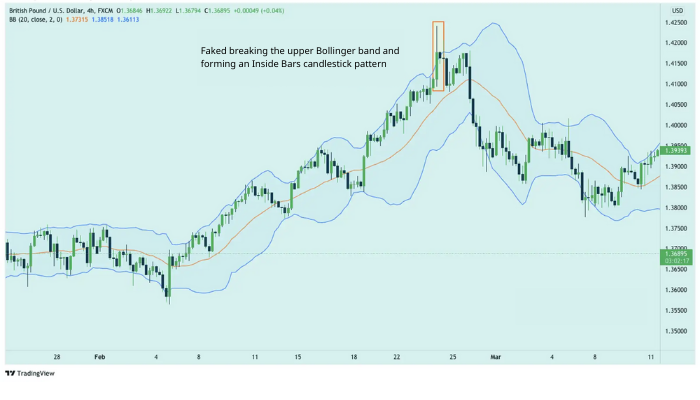
The trading idea behind the strategy combining the Inside Bar and Bollinger Bands creates an excellent technique for identifying tops and bottoms. Traders will enter trades when the price touches the lower or upper Bollinger Band. However, the trade is only executed if the candlestick following the one that touches the Bollinger Band does not break the previous high or low.
The combination of the Inside Bar pattern and Bollinger Bands helps traders identify market tops or bottoms with much higher accuracy. To identify key price levels, Bollinger Bands are used, and confirmation of reversal is sought from the Inside Bar candlestick pattern.
For this trading strategy, traders should avoid trading on very low timeframes. The reason, as mentioned in previous articles, is that the Inside Bar pattern on lower timeframes often gives false signals.
2.1. Selling Trade Using Inside Bar and Bollinger Bands
First, open a chart with the Bollinger Bands indicator set to default settings. For a selling trade, the closing price of the mother bar must break above or lie above the upper Bollinger Band. The second candle, or the Inside Bar, will be considered the signal candle.
Traders will enter a sell order as soon as the third candle closes lower after the Inside Bar pattern is completed. The stop-loss order should be placed a few pips above the high of the mother bar.
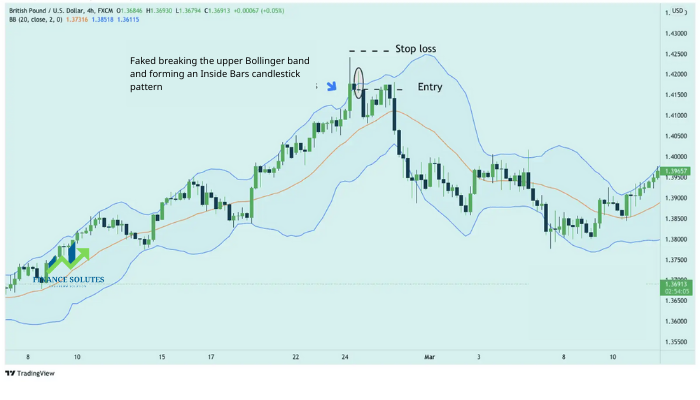
Let’s take a look at the GBPUSD example on the 4-hour timeframe above. After touching the upper Bollinger Band, the price broke through. Then, an Inside Bar pattern formed with a bearish candle entirely within the range of the previous bullish candle.
At this point, we have enough conditions signaling a potential reversal. Enter a sell order when the third candle — in this case, a doji — closes below the first candle. The stop-loss is placed above the first candle (the mother bar).
2.2. Buying Trade
For a buying trade, traders can apply the opposite approach to that of a selling trade.
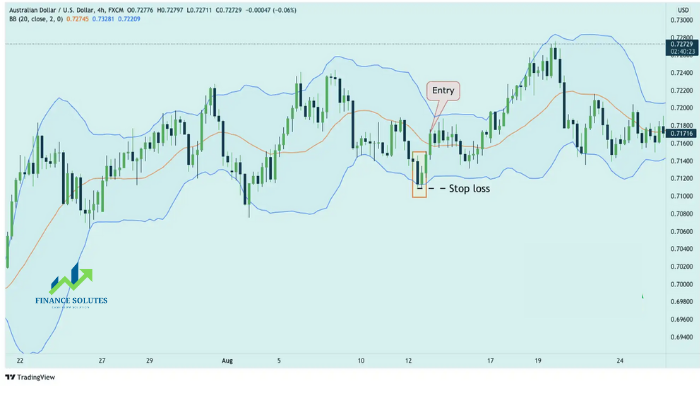
First, watch for when the price touches the lower Bollinger Band. Wait for the next candle to form. Make sure that this next candle has a high and low that does not exceed the high and low of the previous candle — in other words, the Inside Bar pattern is complete. Once all conditions are met, enter a buy order when the third candle closes above the first candle.
Let’s analyze a real-life example below.
This is the AUDUSD chart on the 4-hour timeframe. The price touched the lower Bollinger Band and closed within the range, even though the highest price had dipped below the lower Bollinger Band. After the second candle of the Inside Bar pattern formed, traders could identify a potential buying opportunity.
The entry point is taken when the third candle closes. Take-profit levels can be set at the trader’s discretion based on individual expectations. However, the minimum risk-to-reward ratio should be at least 1:2. The stop-loss can be placed below the mother bar or a few pips away from it.
3. CONCLUSION
This trading strategy using a top-and-bottom spotting technique is quite simple yet delivers relatively high effectiveness for forex traders. That’s because it combines two powerful tools in trading. Consider this guide as a checklist before entering any trade. The Inside Bar should be seen as a crucial element for confirming entry signals. And no matter how effective the tool is—never forget to set a stop-loss!
- t.me/finance_solutes
- Website: https://finance-solutes.com
- Hotline: +1 929 5636 439 ( Hotline )
- 26 Broadway, Suite 934, New York, 10004, US
