
 XM
XM Bybit
Bybit Binance
 Robinhood
 Webull
 IC Markets
 Pepperstone
 OKX
OKX Vantage
 VT Markets
 BingX
BingX Gate.io
 Kucoin
 MEXC
MEXC Exness
 Bitget
Trendlines in Price Channels – A Simple Tool Based on Price Action. Essentially, it’s a pair of parallel lines that highlight market trends, entry, and exit points.
Before you can trade forex with it, you need to understand what a price channel trendline is and how to draw it.
1. PRICE CHANNEL TRENDLINES
As a price action trader, the first thing you need to learn is how to observe the market’s price waves or movements. These price movements allow you to track what is happening in the market.
Next, you connect these movements to form a trendline. The trendline helps you understand past trends.
Finally, draw two parallel lines to create a price channel. The price channel predicts the extent of future price action.
Most charting platforms provide tools to draw these parallel lines.
In short, price channel trendlines offer a comprehensive view of market price action.
Many traders don’t trust trendlines and price channels. This is because they see other traders posting trades with seemingly perfect trendlines. The problem is that anyone can draw a price channel that always works and looks flawless every time.

But in reality, traders often struggle to achieve such perfection. Disappointment follows.
A serious trader doesn’t need to overthink trend channels. What a price action trader needs is a price channel that:
- Adheres to predefined rules
- Is reliable but not perfect
- Is drawn in real-time
There are many methods to draw price movements, trendlines, and price channels. The key is finding what fits best.
2. RULES FOR TRADING PRICE CHANNELS
Once you’ve mastered drawing price channel trendlines, you can follow the trading rules below.
2.1. Setup for Buying Pullbacks in an Upward Channel
- The price channel must slope upward.
- The price pulls back to test the upward trendline.
- Enter a buy trade with any bullish price pattern (Entry point: place a buy limit order just above the trendline).
- Set your take profit at the opposite trendline of the price channel (Adjust if necessary).
2.2. Setup for Selling Pullbacks in a Downward Channel
- The price channel must slope downward.
- The price pulls back to test the downward trendline.
- Enter a sell trade with any bearish price pattern (Entry point: place a sell limit order just below the trendline).
- Set your take profit at the opposite trendline of the price channel (Adjust if necessary).
3. PRICE CHANNEL EXAMPLES
3.1. Winning Trade
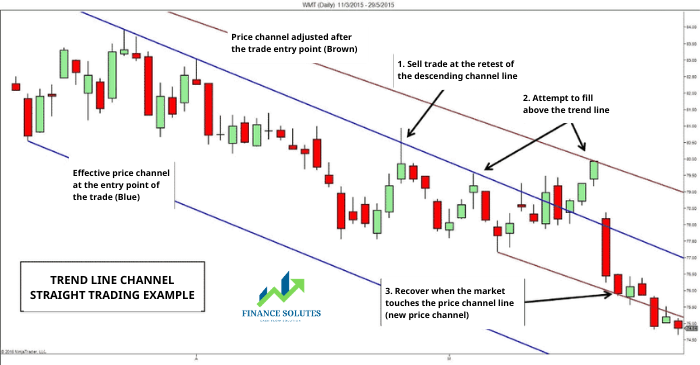
This is a daily chart of WMT in a downtrend.
- We applied the entry strategy mentioned above here. A sell limit order placed us in a short position when the market tested the downward trendline.
- This wasn’t a smooth hypothetical trade that reached its target effortlessly. (This example was randomly selected.) You can see that the market struggled to push the price down and made several attempts to move upward.
- As the market continued its downward momentum, we adjusted the trendline channel. We took profit when the market touched the channel line of the new downward price channel.
3.2. Losing Trade
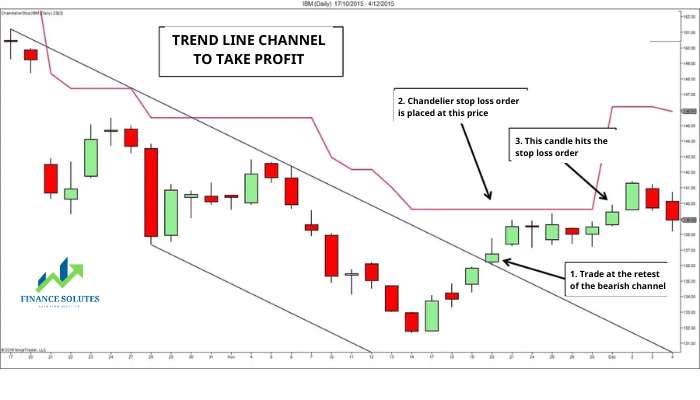
This is a daily chart of IBM, also in a downtrend.
- Once again, in this example, we placed a sell limit order at the downward trendline. We could have avoided this losing trade by using a more cautious entry strategy. (That is, wait for a bearish candlestick pattern and enter with a stop order).
- A Chandelier stop-loss was used, as shown on the chart.
The stop-loss was hit when the market surged upward. - This trade resulted in a loss. Accept it. But there’s a lesson to learn from the price action that followed.
It highlights the advantage of using trendlines in price channels to secure profits. The chart below illustrates a new downward price channel based on the subsequent price action.
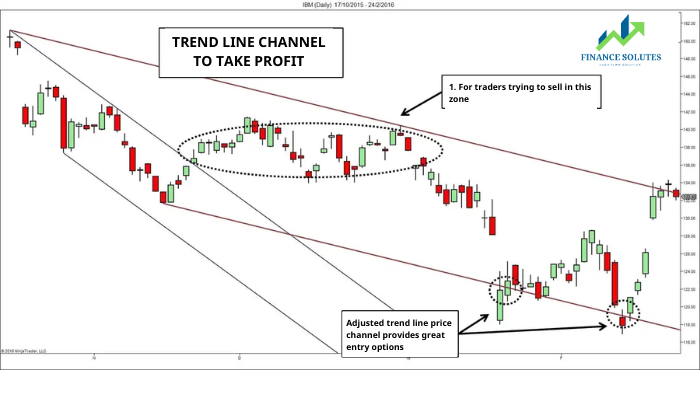
- Every price action trader has different methods for entering the market. It’s conceivable that some traders sold within this zone.
- If you were in a short position, the adjusted trendline channel (brown) offers solid options for taking profit.
4. SUMMARY
Look for trade setups that align with confluence from basic support and resistance zones. For a price action trader, this is a simple yet effective approach. Alternatively, if you find value in combining price action with indicators, use indicator sets (e.g., Stochastic, CCI) to confirm entry setups within the price channel — for example, an oversold indicator paired with a bullish price pattern in an uptrend.
The best trendline price channels have a moderate slope and width. In other words, consider these two factors before trading:
- Extremely steep and shallow channels
- Extremely narrow and wide channels
To assess the slope, use a 45-degree line as a benchmark. Markets with steep channels are more likely to experience deep pullbacks before continuing. Shallow channels may still be tradable if you’re looking for range-bound setups.
To assess channel width, compare the channel’s width to the average price candle range. If the channel width is smaller than a few wide-range candles, treat it as a narrow channel. The key takeaway here is that channel width indicates the potential profit of a price channel trade.
Don’t be mistaken. This simple strategy won’t guarantee success, but it offers price action traders:
- Trend analysis
- Entry timing
- Disciplined exit points
This price channel strategy works on the premise that a trendline channel will contain price action. Other variations focus on capturing breakouts from a price channel.
- t.me/finance_solutes
- Website: https://finance-solutes.com
- Hotline: +1 929 5636 439 ( Hotline )
- 26 Broadway, Suite 934, New York, 10004, US
