
 XM
XM Bybit
Bybit Binance
 Robinhood
 Webull
 IC Markets
 Pepperstone
 OKX
OKX Vantage
 VT Markets
 BingX
BingX Gate.io
 Kucoin
 MEXC
MEXC Exness
 Bitget
BEIJING, March 7 (Reuters) – The slowdown in China trade has raised concerns among economists and investors as the country faces shrinking imports and weakening export momentum. According to recent data from China’s customs agency, imports unexpectedly dropped by 8.4% year-on-year, while exports only grew 2.3%, missing analysts’ expectations.
The unexpected contraction in imports, coupled with slower export growth, has been largely attributed to escalating tariff pressures from the United States. In January, U.S. President Donald Trump imposed an additional 10% tariff on Chinese goods, citing insufficient efforts from Beijing to curb fentanyl trafficking. This move marked the beginning of renewed trade tensions between the world’s two largest economies.
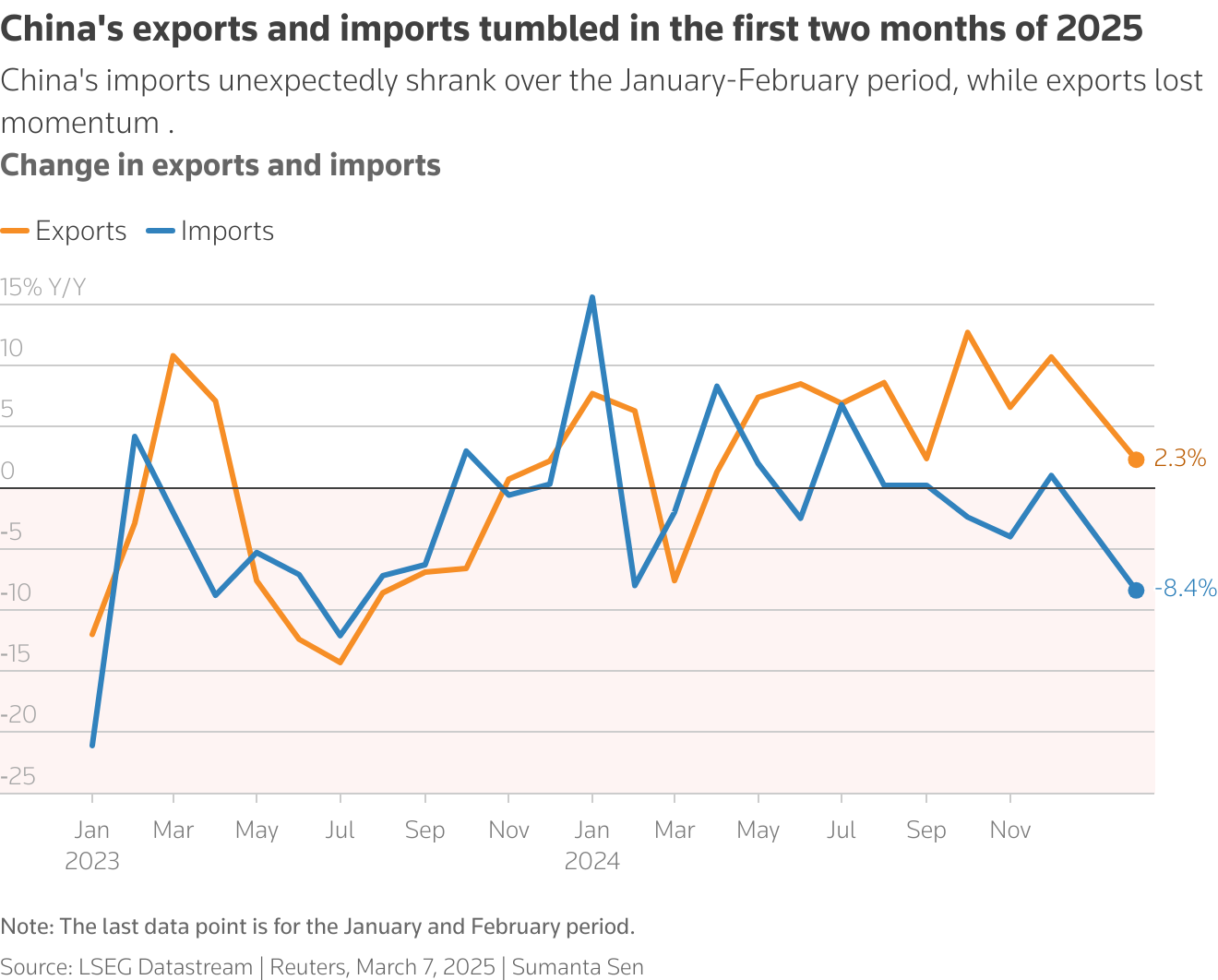
China’s Import Decline: A Reflection of Domestic Adjustments?
China’s decline in imports suggests a strategic shift in its commodity purchases, with key sectors such as grains, iron ore, crude oil, and rare earths experiencing major reductions. Some analysts believe that Beijing may be adjusting its strategic reserves, scaling back purchases after stockpiling excess raw materials in 2024.
According to Xu Tianchen, senior economist at the Economist Intelligence Unit, China likely imported too much in 2024, leading to the current reduction. “This is certainly true for iron ore, as steel production has far exceeded economic demand,” he noted.
- Crude oil imports fell 5% year-on-year, impacted by tougher U.S. sanctions on ships transporting Russian and Iranian oil.
- Rare earth imports dropped 24.1%, affecting industries reliant on these critical materials.
- Copper imports declined 7.2%, reflecting weakening domestic industrial activity.
- Iron ore imports fell 8.4%, partly due to weather-related disruptions in Australia, one of China’s largest suppliers.
These figures indicate that the slowdown in China trade is not only a result of external pressures but also a domestic policy shift aimed at managing resources more efficiently.
For further analysis on China’s import strategies, visit Bloomberg.
Export Growth Slows as U.S. Tariffs Take Effect
While China’s exports managed a 2.3% increase, it was far lower than the 5% growth predicted by economists. A major factor behind this slowdown in China trade is the impact of higher U.S. tariffs on Chinese goods.
In March 2024, Trump doubled tariffs on Chinese imports to 20%, prompting Beijing to retaliate with 10%-15% levies on U.S. agricultural exports and restrictions on 25 American firms.
Analysts suggest that exports had been front-loaded in late 2023, meaning many shipments were sent before tariffs took effect, leading to weaker export figures in early 2025.
“The higher U.S. tariffs on China’s goods will likely show up more clearly in next month’s trade data,” said Zhang Zhiwei, chief economist at Pinpoint Asset Management.
For a detailed overview of the U.S.-China trade war, check out The Wall Street Journal.
The Effect on Global Markets and Trade Policies
The slowdown in China trade has already affected global markets. Following the latest trade report:
- Dow Jones dropped 1%
- S&P 500 fell 1.8%
- Nasdaq plunged 2.6%, officially entering correction territory
China’s state-owned enterprises (SOEs) also saw a massive 20.6% decline in imports, compared to just 2.7% for private firms. This suggests that government-controlled buyers are now relying more on existing stockpiles instead of purchasing new resources.
For global market updates, visit CNBC.
What’s Next? China’s Economic Strategy for 2025
With exports slowing and imports declining, Beijing is shifting its focus to domestic economic growth. Chinese Premier Li Qiang has acknowledged that consumption and private investment remain “insufficient” and has set a 5% GDP growth target for 2025.
To support this goal, Chinese policymakers are exploring interest rate cuts and injecting liquidity into financial markets by lowering bank reserve requirements. These measures aim to:
- Boost household consumption
- Stabilize the property sector
- Encourage domestic industrial growth
However, economists warn that without stronger consumer confidence, these policies may not be enough to counteract the slowdown in China trade and its broader economic impact.
For an in-depth look at China’s economic policy, visit Reuters.
Conclusion: A Challenging Year Ahead for China’s Trade Sector
The slowdown in China trade presents a significant challenge for both Chinese policymakers and global investors. While the country is actively adjusting its import strategies, the ongoing trade war with the U.S. could further disrupt supply chains and impact economic growth.
Looking ahead, China must find alternative export markets and strengthen domestic demand to maintain stability. As 2025 progresses, all eyes will be on whether Beijing can successfully navigate these economic headwinds.
For more expert insights, read Financial Times.
EXPLORE MORE LATEST NEWS RIGHT HERE!
- Forex: Get the latest trends and effective trading strategies
- Crypto: Stay updated on the hottest cryptocurrency market news
- Stock & Commodities: Discover potential investment opportunities
- Trading Brokers: Choose reliable brokers for your trades
- Expert Advisor: Smart tools to assist your trading
- Finance News: 24/7 updates on financial news
DON’T MISS OUT, CLICK AND READ NOW!
- t.me/finance_solutes
- Website: https://finance-solutes.com
- Hotline: +1 929 5636 439 ( Hotline )
- 26 Broadway, Suite 934, New York, 10004, US
