
 XM
XM Bybit
Bybit Binance
 Robinhood
 Webull
 IC Markets
 Pepperstone
 OKX
OKX Vantage
 VT Markets
 BingX
BingX Gate.io
 Kucoin
 MEXC
MEXC Exness
 Bitget
Trend trading in forex is one of the simplest, most reliable, and safest strategies among forex trading strategies. For new traders, it is also the easiest and most effective strategy to apply when analyzing and trading the market.
1. OVERVIEW OF TRENDS
To successfully implement a trend trading strategy, the first essential step is to identify the market trend. Additionally, it is crucial to understand what creates a trend and which factors sustain it over time.
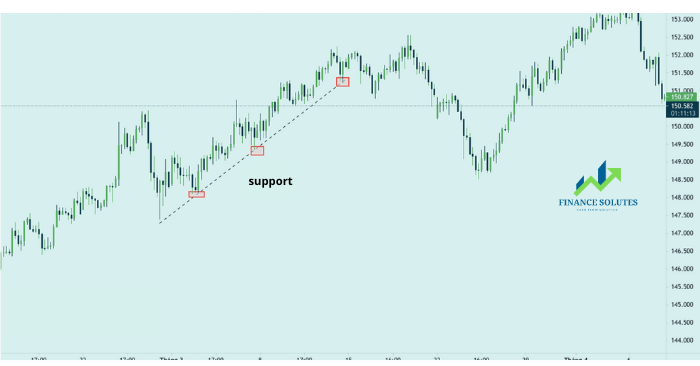
1.1. What Sustains and Creates Trends
What is a trend? Trends in the trading market are influenced by several factors such as economic conditions, market sentiment, etc. For example, in the stock trading market, stock prices partly reflect the business performance and financial health of a company. As for forex, a currency may strengthen or weaken depending on factors such as interest rates, unemployment rates, trade, and other economic factors of a country.
Additionally, trends can also be created by traders’ sentiment in the market. When a large number of traders hold a pessimistic and negative outlook on a currency pair, the price tends to decrease — and vice versa.
Human emotions can also sustain trends in the market. Fear, greed, and confidence are the main emotions, and generally, they can determine the prevailing market sentiment. If market participants are collectively fearful, the market sentiment becomes negative, causing downward pressure on prices. On the other hand, if they are confident (or even greedy), the market sentiment becomes positive, creating an upward trend.
1.2. Trend Duration
Many traders surely wonder: How long can a market trend last? Is there a time limit for each trend in the 24-hour forex trading market?
The answer may be what you’ve already guessed: a trend can last as long as it wants — there’s no limit. With tradafx, we don’t need to know exactly how long a trend will last. Our task is to identify trends, capture part of the trend, trade along with it to profit, and exit before the trend ends or reverses.
Note that there are different types of trends. There are uptrends, downtrends, and sideways trends. In terms of duration, some trends can last for 5–6 years or even longer. Others may last a year or less, and some trends occur within just a single trading session. That is the lifespan of a trend.
2. TREND TRADING STRATEGY
The trend trading method (or trend-following trading) involves identifying a trend that has formed and acting according to the primary price direction. This strategy contrasts with reversal strategies, which aim to pinpoint reversal points. It is considered one of the most popular trading strategies among technical analysis traders.
2.1. Using Trendlines
The simplest tool to identify the current trend is the trendline. You may have come across the saying, “The trend is your friend.” Trendlines can help traders spot entry points for buying or selling.
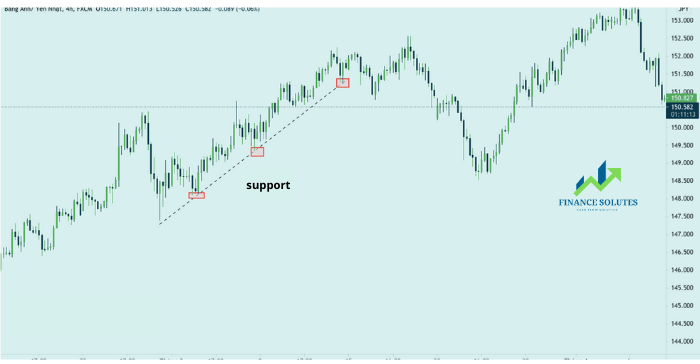
Take a look at the example chart above. The trendline in an uptrend acts as a support level. Traders can place buy orders whenever the price touches the support line.
An uptrend can consist of multiple smaller uptrends or even some downtrends. When using trendlines, it’s crucial to pay attention to their slope or gradient. The steeper the slope, the more significant the trend.
2.2. Price Action Strategy
Trending markets (uptrends and downtrends) are ideal for swing traders, who can set wider price targets, while range-bound markets (sideways trends) suit intraday traders.
In range-bound markets, trend traders buy at support and sell at resistance. This strategy is suitable for intraday traders because they typically aim for shorter profit targets. Take a look at the example chart below to better understand this strategy.
Identifying good trading opportunities along with the trend isn’t enough; ultimately, the success of any position is determined by the exit point. When trading based on price action combined with trendlines, setting targets is most effective when using price channels.
Channels are essentially drawn by two parallel trendlines. The price will fluctuate within the range of the upper and lower trendlines. Channels are ideal places to set targets. For example, in an uptrend, the upper trendline represents areas where the price may start to pull back or decline, making it a good spot to exit buy orders.
3. IS TREND TRADING EFFECTIVE IN THE STOCK MARKET?
The trend trading strategy has proven its effectiveness in the forex market over time. But what about other financial markets? Is it effective there too?
The answer is yes. Trend trading strategies can be applied across all types of assets, including exchange-traded funds (ETFs), stocks, and currencies. You simply need to identify an asset, observe its trend, and then apply the trading strategies mentioned above.
4. CONCLUSION
Even the world’s top professional traders admit that no strategy has a 100% win rate. There is no perfect trading system or method. Even the trend trading strategy sometimes has flaws and gives false signals. What’s important is that you have a proper risk management strategy and only trade with the money you can afford to lose without any major consequences.
Good luck!
- t.me/finance_solutes
- Website: https://finance-solutes.com
- Hotline: +1 929 5636 439 ( Hotline )
- 26 Broadway, Suite 934, New York, 10004, US
