
 XM
XM Bybit
Bybit Binance
 Robinhood
 Webull
 IC Markets
 Pepperstone
 OKX
OKX Vantage
 VT Markets
 BingX
BingX Gate.io
 Kucoin
 MEXC
MEXC Exness
 Bitget
There are always different investment funds in the stock market. Each investment fund represents a separate group of financial assets, so if you invest in these funds, you are investing in a certain economic sector, not investing in an uncertain stock exchange. This investment fund is called ETF – Exchange Traded Fund. In this article, let’s find out what ETF is and useful information about ETF!
What is an ETF? What are ETF certificates?
In response to the question “What is an ETF?” you can understand it simply as an Exchange Traded Fund (ETF) in the stock market, which is a group of stocks that traders can buy and sell. The ETF portfolio will mirror the movements of the assets in a trader’s investment portfolio. ETF certificates, ETF portfolios, or exchange-traded funds are considered investment funds listed on the stock exchange and will represent specific markets.
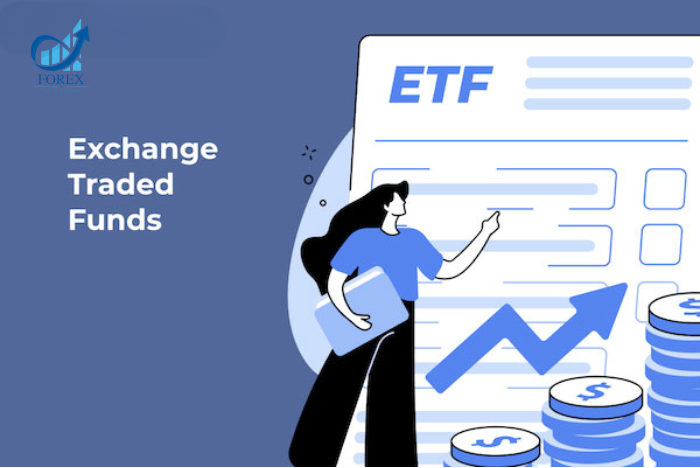
ETF is a representative of various types of financial assets: stocks, currencies, commodities, etc. Additionally, ETF funds can diversify investment categories for traders and help them avoid short-term income taxes.
To understand more about what an ETF is, let’s explore the following interesting content.
History of ETF Formation
After learning what an ETF is, we will explore the history of the ETF to gain a broader and more comprehensive view. The ETF was created in 1993 in the United States by Nathan Most and Steven Bloom, based on the S&P SPDR depositary receipt index.
At the time, this financial product did not make much impact. Harry Markowitz, the famous economist, was one of the first to contribute to the creation of the Exchange Traded Fund.
Initially, the investment fund was used only to list the popular stock index—the S&P 500. However, today, the exchange-traded fund has grown significantly and has become the largest ETF certificate, with a total value of approximately 43 billion dollars.

In 1996, ETF portfolios appeared on many stock indices in the US, Europe, and Asia. This success was due to the investment and support of iShares, which helped ETFs become the largest investment fund, diversifying options for traders. At the same time, this development also allowed small investors to access and trade these portfolios. Following this success, ETFs split into two categories: commodity ETFs and gold ETFs, such as Gold SPDR (GLD).
To this day, ETFs have firmly established their position in the market, with approximately $3 billion being traded every day. This proves that ETFs are highly liquid and trustworthy. Traders participating in ETFs find this market to be an excellent opportunity, as it allows them to diversify their investment portfolios while minimizing risks if they enter new markets.
If you are someone who enjoys investing in new and unique sectors, such as AI (Artificial Intelligence), the Global X Robotics & Artificial Intelligence ETF is an ideal choice. This is a fund focused on technology development, artificial intelligence, and robotics—sectors gaining a lot of attention in the current market.
How to Invest in ETFs
After understanding what an ETF is and its historical formation, many of you may be curious about how to invest in ETFs. Here’s a breakdown of how to do it:
ETFs are listed on stock exchanges, and traders can buy or sell them while the exchange is open. However, it’s important to note that ETF shares are different from regular stocks. The number of shares in an ETF changes daily because new stocks are regularly added, and current shares can be bought back at any time.

The price of an ETF is essentially the same as the price of its underlying assets. ETFs are suitable for both individual investors and large investment organizations. For large organizations, ETFs provide liquidity and can track the fund through the method of buying and selling new shares. It can be stated that investing in ETFs is a profitable and extremely attractive option. Traders can buy and sell ETFs in real-time, similar to trading stocks but with lower management fees. At present, ETFs are starting to replace mutual funds as the best investment choice.
Learn about the important features of ETFs
Here are some notable features you can refer to:
- The price of an ETF is displayed in real-time and can be traded just like stocks.
- Traders can buy and sell ETF certificates at any time during the trading session.
- An ETF is a financial product and can represent other trading instruments, including fixed-income securities.
- Many investment organizations/large investors invest in ETF certificates.
Benefits of participating in an Exchange-Traded Fund (ETF) investment
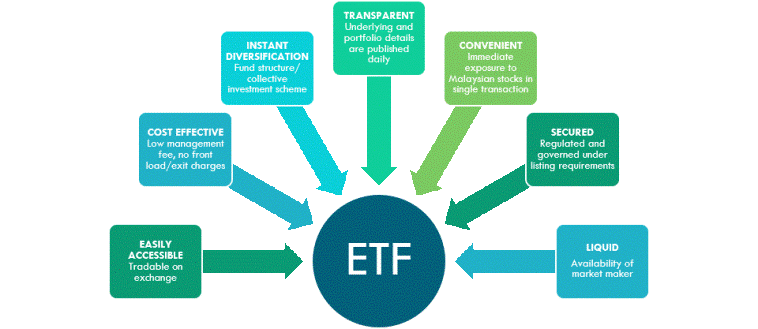
After understanding what ETFs are, we must look at the benefits of participating in an ETF investment fund:
- ETFs can replicate various types of financial assets, so they offer great diversity. Traders can participate in many different markets here.
- Investors can control the timing of capital gains tax payments and enjoy many tax advantages.
- When participating in ETFs, investors will incur only a small fee, as there are no entry or withdrawal fees, and transaction fees are minimal.
- In an ETF fund, traders can buy and sell at any time during the day and can even settle after the market closes.
- ETF certificates are traded like stocks, so orders are very diverse, and investors can place various types of orders.
- ETFs have low risk and a low beta coefficient.
- ETFs have no minimum investment requirement.
Disadvantages of ETF investment funds
Besides the above benefits, ETFs also have some drawbacks:
- After selling ETF certificates, traders may encounter payment delays, meaning they have to wait about 2 days before receiving the payment. This means that the seller cannot use their trading account to reinvest until 2 days later.
- Although ETFs always track the price of the underlying assets, price discrepancies can still occur.
- ETFs are directly affected by net asset value (NAV).
- When buying or selling an ETF position, traders will incur spread fees – hidden costs.
- When opening an ETF, traders may have to pay maintenance fees.
The difference between ETF certificates and investment funds
Here are the basic differences between ETF certificates and investment funds:
- The capital of an investment fund is raised from many investors and is delegated to professional fund managers or companies. On the other hand, ETFs are bought and sold directly on the stock market.
- Investment funds are suitable for both active and passive investors, while ETFs are mainly suited for passive investors.
- Investment funds often generate higher returns than stock indices, while ETFs only provide returns equivalent to the stock indices they replicate.
Risks when trading with ETFs
Any investor knows that investing always comes with risks. Here are the risks that traders may encounter when trading with ETFs:
- Market risk: The ETF portfolios are used to track assets like stocks, indices, commodities, and derivatives. Therefore, everything depends on the market. If the market grows, the investment will be profitable, and conversely, if the market declines, the investment will result in losses. To mitigate this risk, traders should always monitor performance and find appropriate trading strategies.
- Too many ETF options: When participating in ETFs, investors may face the temptation to invest in all portfolios. The differences between the portfolios within the fund are significant, so investors should pay attention to this issue.
What is ETF leverage?
Leveraged ETFs are defined as exchange-traded funds that use derivative financial instruments and debt to increase the return rate of the underlying securities index. The goal of ETF investments is to maintain this leverage ratio during the investment period, typically at 2:1 or 3:1.
Popular types of ETFs
Here are some popular ETFs and stock ETFs:
- Country ETFs: Traders can access and invest in various stock markets worldwide.
- Sector ETFs: Traders can buy and sell across different sectors, such as investing in the iShares UK Property UCITS ETF.
- Commodity ETFs: Commodity ETFs are very diverse. For example, with commodity ETFs like the SPDR S&P Metals & Mining ETF, traders can access the global metals mining market.
- Stock Index ETFs: Traders can buy ETF certificates on the S&P 500 index through the Vanguard S&P 500 ETF. Other notable ETFs currently include currency, bonds, biotechnology, artificial intelligence, etc.
Latest ETFs in Vietnam in 2021
Technology ETF Portfolio
20% of the total S&P 500 stock index, valued at over $20 trillion, is made up of technology stocks. This figure confirms that technology is the largest sector forming this stock index. When participating in a technology ETF investment fund, investors have many options, and the Technology Select SPDR Fund ETF (#XLK) is one of the hottest ETFs currently. This ETF represents 75 stocks, including: Apple, Microsoft, Facebook, and more.
Semiconductor ETF
The semiconductor ETF can be considered a small segment within the industrial portfolio. This ETF tracks and monitors companies that produce semiconductors for electronic devices.
The investment portfolio of this ETF represents some of the largest hardware companies in the world: Nvidia Corp, Intel Corp, etc.
Gold and Silver ETF
Gold and silver are considered stores of value and defensive assets. Therefore, during periods of economic uncertainty and high inflation, gold and silver ETFs are a reasonable investment choice.
Traders wishing to invest in this sector can join the SPDR Gold Shares (GLD) ETF. The advantage of this investment fund is its high liquidity and low transaction fees.
Real Estate ETF
If you’re a real estate investor, you’re probably familiar with Real Estate Investment Trusts (REITs), which offer many benefits to investors. REITs include residential, commercial, industrial, and mortgage REITs.
REITs are regulated and controlled by the U.S. Securities and Exchange Commission. Investors can buy shares in mutual funds or ETFs containing one or more REITs in their portfolios.
For those wishing to invest in the REIT index, traders can refer to the following real estate mutual funds:
- Vanguard Large-Cap ETF CFD (VM)
- SPDR Dow Jones International Real Estate ETF CFD (RWX)
- iShares US Real Estate ETF CFD (IYR)
- Schwab US REIT ETF CFD (SCHH)
Vanguard ETF
Vanguard is the second-largest ETF in the U.S., after iShares. Vanguard ETFs are highly diverse, with the Vanguard FTSE Developed Markets ETF (VEA) being one of the most promising Exchange Traded Funds.
Top ETF Indices
The S&P 500 indices are highly favored by traders. Many traders have invested in sectors they understand and have been able to earn profits, such as technology stocks. The Nasdaq 100 index contains approximately 100 technology stocks and has grown over 50% from January 2019 to January 2020.
There are now many ETFs that track the Nasdaq 100 index, such as the First Trust NASDAQ-100 Technology Index Fund (QTEC) ETF. This ETF allows traders to access many technology companies, including Facebook, Apple, Amazon, Netflix, and Google.
Best Growth ETFs
Growth ETFs focus on rapid sales growth and high P/E ratios. Here are some ETFs that are considered to have good growth potential:
- Vanguard Growth ETF CFD (VUG)
- Technology Select Sector SPDR Fund ETF CFD (XLK)
- Consumer Discretionary Select Sector SPDR Fund ETF CFD (XLY)
- iShares Nasdaq Biotechnology ETF CFD (IBB)
Best Dividend ETFs
Here are some dividend ETFs that traders can consider for investment:
- iShares US Real Estate ETF CFD (IYR)
- PowerShares Preferred Portfolio ETF CFD (PGX)
- Schwab US Dividend Equity ETF CFD (SCHD)
- SPDR S&P Dividend ETF CFD (SDYUS)
Artificial Intelligence ETF Portfolio
The AI ETF sector has grown significantly in recent years. By investing in this fund, traders can potentially earn substantial profits. Here are some of the top AI ETFs traders can consider:
- PowerShares QQQ ETF CFD (QQQ)
- Technology Select Sector SPDR Fund ETF CFD (XLK)
ETF Certificates with High Growth Potential in 2021
Here are some ETFs that have strong growth potential in 2021 for traders to consider:
- iShares US Aerospace & Defense ETF CFD (ITA)
- iShares US Home Construction ETF CFD (ITB)
- iShares Global Energy ETF CFD (IXC)
- SPDR S&P Bank ETF CFD (KBE)
- VanEck Vectors Oil Services ETF CFD (OIH)
- SPDR S&P Biotech ETF CFD (XBI)
- Vanguard FTSE Emerging Markets ETF CFD (VWO)
- Financial Select Sector SPDR Fund ETF CFD (XLF)
- Schwab US Large-Cap Value ETF CFD (SCHV)
Should You Invest in ETFs or Trade ETF CFDs?
On the stock market, Contracts for Difference (CFD) and Exchange Traded Funds (ETF) are highly popular choices for many traders.

What is CFD in securities?
CFD is a financial product that allows the use of leverage, so it carries a high risk. Traders can invest in ETFs through CFDs. CFDs are typically used in active investing – traders will only engage in short-term trading: in minutes, days, weeks, or months.
What is ETF in securities?
An Exchange Traded Fund typically mirrors an underlying index. Therefore, it can be said that it has a lower risk compared to CFD. Unlike CFDs, ETFs are considered a long-term investment option, and traders will buy and hold positions for many years with the aim of selling them later for a profit. As mentioned earlier, ETFs are really suitable for passive investors. This article has helped you understand what ETFs are, while also providing a lot of information on the strengths, weaknesses of ETFs, and types of ETFs that can help you earn substantial profits. Hopefully, through this article, you will grasp useful information about ETFs. Wishing you good luck in your investment journey!
- t.me/finance_solutes
- Website: https://finance-solutes.com
- Hotline: +1 929 5636 439 ( Hotline )
- 26 Broadway, Suite 934, New York, 10004, US
