
 XM
XM Bybit
Bybit Binance
 Robinhood
 Webull
 IC Markets
 Pepperstone
 OKX
OKX Vantage
 VT Markets
 BingX
BingX Gate.io
 Kucoin
 MEXC
MEXC Exness
 Bitget
Perhaps the IRR index is one of the most interested indicators for investors today. By providing meaningful and effective signals, it will help investors find the most potential and effective investment opportunities for themselves. So what exactly is IRR? What are the advantages and disadvantages of the IRR index? Let’s find out with Traderforex the details of the content that IRR wants to express in the article below.
What is IRR?
IRR, short for Internal Rate of Return, is a financial metric used to assess the profitability of potential investments. When evaluating discounted cash flows, IRR is used as the discount rate that makes the Net Present Value (NPV) of all cash flows equal to zero. Currently, IRR plays an extremely important role in the financial planning process, as it helps analyze and assess the income potential of investments. Once you calculate IRR, it means you’re forecasting the accumulated profits you’ll receive each year when you make an investment.

How to Calculate IRR
As discussed above, the IRR metric is often used in conjunction with Net Present Value (NPV). The formula used to calculate IRR involves the following factors: the total initial investment cost, the Net Present Value, and the cash flows at specific time intervals within the year. The result will show when the IRR is high, indicating that the project or investment is performing well.
The general formula to calculate IRR is:
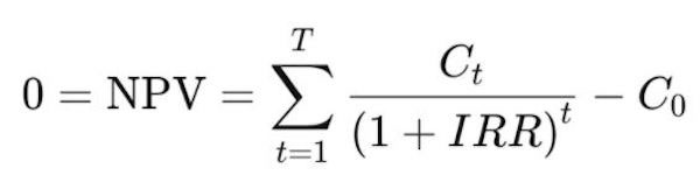
In which:
- NPV is the Net Present Value
- IRR is the Internal Rate of Return
- Co is the total initial investment cost (at time 0)
- Ct is the net cash flow at time t (usually calculated yearly)
- t is the project’s time period
Typically, people calculate various investment options based on IRR metrics, then compare them to choose the one with the highest IRR. This potential investment is what investors should consider exploring.
In practice, the IRR index is usually calculated using formulas programmed in an Excel file, reducing reliance on traditional manual methods. Due to errors that might occur with the manual formula, it becomes difficult to obtain an accurate result using manual calculations.
Significance of Internal Rate of Return (IRR)
The IRR is extremely important because it plays a decisive role for both companies and investors. Specifically, the main points of its significance are as follows:

For Businesses:
The Board of Directors can customize the use of Internal Rate of Return (IRR) to compare different investments. If the result of IRR > 0, the project’s profitability potential is considered highly feasible. On the other hand, if IRR < 0, the profitability potential is low. By calculating the IRR, business owners can make informed decisions about which projects to undertake and which investments to eliminate, aiming to maximize the company’s profits.
These reasons will help the business set the minimum ROI (Return on Investment) required. When a certain proposal is made, if IRR is lower than the minimum profitability threshold or lower than the cost of capital or interest rates, the proposal becomes unfeasible in practice.
For Investors:
- Estimate potential returns: Investors can estimate the profit they can expect from purchasing a particular stock.
- Maximum bond yield: Determine the maximum bond yield until maturity.
- Risk and reward balance: Investors can assess the risk and reward balance when investing in real estate.
- Evaluate investments: Investors can evaluate their potential investment in a company they are considering investing in.
Example of IRR:
For example, if you get an investment and analyze that the IRR of that investment is 20%, this indicates that you will get 20% return on those investments until the end of the investment. At this point, the 20% increase is the clearest reflection of the IRR.
Advantages and Disadvantages of IRR
Each index will have different advantages and disadvantages, and of course IRR will also have two sides to it. Below is some basic information that you can refer to to better understand IRR.
![[ Thắc mắc ] Lựa chọn dự án đầu tư theo NPV, nên hay không? Kỹ Năng Quản Trị](http://finance-solutes.com/wp-content/uploads/2025/01/irr_16991380_7897a5c69b504a68b5bb216f8d939d336c8b5ec2-730x370.jpeg.webp)
Advantages of IRR
- Simple and easy to calculate: IRR is considered a simple and easy method to apply without the need for any cost of capital intervention. The results of IRR are expressed as a percentage, making it easy to compare between projects.
- Determines the time value of cash flows: IRR helps identify and reflect the value of cash flows over time, thus clarifying the financial effectiveness of a project.
- Easy comparison: IRR provides clear data for comparing projects, helping businesses evaluate and choose the project with the highest profit potential.
- No need for a quick payback ratio: IRR can be estimated roughly without using a quick payback ratio, minimizing the complexity of calculations while ensuring accuracy.
Disadvantages of IRR
- Complex calculation and time-consuming: Although not overly complicated, calculating IRR still takes more time compared to other methods. Especially when there is no supporting tool, calculations can be difficult.
- Does not account for cost of capital: IRR does not account for the cost of capital, which means comparing IRR between companies might overlook projects with larger scales and higher net profits (typically, projects with NPV higher have IRR lower).
- Does not provide absolute results: IRR may not be entirely accurate, especially when applied in cases with significant changes in cash flow or costs. This can result in IRR rejecting investment opportunities that could be beneficial for investors.
- Cannot determine project scale: IRR does not account for the scale of different projects or future costs that could affect profitability, which impacts the accuracy of forecasting profits.
- Issues with reinvestment rates: IRR can provide misleading results regarding reinvestment rates because it assumes that all excess cash flows will be reinvested at the IRR rate, which is not always accurate in reality.
Comparison between NPV and IRR
NPV and IRR are two extremely standard metrics that can be used to provide investors and business leaders with a clearer picture of which projects or investments can bring them the most value. NPV and IRR are closely related and complement each other.
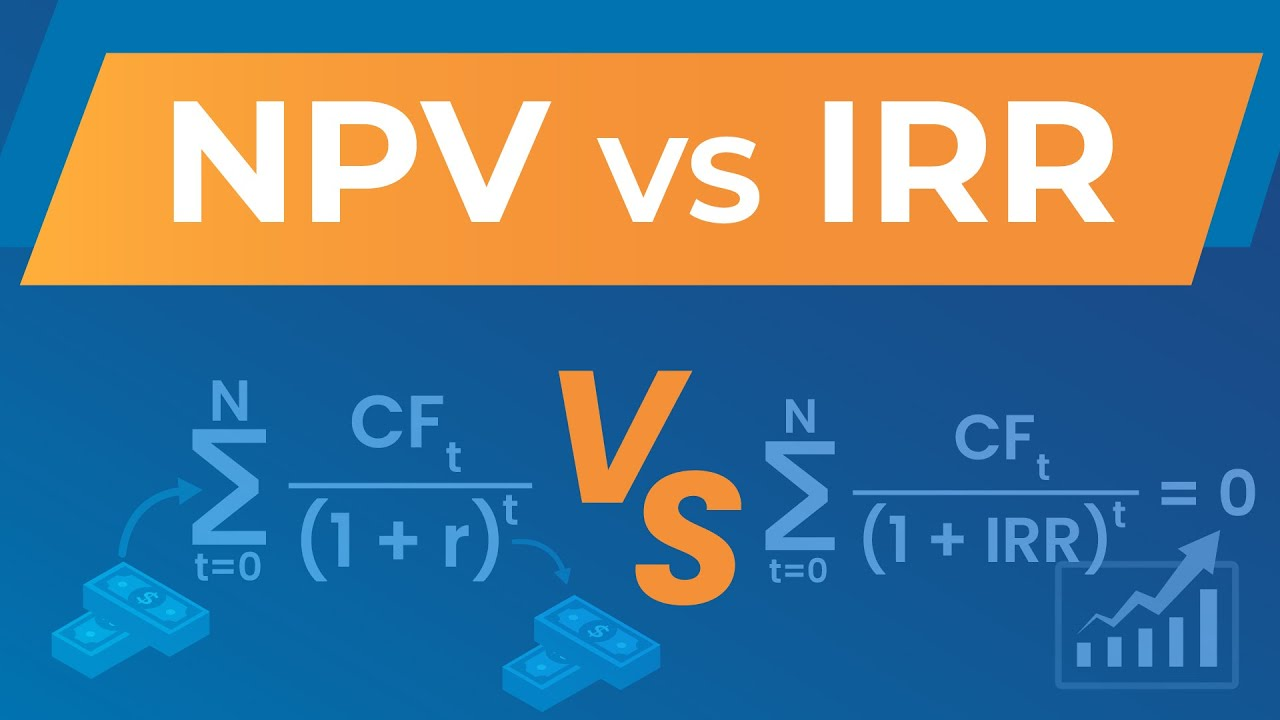
Net Present Value (NPV) and Internal Rate of Return (IRR)
Additionally, the IRR and NPV indicators have the following differences:
- NPV provides a specific amount of money, whereas IRR provides a specific percentage rate. When comparing these two measures, people tend to prefer results expressed in monetary terms rather than percentages.
- NPV has long been used to evaluate projects and requires several additional analytical tools. On the other hand, IRR is focused on short-term evaluations and does not require as many supplementary tools.
Limitations of IRR
IRR, when used alone without being linked to other indicators such as NPV, can lead to misunderstandings in some specific cases. Depending on the initial investment costs of the project, the internal rate of return (IRR) might be lower, but sometimes it can appear higher than the net present value (NPV).

irr là gì 1 – TraderForex
Another limitation of IRR is that it currently relies heavily on the time factor of any given project.
For example, a short-term project might produce a high IRR, and many people might be misled into thinking it is a worthwhile investment. However, in reality, it may have a much lower NPV.
On the other hand, another project with a longer duration and a lower IRR, while producing profits more slowly but steadily, could allow the company to gradually increase value over time, thereby increasing the lower rate over time.
So, we have explored what IRR is and the key concepts about IRR that investors need to know. We hope this information will help you easily approach and make effective investments. Wishing you success.
- t.me/finance_solutes
- Website: https://finance-solutes.com
- Hotline: +1 929 5636 439 ( Hotline )
- 26 Broadway, Suite 934, New York, 10004, US
