
 XM
XM Bybit
Bybit Binance
 Robinhood
 Webull
 IC Markets
 Pepperstone
 OKX
OKX Vantage
 VT Markets
 BingX
BingX Gate.io
 Kucoin
 MEXC
MEXC Exness
 Bitget
Currently, digital currency is one of the most discussed and highly regarded topics in the field of financial investment. Have you ever wondered why opening an account on cryptocurrency exchanges or participating for the first time in ICO projects always requires KYC verification? In fact, KYC is a crucial and indispensable process when engaging in the crypto market.
So, what exactly is KYC? Why is KYC important in cryptocurrency investment? How can you ensure a smooth and successful KYC process? All these questions will be answered in today’s article by Forex.
Stay tuned!!!
1. OVERVIEW OF WHAT KYC IS
So, what does KYC stand for? You may not know, but KYC stands for “Know Your Customer,” which translates to “Understanding Your Customer” or “Knowing Who Your Customer Is.” It is the identity verification process that financial institutions are required to follow.
1.1. What is KYC in Crypto?
In the cryptocurrency market, the term KYC is simply understood as “Identity Verification.” It is considered a necessary procedure in the due diligence process of investment groups issuing digital currencies. They aim to verify the risk appetite and financial investment knowledge of their customers.
The purpose of all forms of KYC is to protect both investors and project owners. Through investment consultations in digital currencies, project owners can determine how to invest for maximum profitability and choose investment methods that suit each individual. Additionally, thanks to KYC, project owners can identify potential clients to include in their investment portfolio.

1.2. Is KYC Verification Mandatory?
The answer depends on each country and specific exchange platform—KYC procedures may or may not be mandatory.
Bitcoin (BTC) was originally created to allow digital currencies to remain unaffected by government regulations imposed on traditional financial investments. However, in some countries where cryptocurrency is legal and regulated, identity verification (KYC), including proof of residence, is now required for anyone wanting to open a crypto account. This requirement aligns with anti-money laundering (AML) regulations enforced by financial institutions.
Most crypto exchanges today encourage users to complete KYC to access advanced services and increase transaction limits on their accounts.
2. WHY IS KYC IMPORTANT IN CRYPTO COINS?
In this section, let’s explore why KYC procedures are critical in the cryptocurrency market.
2.1. Preventing Crime and Tax Evasion
The nature of the cryptocurrency market is decentralized and free from institutional control. This lack of regulation has created opportunities for financial criminals to exploit it for illegal purposes, causing economic instability.
KYC was introduced to manage investor identities within the system and to prevent criminal activities.
Additionally, through KYC, illegal identities and funds transferred abroad can be reported to FinCEN (Financial Crimes Enforcement Network) to curb money laundering activities.

2.2. Building Trust and a Transparent Environment for Customers
In the past, cryptocurrency exchange platforms have faced hacker attacks that eroded investor confidence. By implementing KYC, brokers can demonstrate their credibility. The identity verification system (KYC) helps exchanges identify who is using their services, eliminate fraudulent users, and prevent illegal activities or attacks on the platform.
Additionally, KYC procedures enable new investors to trade in a safe environment with trustworthy individuals whose identities have been clearly verified. This is especially critical for peer-to-peer (P2P) transactions.
2.3. Enhancing the Health of the Cryptocurrency Market
Many investors are leaning toward government-issued digital currencies, increasing competition for private enterprises. Investing in KYC procedures allows businesses to position their products as a secure alternative to traditional assets.
2.4. A Step Towards Legalizing Cryptocurrency
The implementation of KYC rules can be seen as a way to legitimize cryptocurrencies. KYC regulations applied to digital currencies align with existing regulations for fiat currencies.
Although these procedures are not a primary concern for many traders or legal crypto transactions, they enforce additional rules related to declaring personal income, especially income from cryptocurrency investments and trading.
3. KYC VERIFICATION PROCESS ON CRYPTO EXCHANGES
The KYC verification process on crypto exchanges typically involves three steps:
Step 1: Collecting Customer Identification Information
This foundational step involves gathering personal identification details, such as full name, date of birth, and address. Verification is conducted through official government-issued documents (e.g., passport, driver’s license, national ID card) and proof of address (e.g., utility bills, bank statements).
Step 2: Verifying Customer Information
This step uses databases to determine whether a customer has any political exposure or criminal records. Brokers use this information to assess risks related to money laundering or financial crimes for each customer.

Once the customer’s verification data is available, the broker can cross-reference it with internal and third-party data sets to assess risk and determine the skill level of the customer’s disclosures. Ultimately, the decision to accept or reject the transaction with that customer is made.
Step 3: Ongoing Monitoring
Regular monitoring ensures that customers’ KYC information remains up-to-date and allows the system to flag any suspicious transactions.
Real-life example: In the United States, if a large cryptocurrency transaction is detected involving a country under terrorism watch, the transaction will be flagged and monitored. Depending on the investigation and verification process, brokers may temporarily suspend the account of the suspected customer and report the incident to law enforcement agencies if necessary.
4. GUIDELINES FOR A SUCCESSFUL KYC VERIFICATION
In this section, TradaFX will guide you step by step on how to ensure successful KYC verification when opening an account on any cryptocurrency exchange.
4.1. What Documents Are Needed for KYC Verification in Crypto?
What types of documents should you prepare?
- National ID card (CCCD/CMND) or Passport
- Clear photos of the front and back of your ID card or Passport
- A photo showing your face while holding the ID card or Passport along with a piece of paper containing the required information from the broker or ICO.
- Driver’s license (Some platforms may request this additional document.)
- Proof of address dated within the last three months, such as utility bills, bank statements, or internet bills.

4.2. Steps for KYC Verification for Investors
KYC identity verification is carried out in 4 steps as follows:
Step 1: Log in to the homepage of the broker or ICO project. Navigate to the Settings section and select Verify/Identity Verification.
Step 2: Provide all necessary personal information as required and select the document you want to use for identity verification, such as a National ID card (CCCD/CMND), passport, or driver’s license.
Step 3: Complete the information automatically populated by OCR technology and take a selfie if requested.
Step 4: Once the KYC process is completed, the system will review the information and photos you provided. Depending on the broker or project, verification results will be sent to your email within 1 hour to 1 week.
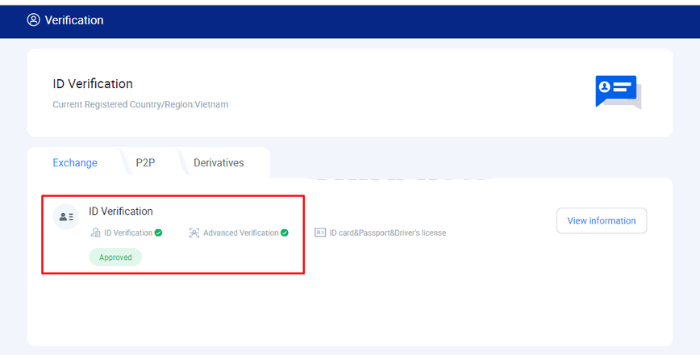
Below is an example of successful KYC verification on the Houbi exchange:
4.3. Important Notes for KYC Verification in Crypto Coins
To successfully and quickly verify KYC with most brokers, keep the following points in mind:
- Ensure that all the information you provide during the KYC process matches your identification documents. If the information you enter differs from the documents you provide, your verification may fail.
- Your CCCD/CMND, passport, or driver’s license must be valid.
- Based on Forex experience, it is recommended to use a passport rather than a CCCD/CMND, as bilingual Vietnamese-English documents are more likely to be accepted.
- Address verification documents, such as utility bills, internet bills, or bank statements, must be recent—within the last 3 months.
- Uploaded images must be in formats like PNG, JPG, JPEG, or PDF.
- All information must be clear and complete.
- Photos must not be blurry, overexposed, missing information, and should clearly show your face and address.

5. IS KYC VERIFICATION SAFE FOR CUSTOMERS?
KYC is a safe process if the broker you are trading with has privacy and security policies in place to protect your information. However, hackers may attempt to use KYC verification as a means to steal your data.
Therefore, always ensure that you provide information directly to the broker you are trying to verify with. It is important to remember that KYC only requires the verification of documents, and it cannot be completed over the phone. Any phone call requesting personal information related to KYC is a scam.

6. SUMMARY
So, through today’s article by Forex, you now have a clear understanding of the term KYC, why KYC is important and necessary in the Crypto market, along with a detailed guide on how to successfully complete this procedure. Although it may take a little extra time to complete KYC identity verification, the benefit is that you will be able to trade and buy cryptocurrencies in a safer environment.
We hope that the information we shared has been helpful to you in understanding and researching this term. If you have any further questions, please feel free to comment below, and TradaFX will respond to you right away.
Wishing you success in your trading career!
- t.me/finance_solutes
- Website: https://finance-solutes.com
- Hotline: +1 929 5636 439 ( Hotline )
- 26 Broadway, Suite 934, New York, 10004, US
