
 XM
XM Bybit
Bybit Binance
 Robinhood
 Webull
 IC Markets
 Pepperstone
 OKX
OKX Vantage
 VT Markets
 BingX
BingX Gate.io
 Kucoin
 MEXC
MEXC Exness
 Bitget
Have you heard about NPV? This is one of the critical and effective Net Present Values that helps investors easily evaluate and predict cash flow discrepancies in and out of a specific project. This metric will provide you with opportunities to earn significant and highly effective profits. Join Forex to explore the details of the NPV metric in the article below!
What is the NPV index?
NPV (Net Present Value) refers to the net present value. This term describes the difference between the cash inflows and outflows of a project at the present time. Every project requires a certain amount of investment. To determine whether these investments are currently profitable, investors can utilize the sum of all cash inflows and outflows to identify profit opportunities. Since each cash flow has a different value and significance at various points in time, summarizing cash inflows and outflows accurately requires considering an approximate time frame.
In this case, the NPV ratio is often used for calculations. NPV is commonly applied in planning and budgeting for investments, enabling you to easily evaluate and analyze the potential profitability of a project or the invested capital.
NPV Calculation Formula
Below is the most accurate formula to calculate NPV. You can effectively use this formula for financial investment calculations and apply this net present value in your investment strategies.

In which:
- i: Discount rate
- t: Time to be calculated (usually by year)
When the cash flow shows signs of uneven flow, investors can also apply the following formula:
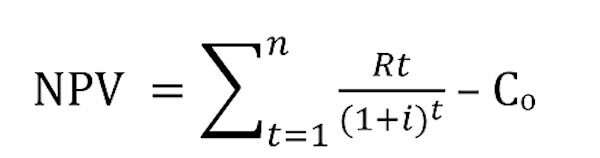
In which:
- Rt: Cash flow at time t
- i: Discount rate
- Co: Initial cost used for investment
- t: Calculation time (usually in years)
Meaning of NPV
When calculating the NPV index, investors can easily know the content and meaning that the NPV index represents, whether it is positive, negative or zero. From that result, investors can evaluate the level and content as follows:
- NPV > 0: This indicates that the project’s profitability is trending significantly higher than the initial costs. Such a project is highly feasible and a good investment option for you to consider.
- NPV < 0: This metric reflects that the project’s returns are lower than the initial investment costs. Hence, investors can evaluate that this project is not feasible for investment.
- NPV = 0: The project is currently at a breakeven point, meaning investors can decide whether or not to proceed with the investment based on their judgment.
Example of Net Present Value
Here is a specific example of the NPV metric for better understanding. Suppose you purchase a lemon juicer priced at $100, which you plan to use for 3 years. The projected revenue from the juicer is $50 in the first year, $40 in the second year, and $30 in the third year. The discount rate is 4%. NPV for each year can be calculated as follows:
- Year One: 50/(1+0.04)1=50/1.04=$48.0850 / (1 + 0.04)^1 = 50 / 1.04 = $48.08
- Year Two: 40/(1+0.04)2=40/1.082=$36.9840 / (1 + 0.04)^2 = 40 / 1.082 = $36.98
- Year Three: 30/(1+0.04)3=30/1.125=$26.6730 / (1 + 0.04)^3 = 30 / 1.125 = $26.67
The NPV of the juicer purchase project is: 48.08+36.98+26.67−100=$11.7348.08 + 36.98 + 26.67 – 100 = $11.73.
Advantages and Disadvantages of the NPV Metric
Every metric has its own advantages and disadvantages, and NPV is no exception. Below is a summary of the most notable pros and cons of the NPV metric for you to consider and gain a comprehensive evaluation.

Advantages of the NPV Metric
Easy to Use
The NPV ratio is an effective tool for investors to easily identify the specific and most attractive potential of an investment. Essentially, it is based on determining the present value of profits or losses from a given investment, making it straightforward for investors to apply flexibly and efficiently.
Easy to Compare
NPV allows for straightforward comparisons of potential investments. As long as the NPVs of different options are calculated in detail, investors can use these values to evaluate the feasibility of each option. Once the present values of multiple options are established, the investor only needs to select the option with the highest NPV, as it offers the greatest value to the company. If none of the options have a positive NPV, the investor will not be able to choose an alternative since no investment in that case would add value to the company.
Customizable
The present value can be adjusted to accurately and effectively reflect the financial investment needs and concerns of the company. For example, the discount rate can be modified to account for factors such as risk, opportunity costs, and other fees. This flexibility helps align with changing yield curves and mitigates risks associated with long-term liabilities.
Disadvantages of NPV index

Difficulty in Making Accurate Estimates
Calculating NPV requires investors to accurately determine the discount rate, cash flow amounts, and timing of each cash flow. This is often challenging or even impossible to estimate precisely.
For instance, when a new product is launched and becomes highly popular, such as a new pharmaceutical drug, NPV relies on estimates of costs, revenues, and recurring development expenses, which may not yet be defined. Revenue from drug sales can be particularly hard to estimate, especially for subsequent years.
Does Not Account for Opportunity Costs
Net Present Value is only useful when comparing projects at the same point in time and does not fully account for opportunity costs. For example, a company might decide to invest in a project based on NPV but later discover a new product offering higher capital value. NPV can help outline opportunity costs by calculating the lack of available funds for potentially more lucrative future investments. However, investors cannot rely solely on the highest NPV project. They may choose to forgo all options, anticipating a better alternative in the future.
Fails to Provide a Comprehensive Picture
Another issue with using NPV in business investments is its inability to offer a full picture of the benefits or losses upon project completion. It does not determine the return on investment ratio (ROI). Internal Rate of Return (IRR) or other efficiency measures are often needed as complementary metrics to NPV.
Does Not Consider Project Scale
To illustrate this limitation, consider the following example: Project A requires an investment of $4 million and generates an NPV of $1 million. Project B, a competitor’s project, requires $2 million to generate an NPV of $0.8 million. Based on the NPV metric, one might prefer Project A because of its higher NPV. However, looking at the bigger picture, Project B generates more value per dollar of initial investment.
Relationship Between NPV and IRR
The relationship between NPV and IRR provides a forecast or signal for investors to evaluate and utilize these metrics effectively. IRR is the solution to the equation NPV=0\text{NPV} = 0. To calculate IRR, you solve NPV=0\text{NPV} = 0. If there is no solution, then IRR does not exist, making it impossible to accurately assess the project. If multiple solutions exist, it means multiple IRRs are present, which complicates determining the appropriate IRR for comparison. IRR can only rank projects individually and cannot compare two projects as effectively as NPV.
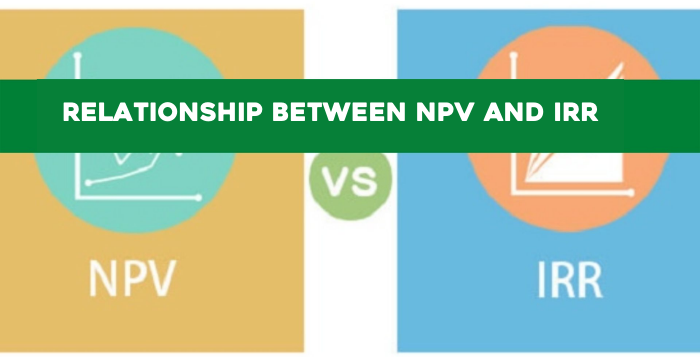
IRR assumes that all cash flows are discounted at the same rate, while in reality, cash flows have different rates over time. Therefore, IRR is not suitable for long-term projects. In general, NPV and IRR are two methods used to evaluate capital investments or projects. IRR makes it easier for companies to visualize, as it presents specific percentages, while NPV can be harder to visualize. However, NPV is more convenient because it is expressed in monetary terms. In some cases, IRR may not be as effective as NPV, which is why investors often combine both metrics when selecting a project.
With the information provided above, I hope you now have a more effective and accurate understanding of what NPV is. However, it still has certain limitations, so it is important to apply various methods to make the best and most effective investment decisions. Wishing you success!
- t.me/finance_solutes
- Website: https://finance-solutes.com
- Hotline: +1 929 5636 439 ( Hotline )
- 26 Broadway, Suite 934, New York, 10004, US
