
 XM
XM Bybit
Bybit Binance
 Robinhood
 Webull
 IC Markets
 Pepperstone
 OKX
OKX Vantage
 VT Markets
 BingX
BingX Gate.io
 Kucoin
 MEXC
MEXC Exness
 Bitget
Do you know what NYSE is? It is an extremely popular and well-known exchange, chosen by a large number of investors for its high quality and diverse trading products, as well as its excellent reputation. If you are looking for a safe stock trading platform, you can refer to NYSE. Below, Traderforex will help you thoroughly and comprehensively understand all the essential information about this exchange. This article will definitely be very helpful to you, so don’t miss it.
What is the concept of NYSE?
NYSE (New York Stock Exchange) is one of the largest and most widespread stock exchanges in the world for buying and selling shares. It is also a crucial and valuable source of liquidity, allowing investors to execute millions of stock transactions daily in a convenient and efficient market.
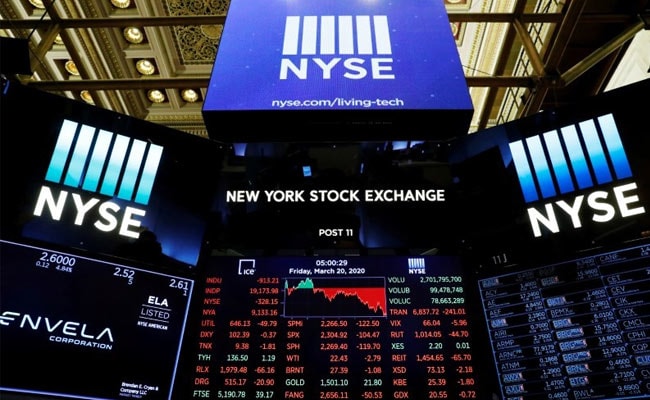
The NYSE was established in 1792 by 24 stockbroker companies under the Buttonwood Agreement and is regulated by the NYSE Group. The business office is located at 11 Wall Street and includes 5 representative offices used for business activities. The main building of this exchange is also listed in the National Register of Historic Places and is located at 18 Broad Street, at the corner of Wall Street and other bustling intersections.
How are trading methods and hours at the NYSE regulated?
Many investors are likely curious about how to conduct effective trades on the NYSE. Over many years of continuous operation and development, the New York Stock Exchange has only traded through the floor and uses an open auction system. Many trades on the NYSE have shifted to electronic systems, but floor traders still operate on-site, where participants must come to place bids and conduct large-volume transactions.
The New York Stock Exchange is open for trading from Monday to Friday, from 9:30 AM to 4:00 PM Eastern Time. The exchange is closed on all federal holidays. When a federal holiday falls on Monday through Saturday, the NYSE may close on the preceding Friday. If the holiday falls on Sunday, the NYSE may close the following Monday.
Primary and Secondary Markets
A company listed on the New York Stock Exchange can attract significant investment capital to grow its business through an Initial Public Offering (IPO), which refers to the stocks that the company initially issues to the public. The NYSE must meet specific listing requirements, such as stock price, market capitalization, and minimum share count.

Most of the trading on the NYSE takes place in the secondary market. For example, if an investor wants to buy IBM shares, they cannot buy directly from IBM; instead, they must buy from another person who owns IBM shares and wishes to sell them.
Trading Process
Trading on the NYSE is primarily conducted through member brokers and experienced professionals. An investor who wishes to buy or sell shares of a company listed on the NYSE will contact a broker who is a member of the NYSE. Afterward, the two parties exchange and the transaction proceeds as usual, ensuring that the trading process is conducted properly.

Additionally, specialists will contact brokers to inform them that the trade is proceeding smoothly and will report the details of the transaction. However, today, most trade details are reported electronically.
Regulations at the NYSE
To ensure quality service for all investors, the NYSE is closely monitored to maintain an orderly and fair system for traders. The NYSE is regulated by the U.S. Securities and Exchange Commission (SEC). The NYSE itself also has to closely supervise all daily transactions occurring on the exchange. Both the SEC and NYSE are responsible for ensuring that trading is fair and efficient, delivering the best possible value.
Comparing NASDAQ and NYSE
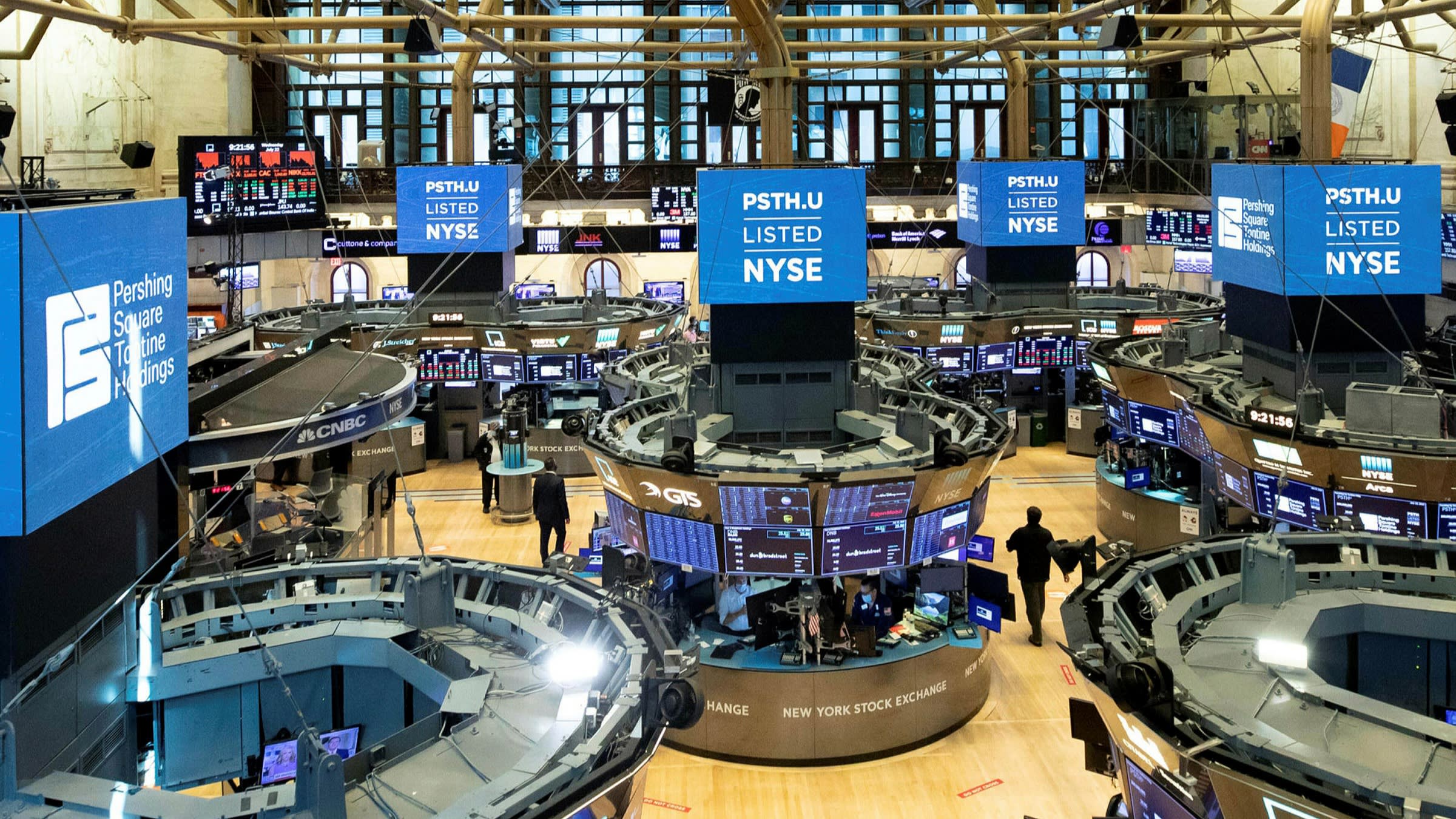
In the United States, NYSE and NASDAQ are two prestigious and large stock exchanges that dominate trading volumes in North America and globally. However, they have differences in terms of their operating methods and the types of stocks traded. These differences create distinct advantages and features that suit different types of investors, such as:
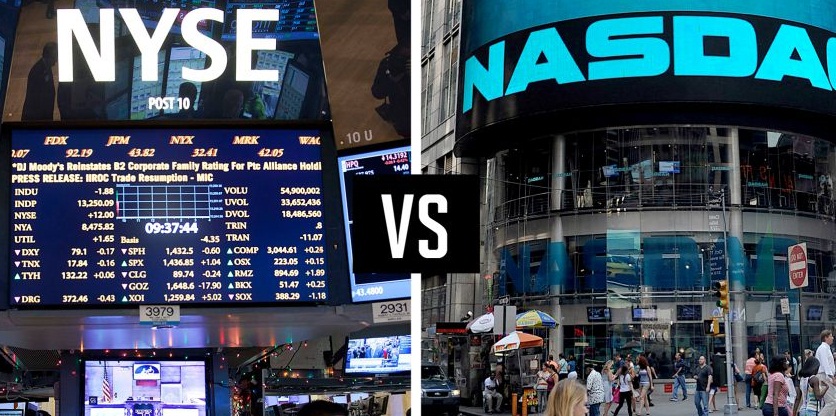
Trading Locations
This is the first key difference between the NYSE and NASDAQ. All trades on the NYSE take place at a specific location, which is the New York Stock Exchange in New York. When the bell rings, everyone knows it’s a signal that a new trading day is about to begin. On the other hand, NASDAQ does not have a physical location. Instead, investors must work on a telecommunications network connected via the internet through computer systems. They need to gather and understand market information to trade effectively and at the right places.
Trading Methods
The NYSE is the oldest stock exchange in the world, and its value has remained consistent over the years. It is a place where millions of investors trade, buying and selling, and competing with each other by placing and matching orders directly on the exchange floor. Brokers play a crucial role as intermediaries between investors and the market. In contrast, NASDAQ operates as a dealer market, meaning that trades on NASDAQ are conducted through brokers rather than directly between investors, as is the case with the New York Stock Exchange.

Coordinators
Both the NYSE and NASDAQ require coordinators to ensure that trading activities run smoothly and without congestion. These coordinators are crucial for the exchange process, but their roles differ between the two exchanges. On the NYSE, these coordinators are called Specialists. Their main job is to connect buyers and sellers to facilitate trades, ensuring that opportunities for transactions arise. Specialists are responsible for ensuring that the link between buyers and sellers remains uninterrupted, maintaining order in the market.
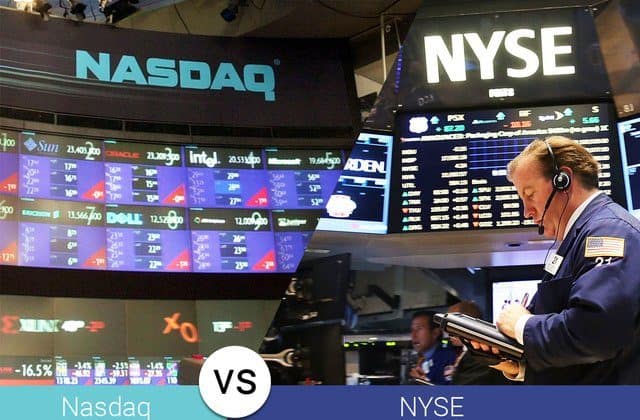
On the NASDAQ exchange, the regulatory bodies are referred to as Market Makers, and their primary role is to create an open market for securities.
Participating Companies
The NASDAQ stock exchange is often called the high-tech exchange, attracting many companies that operate through the Internet or other electronic means. As a result, stocks listed on this exchange tend to be more volatile and growth-oriented. On the other hand, companies listed on the New York Stock Exchange (NYSE) are typically established, reputable, and long-standing companies. Many of the companies listed on the NYSE are blue-chip companies, and stocks on this exchange tend to be more stable.
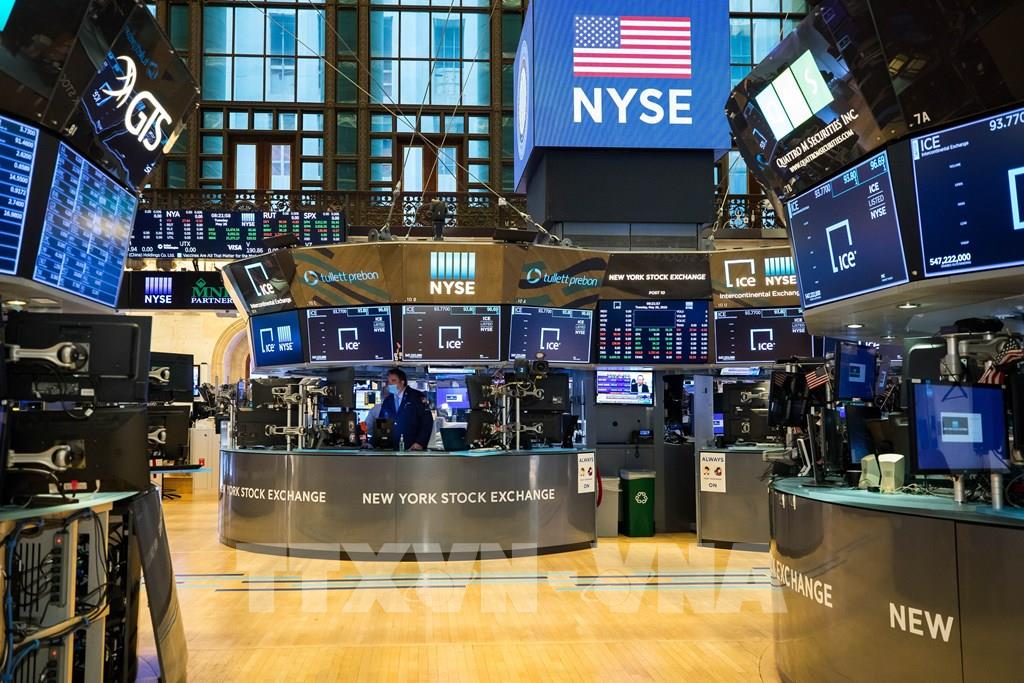
Should investors trade on NASDAQ or NYSE?
Deciding whether to trade on NASDAQ or NYSE can be challenging for investors, as both markets have distinct characteristics. However, the choice between these exchanges is crucial for companies, as it is influenced by listing costs and the exchange’s requirements. NASDAQ has a relatively high listing cost, around $150,000, compared to the industry average. However, what truly matters is the annual maintenance fee: $500,000 for NYSE and $60,000 for NASDAQ. Therefore, it can be understood that NASDAQ focuses on growth-oriented companies.

For investors, choosing between NASDAQ and NYSE depends on their investment strategy. If you prefer companies with higher growth potential, NASDAQ might be more attractive. But if stability and well-established companies are your focus, NYSE may be the better option.
Before March 8, 2006, the main financial difference between the two exchanges was their ownership structure. The NASDAQ stock exchange was listed as a public company, while the New York Stock Exchange (NYSE) was a private company. However, on that date, the NYSE was privatized and publicly traded after 214 years of operating as a charitable institution.
Many people think of NASDAQ or NYSE as stock exchanges, but in fact, these exchanges are corporations that provide services to shareholders to generate profits. The stock values of these exchanges can be traded just like any other public companies, and of course, both must comply with listing requirements from the Securities and Exchange Commission (SEC) in order to be listed.
So, now we’ve learned what the NYSE is, right? It’s a very well-known and popular exchange that investors can consider when choosing where to trade, offering opportunities for the best profit potential. Forex hopes this article has been helpful to you.
- t.me/finance_solutes
- Website: https://finance-solutes.com
- Hotline: +1 929 5636 439 ( Hotline )
- 26 Broadway, Suite 934, New York, 10004, US
