What is ROCE?
ROCE stands for Return on Capital Employed, which means the profit earned on the capital employed. This ratio helps investors easily understand and recognize the model expressed as a percentage to measure the level and profitability, as well as the effectiveness of a company’s capital usage. This is an important factor as it informs the company about the profitability of the initial investment capital. From this, the company can determine whether its capital is being used effectively and identify areas that need adjustment to generate profits. For these reasons, investors often use ROCE to measure a company’s growth potential.
How to Calculate ROCE
Let’s first look at how to calculate ROCE. Understanding the calculation formula below will make it much easier for you to successfully apply ROCE effectively.

In which:
- EBIT = Earnings Before Interest and Taxes. This is considered the profit earned after deducting the cost of goods sold and operating expenses from total revenue.
- Capital Employed = Total Assets – Short-term Liabilities. Total assets include everything the company currently owns, such as stocks, debt capital, equity, reserve funds, and preferential accounts…
Significance of the ROCE Ratio
Each financial ratio carries its own significance. For both businesses and individual investors, the meaning of ROCE directly impacts decision-making. Below are the specific details:
Significance for Businesses
Calculating ROCE shows the profit earned on every dollar of capital employed. Companies use this ratio to assess the effectiveness and efficiency of their business operations after investing a significant amount of capital. The ROCE figure also helps business leaders determine the optimal breakeven point, and it serves as a useful tool for evaluating and forecasting the company’s growth.
Significance for Individual Investors
ROCE is particularly useful for making effective and accurate evaluations of business operations and comparing profits among companies, especially those in industries that require significant capital investment (e.g., oil and gas companies, power companies, telecommunications, etc.). Only ROCE enables investors to compare the operational efficiency of two companies in the same sector: the higher the ROCE, the stronger the company’s operational performance.
Advantages and Disadvantages of ROCE
To help you better understand the ROCE ratio, below are details about its advantages and disadvantages:
Advantages
- The formula for calculating ROCE is relatively simple and easy to use, making it accessible to any investor.
- Most managers, even those without an accounting background, can easily calculate ROCE to assess business performance or evaluate investment projects. It is expressed as a percentage, allowing investors to use it to compare projects of different scales and interests.
Disadvantages
- ROCE uses data from historical financial information. Therefore, if a company manipulates accounting results, the ROCE ratio can become distorted, reducing its accuracy.
- Management may avoid investing in new assets when ROCE is used as a performance metric. This is because investing in new assets increases asset value and depreciation, which, in turn, lowers earnings before interest and tax, as well as ROCE.
- ROCE is only calculated on an average level and does not consider the time frame of the final project. The longer the project, the higher the risk. If the company has excessive reserves, ROCE will not respond.
- It may not reflect the true operational effectiveness of the company because the reserve funds may or may not be used as investments. Thus, you may overstate the capital employed, which could lead to inaccurate analysis.
Some Notes When Using ROCE
When using the ROCE ratio, investors should be mindful of the following points to avoid using it incorrectly and ensure that the ratio remains accurate and effective.
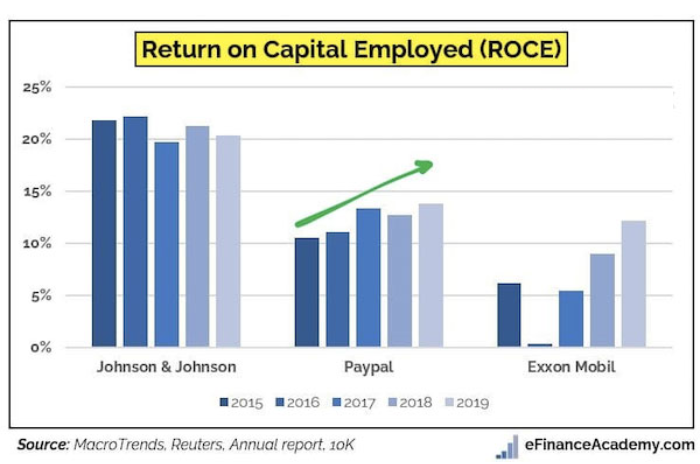
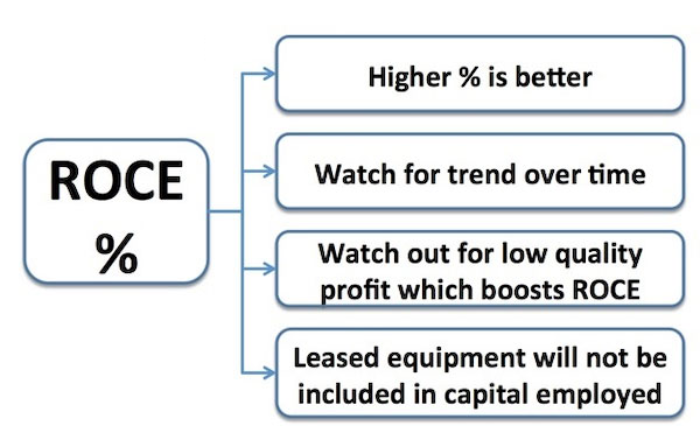
- A wise investor will look at the ROCE ratio over the years to assess how a company has performed in the past. Investors should only consider investing in companies where ROCE has been on an upward trend over the years.
- Investors should use ROCE to compare companies within the same industry and over the same time period.
- ROCE should be compared with the industry’s benchmark ROCE. For example, a company with a 20% ROCE looks better than one with a 10% ROCE. However, if the industry benchmark is 35%, both companies would be considered to have low ROCE.
The Difference Between ROCE and ROA
The Return on Capital Employed (ROCE) ratio and the Return on Assets (ROA) ratio are two similar profitability ratios that investors and analysts use to evaluate companies. The ROCE ratio is an extremely effective measure when evaluating and utilizing a company’s available capital.
The Formula for Calculating ROCE:
ROCE = EBIT / Capital Employed
Capital Employed is understood as the total assets minus short-term debt or the total equity plus liabilities. Therefore, it is similar to the Return on Equity (ROE) ratio, except it includes liabilities. The higher the ROCE, the more efficiently the company is operating, which means they can use their available capital to generate more profits.
The ROCE ratio is particularly useful and effective for comparing companies based on their capital intensity. A good ROCE figure for a company should always be higher than the average financial performance. ROA is similar to ROCE in that it can measure profitability and financial efficiency. The difference is that the ROE ratio focuses particularly on the efficient use of assets. The ROA ratio divides annual revenue by total assets to show how much revenue is generated per dollar of the company’s assets.
The ROA formula is as follows:
ROA = Net Income / Total Assets
A high ROA ratio is a strong indicator of growth, showing that the company is performing well and generating significant profits from working capital. Like other performance metrics, ROA is best used to compare similar companies within the same industry. The difference between ROCE and ROA is not large, but it is significant enough for investors to consider. Different income measures exist so that investors and analysts can assess a company’s performance from various perspectives, gaining a more comprehensive picture of the company’s net value, financial condition, and growth prospects.
That’s it! Now you’ve gained a detailed understanding of what ROCE is and tips for effectively using this ratio. I hope the information above is helpful to you. Wishing you success in your financial investment trades.

 XM
XM Bybit
Bybit Binance
 Robinhood
 Webull
 IC Markets
 Pepperstone
 OKX
OKX Vantage
 VT Markets
 BingX
BingX Gate.io
 Kucoin
 MEXC
MEXC Exness
 Bitget
