
 XM
XM Bybit
Bybit Binance
 Robinhood
 Webull
 IC Markets
 Pepperstone
 OKX
OKX Vantage
 VT Markets
 BingX
BingX Gate.io
 Kucoin
 MEXC
MEXC Exness
 Bitget
Have you ever heard of Spread in forex? It is crucial for traders to become familiar with exchange rate spreads as they represent the primary cost of currency trading. In this article, we will explore how forex spreads work, how to calculate the costs, and how to monitor spread changes to maximize your trading success.
1. WHAT IS SPREAD?
The spread is the price difference at which a trader can buy or sell an underlying asset. In the case of securities, it is the difference between the bid price and the ask price.
Below, let’s look at an example of the exchange rate spread for the GBP/USD pair. First, we take the buy price as 1.37843; then subtract the sell price of 1.37840, which gives us a result of 0.00003. Remember, the pip value for GBP/USD is determined by the fourth decimal place, which means the final spread is calculated as 0.3 pips.
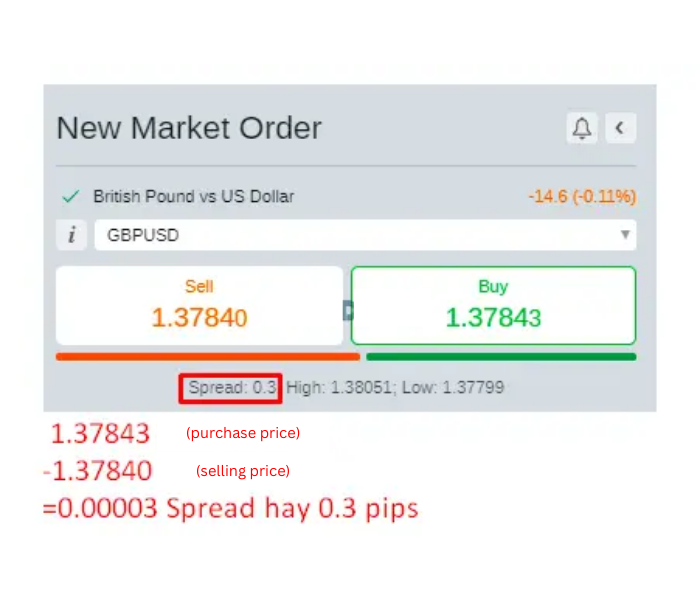
Now that we know how to calculate the spread in pips, let’s look at the actual cost traders have to bear.
2. HOW TO CALCULATE SPREAD COSTS IN FOREX
Before calculating the cost of the spread, remember that the spread is essentially the difference between the ask price and the bid price of a currency pair. Using the example above, for the GBP/USD pair, the spread is calculated as: 1.37843 – 1.37840 = 0.00003 or 0.3 pips.
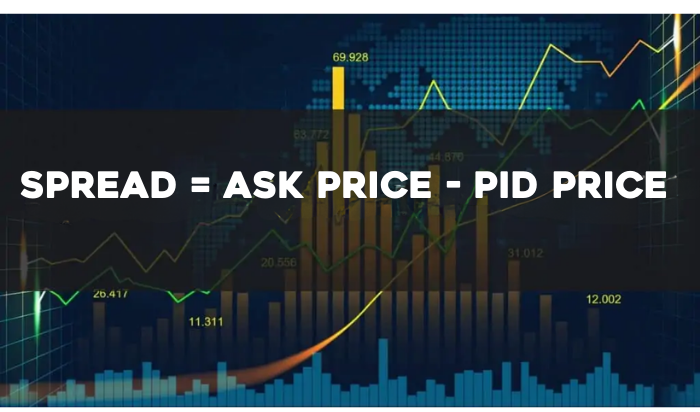
From the quote above, we can see that you can buy GBP/USD at 1.37843 and close the trade with the sell price at 1.37840. This means that as soon as the trade is opened, a trader will face a spread of 0.3 pips.
To find the total spread cost, we now need to multiply this value by the pip cost while considering the total number of lots traded. When trading a 10k lot of GBP/USD, the total cost would be 0.00003 (0.3 pips) × 10,000 (10k lot) = $0.30. If you’re trading a standard lot (100,000 currency units), your spread cost will be 0.00003 pips (0.3 pips) × 100,000 (1 standard lot) = $3.
If your account is denominated in another currency, such as GBP, you’ll need to convert it into US dollars.
3. CLASSIFYING HIGH AND LOW SPREADS
It is important to note that exchange rate spreads can change throughout the day, fluctuating between “high spreads” and “low spreads.”
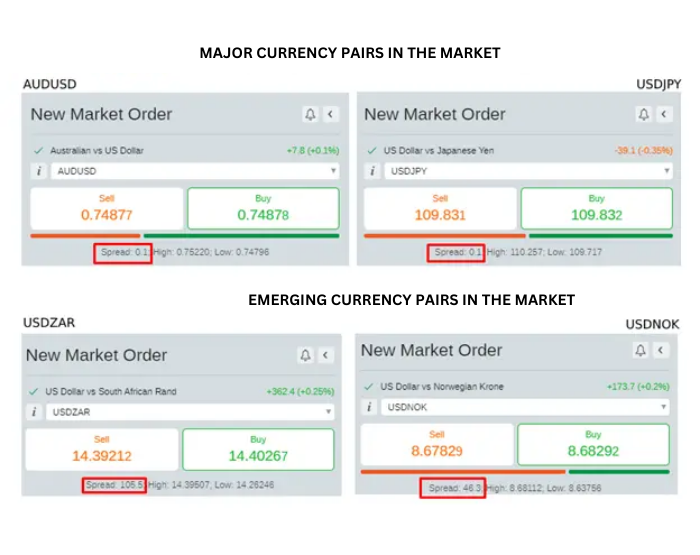
This is because spreads can be affected by various factors, such as volatility or liquidity. You’ll notice that for some currency pairs, like emerging market currencies, the spreads tend to be larger than for major currency pairs.
Your major currency pairs trade with higher volumes than emerging market currencies, and higher trading volumes usually lead to lower spreads under normal conditions.
Moreover, liquidity can dry up, and spreads can widen during major news events or between trading sessions.
3.1. High Spread
A high spread means there is a large difference between the bid and ask prices. Emerging market currency pairs typically have higher spreads compared to major currency pairs.
A higher-than-normal spread usually indicates one of two things: either the market is experiencing high volatility, or there is low liquidity due to off-hours trading. Before news events, or during major shocks (e.g., Brexit, U.S. elections), spreads can widen significantly.
3.2. Low Spread
A low spread means there is a small difference between the bid and ask prices. It is better to trade when the spread is low. Key trading sessions usually have lower spreads. A low spread typically indicates low volatility and high liquidity.
4. SPREAD TRADING STRATEGIES IN FOREX
4.1. Be Cautious of Widening Spreads
Traders should always be mindful of spreads because it is the main cost associated with forex trading. A higher spread will lead to higher trading costs.
When the market is volatile or when liquidity is low, combined with leverage, it can signal the end for a forex trader. Remember, the more leverage you use, the higher the spread cost will be relative to your account equity. Therefore, it is advantageous to use little or no leverage.
New traders, in particular, should be cautious of spread levels. If you have a small account size and take a large position relative to your account size, the spread could widen, and you could face a margin call or even have your position closed.
Here are three key techniques and strategies for trading spreads, which are a great way to learn the basics and ensure your forex trading success: monitor the factors affecting spreads, the liquidity of currencies, and the time of day.
4.1.1. Monitor Factors Affecting the Spread
To avoid high spread costs from widening spreads, traders should keep an eye on the following factors:
- Volatility: Market volatility due to economic data releases or a hot news event can trigger a very wide spread.
- Liquidity: A lack of liquidity in the market can also cause spreads to widen. Liquidity and volatility are two interrelated concepts. Liquid currency pairs, such as emerging market currencies, are typically known for having higher spreads. Illiquid markets can also lead to increased volatility.
- Spread and News Relationship: Before a major news event, such as the release of the Non-Farm Payroll (NFP) report, liquidity providers may widen their spreads to offset some of the risks the event causes.
Typically, the spread will revert to its average value after a few minutes, so traders should be patient and only trade when the spread stabilizes.
4.1.2. Choose High-Liquidity Forex Pairs
Another spread trading strategy that many traders—especially beginners—should adopt is selecting currency pairs with high liquidity. Normally, highly liquid pairs have lower spreads.
Major currency pairs such as EUR/USD (Euro/US Dollar), USD/JPY (US Dollar/Yen), GBP/USD (British Pound/US Dollar), and USD/CHF (US Dollar/Swiss Franc) will have the lowest spreads compared to all other pairs because they are traded in large volumes.
These currencies don’t always trade with low spreads, and they can be affected by volatility, liquidity, and news, which can lead to wider spreads during certain periods.
Emerging market currencies, such as USD/MXN (US Dollar/Mexican Peso), USD/ZAR (US Dollar/South African Rand), or USD/RUB (US Dollar/Russian Ruble), generally have higher spreads compared to major currency pairs. Therefore, traders would be wise to trade these pairs with less leverage or no leverage at all.
In the image below, the black boxes show the spread of certain currencies. Major currency pairs like USD/JPY and EUR/USD have spreads of 0.7 pips and 0.6 pips, respectively.
On the other hand, emerging market currencies like USD/ZAR and USD/RUB have extremely wide spreads of 90 pips and 1,000 pips, respectively.
4.1.3. Trading Hours During the Day
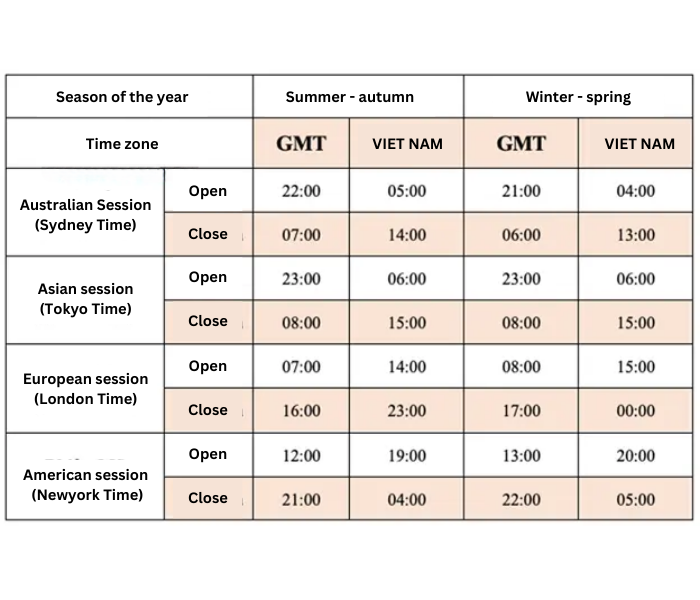
The time of day affects the exchange rate spread; therefore, this is something you should pay attention to when developing a trading strategy. During major market sessions like London, New York, Sydney, and Tokyo, the exchange rate spread is typically at its lowest due to high trading volume.
Traders can take advantage of these periods to benefit from lower spreads. When the London and New York sessions overlap, the exchange rate spread may become even narrower.
4.2. Trading with Spread in the USDJPY Pair
By combining all the trading techniques mentioned above, you can reduce risk when trading at high spreads. It is important to remember these steps when opening or closing a trade because the spread can change from the time you open a position until you want to close it.
Let’s look at a simple example using USD/JPY, one of the major currency pairs, meaning it has high liquidity and, therefore, a very low spread compared to other currency pairs.
4.2.1. Monitoring Factors That May Affect the Spread
When trading USD/JPY, we need to ensure that there are no shocking events or data releases that could affect the spread. You can do this by staying updated with the latest news and using an economic calendar.
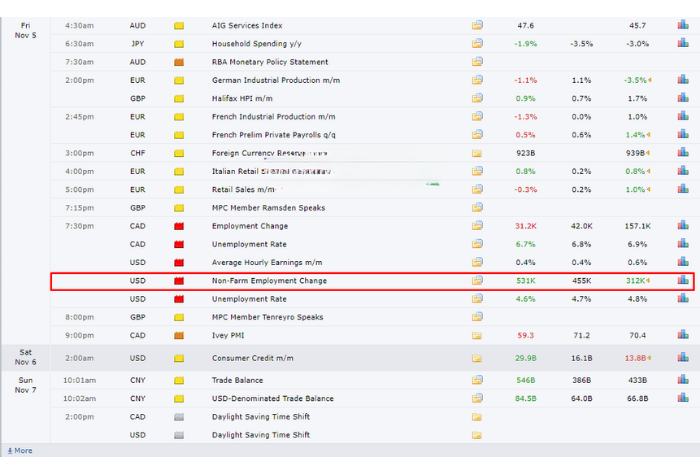
Here is an example from the economic calendar. Events with a “high impact” have the potential to increase the spread, so unless you are trading based on news, it’s advisable to trade outside of these periods.
Some events that can increase volatility and spreads include:
– GDP releases
– CPI (inflation data)
– NFP (Non-Farm Payrolls)
4.2.2. Considering Trading Times During the Day
We also need to consider the timing when trading USD/JPY, as this pair experiences significant volatility. One of the most liquid times to trade forex in general is when the London and New York sessions overlap. The USD/JPY pair also has high liquidity during the Tokyo trading session.
Emerging market currencies can experience extremely large spreads when traded during their respective major market sessions. When trading emerging market currencies, you should plan to trade them during times when the market is most active, as this is when they have the highest liquidity.
5. SUMMARY
Understanding forex knowledge and the nature of the spread fee will greatly help you in setting up a trading strategy and minimizing risks from the market. It is a basic term, but to understand it deeply is not easy, and once you grasp it clearly, everything will become simpler and more rewarding.
Wishing you success in your trading career!!!
- t.me/finance_solutes
- Website: https://finance-solutes.com
- Hotline: +1 929 5636 439 ( Hotline )
- 26 Broadway, Suite 934, New York, 10004, US
