
 XM
XM Bybit
Bybit Binance
 Robinhood
 Webull
 IC Markets
 Pepperstone
 OKX
OKX Vantage
 VT Markets
 BingX
BingX Gate.io
 Kucoin
 MEXC
MEXC Exness
 Bitget
There are many pathways for cash flow to enter the stock market, such as foreign direct investment (FDI) in various projects, government fiscal policies like capital disbursement, and bank interest rate adjustments, which also cause fluctuations in cash flow within the stock market. For example, government projects that disburse public investment capital also help the flow of money into stocks.
That is the macro perspective; professional investors often observe the overall economic context of both Vietnam and the world.
This article, however, will simplify the perspective for new investors entering the market, which is to observe cash flow into stocks through chart analysis.
Simply put, money is the lifeblood of the economy and a crucial factor in finance. In stocks, the flow of money into the market is an important indicator that helps you develop suitable investment strategies for effective profitability.
1. What is cash flow in stocks?
Cash flow is a general term referring to the movement of money into or out of a business, project, or financial investment product. In stocks, cash flow is used to examine supply and demand trends flowing into certain stock groups, thereby selecting good codes within that sector for investment and somewhat predicting future price movements.
2. Why is it important to know cash flow into stocks?
Trading stocks based on cash flow means investors look at the trend of money flowing into the stock market and which stock groups are receiving strong inflows, from which they select good codes within that sector to invest in. When trading stocks at a price higher than before, the difference is called positive cash flow. Conversely, negative cash flow occurs when subsequent purchase prices are lower than previous ones. When stocks are bought at the same previous price level, such trades do not create specific cash flow.
-
Stock valuation: Cash flow is considered one of the most important factors in valuing stocks. If cash is flowing into a stock, the stock price may rise, and vice versa, if cash is flowing out of a stock, the price may fall. Monitoring and analyzing cash flow helps investors assess whether a stock is correctly priced.
-
Identifying market trends: Cash flow in stocks also helps determine stock market trends. If money is flowing into the stock market, market value may rise; conversely, if money is flowing out, market value may decline. Monitoring cash flow helps investors make accurate decisions about market trends and adjust investment strategies accordingly.
-
Buy/sell decisions: Cash flow is also an important factor in making buy and sell decisions for stocks and bonds. If cash is flowing into a stock or bond, it is a positive signal and could be an investment opportunity. Conversely, if cash is flowing out, it is a negative signal, and investors should consider reducing investment weight or selling.
-
Adjusting investment strategies: Monitoring and analyzing cash flow helps investors adjust their investment strategies to suit market conditions. If cash is flowing into the stock market, investors may increase their allocation to stocks and bonds to optimize profits.
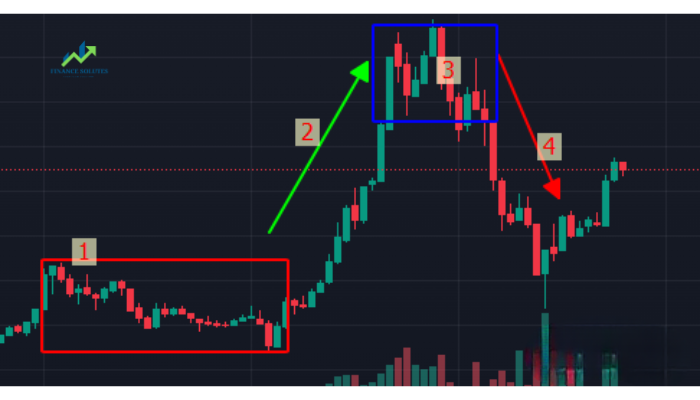
According to VSA (Volume Spread Analysis) – a method that analyzes volume and price spread – the cash flow in the stock market moves through four phases:
- 1- Accumulation: The stock price chart tends to move sideways, with narrow fluctuations and low trading volume.
- 2- Growth: The stock price tends to rise, price range expands, and trading volume increases significantly.
- 3- Distribution: The stock price continues to rise but shows signs of slowing down, even though the price range and liquidity remain high.
- 4- Decline: The stock price chart starts to drop with a significant decrease in price range, and liquidity gradually declines until supply runs out.
3. How to track cash flow into the stock market
To evaluate cash flow in stocks, investors can use different methods to identify it. Below are 2 methods to determine cash flow:
3.1 Identifying cash flow based on data
Determining the inflow of money into specific stocks helps investors spot buy–sell signals accurately. Investors can follow these 3 steps to detect cash flow into a stock:
- Step 1: Determine which cycle the stock is in. Typically, a stock goes through 4 stages: recovery, growth, leading, and weakening. The leading and weakening stages are not ideal times to buy.
- Step 2: Use indicators to trace strong buying flows and stable buying momentum. At this point, investors can sell to take profit.
- Step 3: Measure the strength of the cash flow.
Investors can calculate the strength and trend of cash flow using the formula:
PV = %P * V
Where:
-
%P: Price fluctuation over a certain time period (daily, weekly, monthly, quarterly, annually)
-
V: Trading volume in the corresponding period
-
PV: Corresponding value during the evaluation period. Depending on stock price movements, PV can be either positive or negative.
Example:
This index is calculated by taking the average value of the stock price (average of the highest price, lowest price, and closing price) and multiplying it by the daily trading volume. Cash flow will be clearly visible when comparing the average value with past data. At this point, investors can observe whether the cash flow is positive or negative, growing or declining.
| Stock A | Day 1 | Day 2 | Day 3 |
|---|---|---|---|
| Highest price (VND) | 50,000 | 52,000 | 55,000 |
| Lowest price (VND) | 45,000 | 47,000 | 51,000 |
| Closing price (VND) | 48,500 | 50,000 | 54,000 |
| Trading volume | 1,000,000 | 1,200,000 | 1,300,000 |
| Cash flow (VND) | 47,833,333,333 | 59,600,000,000 | 69,333,333,333 |
Thus, the cash flow of Stock A is growing. If this momentum continues over multiple trading sessions, it indicates that cash is flowing into Stock A. Typically, such a stock has high potential for price increase and strong liquidity in the near future.
3.2 Identifying cash flow using technical analysis
Investors monitor the price action and trading volume of a stock across successive sessions to assess the stock’s potential and to more accurately determine market trends in the near future.
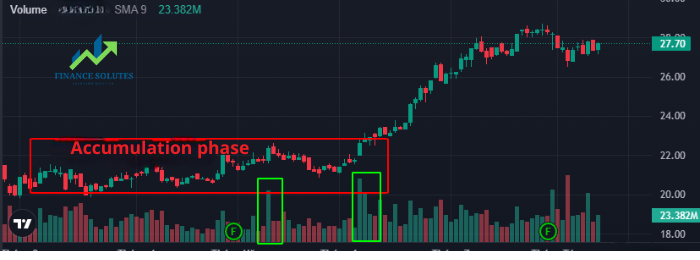
When the price range is narrow but trading volume increases, this is an excellent time for investors to accumulate shares. Investors don’t necessarily need to follow the price to increase or decrease trading volume.
When trading volume is high and the price range is wide.
When large buying volume is identified during a session, investors should take additional time to observe the market to accurately confirm the upcoming trend. Although the potential profit may be lower, it helps minimize risks. Conversely, when selling volume is significantly higher than buying volume, investors should consider selling part of their holdings if the stock price has reached a short-term support level.
When trading volume is low and the price range is wide.
If a stock’s price fluctuates within a wide range but trading volume is low, investors should not rush to make buy or sell decisions. This is a sign that there is no broad consensus among investors to push the price higher. On the other hand, when the price declines with large candle bodies but low trading volume, investors need to be cautious and deliberate in making decisions.
4. Pros and cons of trading based on money flow
The following evaluation of investing based on cash flow into stocks will help readers better understand the strengths and weaknesses of this method.
4.1 Advantages
- The method of investing in stocks based on money flow reveals the current direction of capital into specific stock groups. This trading style follows the crowd, resulting in lower risk levels for stock transactions.
- This strategy is not overly complicated and doesn’t require complex technical analysis. It is suitable for a wide range of investors, especially beginners with limited experience.
4.2 Disadvantages
- Investors may find it difficult to achieve breakthrough profits when investing solely based on money flow indicators.
- Money flow indicators are not the only factor reflecting future price trends of stocks.
- Risks related to monetary policy: The monetary policies of countries can cause major shifts in cash flow and affect the stock market. These fluctuations may pose risks to investors and lead to inaccurate investment decisions.
5. Conclusion
Investing based on money flow is a strategy trusted by many, whether they are new (F0) or experienced investors. This method partly eliminates the need to worry too much about risks or taking big chances. Money flow allows investors to identify which stocks are attracting market attention, thereby seizing opportunities to take profits. Overall, this approach is relatively simple, requires no complex analysis techniques, and is suitable for most investors—especially those new to the market.
However, it’s important to note that money flow represents a general trend. Therefore, “following the crowd” isn’t always safe and sometimes may not yield the desired returns. Moreover, heavy cash flow into a particular stock does not always indicate a future trend. Investors need to analyze additional indicators and gather more information to make more accurate investment decisions.
- t.me/finance_solutes
- Website: https://finance-solutes.com
- Hotline: +1 929 5636 439 ( Hotline )
- 26 Broadway, Suite 934, New York, 10004, US
