
 XM
XM Bybit
Bybit Binance
 Robinhood
 Webull
 IC Markets
 Pepperstone
 OKX
OKX Vantage
 VT Markets
 BingX
BingX Gate.io
 Kucoin
 MEXC
MEXC Exness
 Bitget
What is Bandwagon? This is a psychological term that explains many phenomena in areas such as music, fashion, and even in the financial markets. Additionally, it is associated with many related terms like “bandwagon effect” and “jump on the bandwagon.” Let’s explore this effect in today’s article!
1. WHAT IS BANDWAGON?
Bandwagon, in Vietnamese, is defined as a movement. It refers to a logic and argument that because something is popular or has become a trend, everyone should adopt or follow it. The term “Bandwagon” first appeared in 1849 and was used for a large wagon that carried bands during circus parades and political celebrations.

The term Bandwagon is generally used with a negative connotation. It explains that people are attracted to something simply because it is popular or endorsed by the majority. In this sense, it is quite similar to the crowd psychology effect.
Humans, or any group in society, tend to naturally identify with certain groups and fear the pressure of being excluded, isolated, or alone. Initially, following the crowd or agreeing with something because everyone else does may seem quite reasonable. However, it can also lead to consequences when widely popular things are not truly beneficial.
2. WHAT IS THE BANDWAGON EFFECT?
The Bandwagon Effect refers to the psychological tendency where people adopt an action, style, or attitude simply because others are doing it. As mentioned in the history of the term, it is also known as the train effect. This term belongs to the field of behavioral psychology and explains how people behave and make decisions.
The Bandwagon Effect reflects the psychological trend of individuals who believe they should follow a specific behavior or trend just because others are doing it. This effect strengthens and amplifies as more people get involved. The more people adopt a certain trend, the higher the chance others will also follow suit, without critically thinking about whether it is the right decision or not. As a result, the Bandwagon Effect leads to the development of another term: Jump on the bandwagon.
So, what does “Jump on the bandwagon” mean?
Simply put, “Jump on the bandwagon” is an idiom that refers to actions of following trends or popular movements that are currently in style or widely accepted.
2.1. Example of the Bandwagon Effect
A clear and familiar example of the Bandwagon Effect is seen in advertising campaigns. Marketers often use the Bandwagon Effect to influence consumer behavior. For instance, Oral-B’s dental care products are marketed with the slogan, “The brand most dentists and dental professionals use.”

When hearing this, the psychology of the user will automatically assume that because it is recommended by dentists and dental professionals, the product is widely used. Similarly, in the political realm, you may have been influenced by seeing that the majority of people are voting for a particular candidate. The very act of showing surveys about the number of votes leads many people to be influenced by the Bandwagon Effect, thinking that a certain candidate is being favored by most voters.
2.2. The Impact of the Bandwagon Effect
The Bandwagon Effect is observed in various fields such as psychology, politics, economics, etc., and the financial markets are no exception.
2.2.1. The Bandwagon Effect in Economics
Most of us are familiar with the principle that as prices rise, demand falls, and vice versa. This is a basic economic principle often taught in introductory university courses. However, according to an economist at the University of Chicago, if the Bandwagon Effect is strong enough, it can cause the demand curve that traditionally slopes downward to actually slope upward.
Let’s look at the following illustration to better understand this concept.
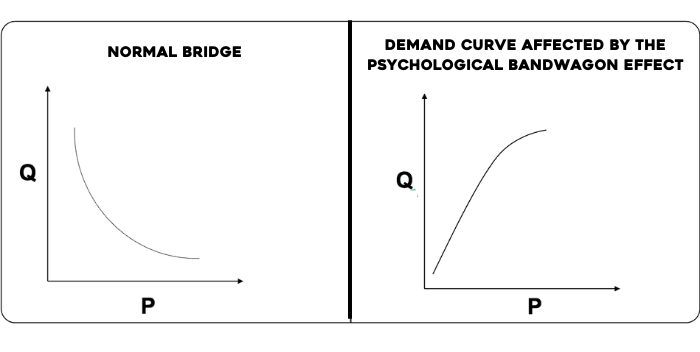
According to conventional economic principles, the demand curve for a typical product slopes downward, meaning that as prices increase, demand decreases, and conversely, as prices decrease, demand increases. However, when influenced by the Bandwagon Effect, the demand curve may shift to an upward slope. This suggests that even if prices rise, demand still increases.
2.2.2. The Bandwagon Effect in Investment
In the financial markets or in investment, the Bandwagon Effect is typically observed in two forms:
– Price Bubbles: This phenomenon often occurs in the stock market when the price of a popular stock continuously increases. The stock price can rise beyond normal economic principles, causing the stock to be overvalued. Price bubbles in stocks are often fueled by short-term speculators. Pushing prices up so high attracts many other investors, clearly demonstrating the Bandwagon Effect, herd mentality, and FOMO (Fear of Missing Out).
– Liquidity Black Hole: In cases of sudden news or events, market participants tend to stop trading until things become clearer. This reduces the number of buyers and sellers in the market, causing liquidity to drop significantly. This results in major price changes in assets.
For investors who have been in the market for some time, the “Black Monday” event in October 1987 is a well-known example, where we witnessed the historic collapse of the market as the Dow Jones Industrial Average dropped 22% in a single day. This collapse is believed to have been influenced by multiple factors, from economic news to portfolio insurance strategies.
However, a study has shown that this collapse was the result of the Bandwagon Effect. The survey indicated that investors were simply expecting a collapse without a specific reason. This was because they had portfolio insurance. The widespread popularity of this type of insurance is believed to have been the cause of the severity of the collapse event.
3. HOW TO AVOID THE BANDWAGON EFFECT
If you haven’t read about the “Black Monday” event mentioned above, you might still wonder about the negative impact of the Bandwagon Effect. However, not only in investment markets, but the Bandwagon Effect, when applied to health issues, can cause many more negative consequences. So how can we adjust and avoid the negative Bandwagon Effect?

First, we must always be aware that the Bandwagon Effect can influence our daily decisions, including investment decisions. Moreover, when deciding to do something based on a popular trend, ask yourself questions like: Is this really necessary? Will my life be affected if I don’t have this item? In terms of shopping needs, being aware of the Bandwagon Effect can help you identify the right time to buy or sell, avoiding unnecessary costs.
4. CONCLUSION
With today’s article on what Bandwagon is, you should now have a clearer understanding of what Bandwagon means, how this psychological effect impacts daily behaviors, as well as examples of the Bandwagon Effect in investment. It is also worth mentioning that this effect is not entirely negative. The Bandwagon Effect is quite an effective approach to persuade and promote meaningful strategies or campaigns.
- t.me/finance_solutes
- Website: https://finance-solutes.com
- Hotline: +1 929 5636 439 ( Hotline )
- 26 Broadway, Suite 934, New York, 10004, US
