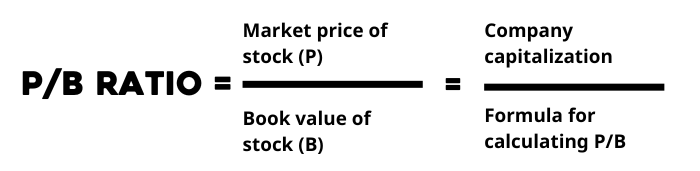
The P/B ratio is widely used today to determine how many times a company’s current stock price exceeds or falls short of its book value.
Specifically:
If the P/B ratio is low (P/B < 1):
- This suggests that the company’s stock is priced lower than its book value, which may indicate undervaluation or potential issues within the company.
- The high P/B is because the company is assessed to have good and faster growth prospects in the future, so there will certainly be many investors willing to pay a higher price. The company may have many hidden assets, diverse intangible assets such as real estate, patents, etc.
What is a Good P/B Ratio?
A question is raised that how to use and determine a P/B index, at what level is the best? most reasonable? To answer this question, let’s prove the following factors in turn: A low P/B ratio is not always good because it will depend on many other factors such as: profits, business lines, business growth rate, products, competitive advantages…

An example to help you understand better is that a P/B ratio is considered good for the IT industry (an industry with many intangible assets), but this is negative for the oil and gas industry. The P/B ratio is considered good when all factors combine together. The point is: the higher the P/E, the better if the company is currently on a strong growth trend. The P/B ratio does not need to be too high if the company operates in a quality-oriented business. At this point, the P/E is not too high, just over 1.
Low P/E ratios are good for companies with highly volatile markets, such as oil and gas companies. If you are a beginner, you should choose to invest in companies with P/E ratios from 0.7 to 1.5, because most companies with higher P/E ratios have higher risks. Meanwhile, companies with low P/B ratios can manage or respond to sudden changes or economic fluctuations more quickly. In addition, if a company is currently in an average business situation but has a high P/B ratio, investors should also carefully consider possible scenarios, and it is best not to buy stocks right now to limit other major risks.
Example of P/B Ratio
To help you better understand how the P/B ratio is calculated and how it is most effectively applied, here is a specific illustrative example of the P/B ratio:
Company A currently has assets worth 10 billion VND and liabilities of approximately 7.5 billion VND on its balance sheet. Therefore, the current book value of the company is calculated as: 10 – 7.5 = 2.5 billion VND.
The company has 10,000 outstanding shares, so the book value per share is calculated as:
2,500,000,000 / 10,000 = 250,000 VND. The market value of the stock is 300,000 VND.
Thus, the P/B ratio is: 300,000 / 250,000 = 1.2.
From this, we can see that investors have to pay 1.2 times the book value of the company to purchase a share of Company A.
Advantages and Disadvantages of the P/B Ratio
The P/B ratio is highly significant for investors. However, this ratio also has its own advantages and disadvantages that any investor or business should be mindful of when using it. Below, Traderforex will specifically analyze the two sides of this ratio for you.
Advantages
- Investors can use the P/B ratio to evaluate the condition and operational capability of loss-making companies, as the P/B ratio is usually positive.
- Compared to EPS, the P/B ratio is significantly less volatile. In volatile conditions, earnings per share (EPS) fluctuate sharply, making it difficult for investors to monitor and make judgments. In contrast, the P/B ratio is much more stable, allowing investors to observe and make more accurate assessments.
- Investors prefer the P/B ratio for analyzing and evaluating companies with substantial assets and high liquidity, such as investment firms, insurance companies, and banks. The P/B ratio is also highly useful for assessing companies that are expected to close or go bankrupt.
Disadvantages
- It is rare for a company to have a negative book value. However, if this occurs, the P/B ratio becomes ineffective in accurately estimating the company’s value. At this point, it can also be said that the P/B ratio is not very useful.
- The P/B ratio may not be comparable for companies from different countries with differing asset accounting systems. It is also challenging to quickly compare the P/B ratios of companies in different industries, especially those with significant intangible assets like intellectual capital, brand awareness, goodwill, etc., which outweigh the tangible assets recorded on the balance sheet. For example, companies like Apple, Microsoft, Google, and Facebook possess such large intangible assets that the book value becomes meaningless, rendering the P/B ratio ineffective for evaluation.
- Inflation and technological advancements can cause significant discrepancies between the book value and the market value of assets. In such cases, the price-to-earnings (P/E) ratio may not always serve as a reliable measure of shareholder investment value.
- Many companies still use book values from several years ago. As a result, these values may not accurately reflect the current market value of assets used in production.
Example: A plot of land used by a company two years ago may have increased tenfold in value today. Therefore, besides using the P/B ratio, investors should consider other combinations before making investment decisions in the company’s stocks. The P/B ratio is not effective when investors use it to evaluate rapidly growing companies.
Relationship Between P/B and ROE
Experienced and seasoned investors likely understand that there is a close and interconnected relationship between the P/B ratio and ROE (Return on Equity). According to research by various experts, ROE is considered the factor that has the most significant impact on the P/B ratio:

- The higher the ROE, the more favorable the companies offering a higher P/B ratio become, as they generate good returns from investments. As a result, investors are willing to assign higher valuations to the company’s stocks.
- Investors often pay particular attention to companies with high ROE and P/B ratios lower than the industry average. They believe that such companies are currently undervalued and could provide profits by purchasing the company’s shares.
The above provides a comprehensive overview of the P/B ratio that Forex aims to share with you. Hopefully, this information will be helpful in effectively using this metric for financial investment. Best of luck!

 XM
XM Bybit
Bybit Binance
 Robinhood
 Webull
 IC Markets
 Pepperstone
 OKX
OKX Vantage
 VT Markets
 BingX
BingX Gate.io
 Kucoin
 MEXC
MEXC Exness
 Bitget