
 XM
XM Bybit
Bybit Binance
 Robinhood
 Webull
 IC Markets
 Pepperstone
 OKX
OKX Vantage
 VT Markets
 BingX
BingX Gate.io
 Kucoin
 MEXC
MEXC Exness
 Bitget
What is Commission in Forex? In Forex trading, the commission, also known as the “phí hoa hồng” in Vietnamese, plays a crucial role in determining the net profit of a trader. So, how can one choose a quality Forex broker with low commission fees? To answer this and understand the characteristics of commission in Forex, let’s explore the following information.
What is Commission in Forex?
Commission is a fee that traders pay to brokers for executing trades, including opening and closing positions. When considering trading costs, commission and spread fees are the two main sources of income for Forex brokers, excluding other fees or charges.

In reality, when traders pay commission fees to Forex brokers, it is similar to when you transfer or withdraw money. In such cases, the bank charges a certain fee to carry out the transaction for the trader. Just as banks use transaction fees to pay employees or maintain operations, Forex brokers use commission fees in a similar manner.
Basic Features of Commission Fees in Forex
Typically, the commission in Forex averages around $7 per lot for both directions. This means that for a 1-lot trade, the commission will be $7, for 0.1 lots it will be $0.7, and similarly, for a 0.01 lot, the commission will be $0.07.
The reason it is called a “two-way trade” is because when a trade is executed, it involves both a closing and an opening position. Once the position is opened, any Forex broker will charge commission fees for both directions of the trade.
However, some Forex brokers may set commission fees differently based on the type of product. Commission fees can range from $7 per lot to $10 per lot. For example, the commission fee for Forex pairs differs from the commission for cryptocurrencies, stocks, etc. Typically, compared to other Forex pairs, gold will have a higher commission fee. Nevertheless, these fees are fixed for each type of product and do not fluctuate like accounts that only charge spread fees.

Accounts that charge commission fees typically offer spread fees that are much more attractive and lower than accounts that charge only the spread fee. This makes sense because, fundamentally, a Forex broker acts as an intermediary that receives trade orders from traders. Therefore, if a broker charges a commission fee, the spread fee must naturally be lower, and vice versa, to attract more traders to participate in trading.
Moreover, most accounts that charge commission fees generally require a higher minimum deposit compared to accounts that charge only the spread. Usually, the minimum deposit is between $50 and $200 at many brokers. In contrast, brokers like XTB, Exness, FBS, etc., only require a minimum deposit of $1 for accounts that charge only the spread.
Therefore, when traders engage in large-volume trades and prefer a scalping style, they should consider accounts that offer low spreads as the most attractive points. In such cases, traders should think about opening an account with commission fees. As a result, most accounts that charge only spreads are more suitable for novice traders, while professional traders tend to prefer accounts that charge commission fees.
Types of Accounts that Apply Commission Fees
To meet the needs of traders, Forex brokers today offer two main types of accounts: accounts that charge no commission, accounts that charge only spread fees, and accounts that charge commission fees. Typically, brokers name accounts that charge only commission as ECN/STP accounts.
The ECN/STP commission-based accounts in Forex, once they receive trade orders from traders, immediately send those orders directly to the market. At this point, the broker cannot interfere with the spread fee to “earn more” from traders. Simultaneously, when traders allow their orders to “swim” directly alongside other traders and liquidity providers, it means that the broker will collect a commission fee from these orders instead of charging a spread fee.
To find out the commission fee of a Forex broker, traders typically refer to the account information provided by the broker.
Based on the software provided by the broker, commission fees come in two forms:
- Commission fees for MT5/MT4 trading accounts.
- Commission fees for accounts that are under a trader’s management.

Currently, most Forex brokers charge commission fees via the MT4 platform, with the average fee ranging from $7 to $10, as shared earlier. Brokers rarely use the cTrader platform, and when they do, the commission fees tend to be higher than those on MT4. This is because the exchange rate of the currency pair impacts the value calculation at the time of opening and closing a trade.
Additionally, some Forex brokers offer attractive commission fee reductions for traders who have large monthly trading volumes. The more a trader trades, the lower the commission they have to pay.
Where Can You View Commission Fees in Forex?
As mentioned, when a trader places a trade and opens an account that charges commission, the broker will always display the commission fee for the entire trade. This fee is usually visible in the “running” area of the trades.
Currently, brokers also apply two types of commission fees:
- Fixed Commission Fee: The broker does not change the fee regardless of the trading volume. For example, each trade could have a commission of $1 for both opening and closing the trade.
- Variable Commission Fee: This fee depends on the volume of the trade, with the broker calculating the commission based on the amount. For example, each 1 lot trade could be $7 or $10 per 1000 lots. The trader pays a higher commission as the trading volume increases.
However, fixed commission fees are not as common today, with most Forex brokers now applying variable commission fees.
How to Calculate Commission in Forex?
Forex brokers typically apply commission fees for one side of the trade (per side). This means the fee is calculated only for either the opening or closing of the trade. However, in reality, the trader will pay the fee for a complete round-turn trade (both opening and closing a position to take profit or cut losses).
For example, ICMarkets offers a Raw Spread account with a commission of $3.5 per 1 lot. This is the commission for one side, and for a two-sided trade, the trader would pay $7.
Since most Forex brokers calculate commission fees for one side of the trade by default, traders should be aware that the examples provided refer to a per-side commission fee in Forex.
So, what is the formula for calculating commission in Forex? The current commission fee will be shown in three different ways and this will depend on each type of asset as well as each Forex floor.
- Commission = A $/lot
- Commission = A $/1 million $ traded
- Commission = A%/trade value
The first two methods are generally used for gold and Forex pairs, while the third method applies to stocks. To better understand how these calculations work, let’s look at examples using a default USD-denominated trading account.
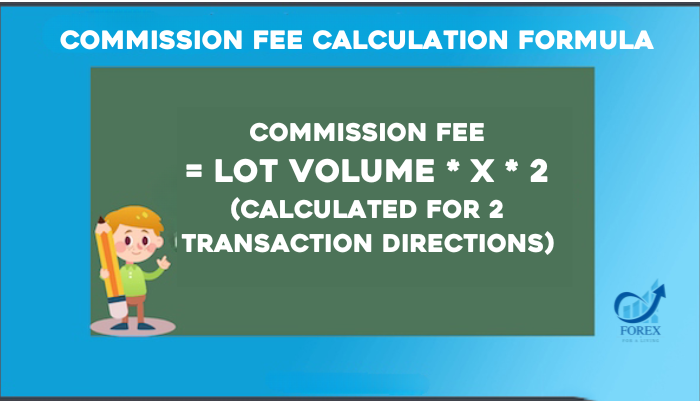
Commission = A $/lot
Commission Fee = Trading Volume in Lots * A * 2
For example, if a trader opens a Buy trade for the EUR/USD pair with a trading volume of 0.25 lots, and the commission fee applied to gold and all major Forex pairs is $3.5, the commission for this trade would be calculated as: 0.25 * 3.5 * 2 = $1.75.
This fee is immediately recorded and deducted from the trade’s profit or loss once the trade is executed.
Commission = A $/1 million $ traded
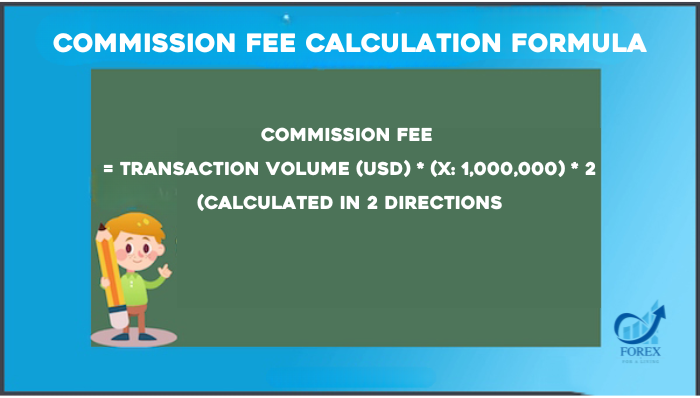
Commission fee = Trading volume in USD * (A/1,000,000) * 2
For example, with the USD/JPY currency pair, the trader opens a Buy order with a trading volume of 1 lot. At the same time, 1 lot = 100,000 USD, with the rule that 1 lot = 100,000 is the base currency. The commission fee will be $10 per 1 million $ traded. Therefore, the commission fee for this trade is: 100,000 * (10/1,000,000) * 2 = 2 USD.
Alternatively, another example with the EUR/JPY pair, the trader opens a Buy order with a volume of 0.05 lots. The commission fee for this transaction is $10 per 1 million $ traded. Therefore, the commission fee will be:
We have: 0.05 lots = 5,000 EUR. However, USD is the base currency of the account, so the trading volume must be converted into USD. When entering the EUR/USD trade, the exchange rate is 1.11500. So, we get 5,000 EUR = 5,575 USD. Finally, the commission fee is: 5,575 * (10/1,000,000) * 2 = 0.1115 USD.
Commission = A%/transaction value
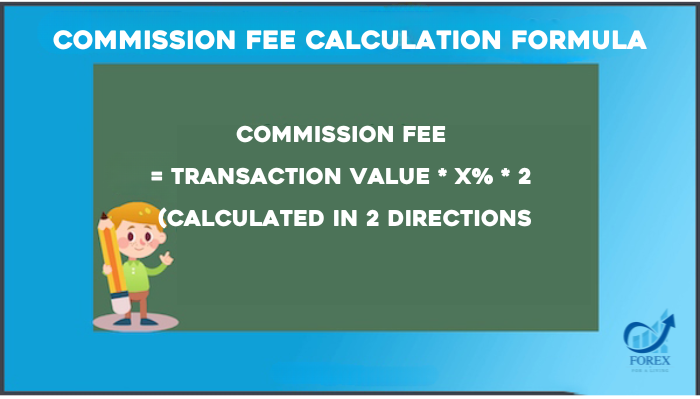
Commission fee = Transaction value in USD * A% * 2
With this method of calculation, an example would be opening a Buy order for Apple stock with a volume of 10 lots, where 1 lot = 1 share and the execution price is 320 USD. The commission fee is 0.2% on the transaction value.
Before calculating the commission fee, we first calculate the total transaction value of this order, which is 10 * 320 = 3,200 USD. Finally, the commission fee is: 3,200 * 0.2% * 2 = 12.8$.
Traders should note that if the Forex broker has a minimum commission fee rule, when the calculated commission fee is lower than the minimum, the minimum fee will apply.
For example, when a trader opens a Buy order for Apple stock with a trading volume of 2 lots and an execution price of 320 USD, and the commission is set at 0.2% on the transaction value with a minimum value of 8$.
The commission fee that the trader needs to pay for this order is: 2 * 320 * 0.2% * 2 = 2.56$ < 8$. Therefore, the commission fee for this order must be 8$.
Some Notes on Commission Fees When Choosing a Forex Broker
As mentioned, commission fees in Forex are a mandatory fee that traders must pay for each transaction. Therefore, they have a significant impact on whether a trader makes a profit or incurs a loss on each trade. If the commission fee is too high, the trader’s trade must achieve a high profit to cover the cost of the commission. This can heavily affect the trader’s mindset. Moreover, high trading fees over time will lead to a significant depletion of the trader’s account balance. Therefore, one of the key factors that traders need to keep in mind when choosing a Forex broker is the commission.
However, brokers don’t only charge commission fees from traders, but they also collect another important fee known as the spread.

For beginner traders just entering the market, there are several things to consider when it comes to commission fees in Forex when choosing a trading platform.
Example Calculation: If a trader opens a Buy order with 1 lot on the EUR/USD pair:
- Forex Broker A: Commission of $3.5/lot with an average spread of 1 pip to 1.5 pips.
- Forex Broker B: No commission, but with an average spread of 3 pips to 5 pips.
The total cost would be:
- Forex Broker A: Between $17 and $22.
- Forex Broker B: Between $30 and $50.
Traders can easily see the cost difference. This doesn’t even account for instances where spreads widen significantly or during periods of market volatility, where traders will incur much higher costs.
In addition, there is a third type of cost that is very important, which is the overnight fee – the swap fee. If a trader has a short-term trading style or day trading, the orders closed within the same day usually don’t need to worry about the swap fee, as this fee is only applied in cases where the orders are kept overnight.
However, for traders who engage in long-term trading, this type of cost definitely needs to be given attention. Especially, the fee can increase significantly if the trader holds positions for weeks or even months.
Why do some brokers no longer charge commission fees?
Commission fees in Forex are the fees paid to cover the cost of processing the opening and closing of orders made by traders. A large portion of this commission comes from the operational costs of the trading platform.
For some traditional brokers, the trading platforms they provide are often licensed from major software developers like MetaQuotes (MT5 and MT4 platforms) or Spotware (cTrader platform).

It can be seen that every month, these companies collect significant amounts in operating costs, maintenance fees, and licensing fees from brokers. Therefore, brokers have to charge traders commission fees to cover these costs.
So, what is the reason that brokers no longer charge commission fees?
Currently, with strong financial potential and capabilities, brokers have developed proprietary trading platforms specifically for their brands. These platforms tend to focus on new traders who require simple and user-friendly platforms, as well as professional traders who need a flexible, multi-functional platform that works anywhere.
With proprietary platforms, brokers can easily support traders with low or even zero commission fees. This also helps brokers enhance their competitiveness, and the transaction costs for traders are managed more easily.
How to trade with zero commission fees?
It can be seen that many brokers also aim to offer commission-free trading. However, it is not the only fee that traders have to pay to brokers. Therefore, traders need to pay attention to the following two points when trading with zero commission.
Choose brokers with zero commission fees
There are two types of brokers that allow traders to trade with no commission:
- Completely free commission fees for all trading accounts and assets.
- Free commission fees for certain accounts and assets.
Pay attention to other fees of the broker
When trading, net profit will be affected by other fees as follows:
Spread fees
Spread fees are the most common type of fee and can greatly affect the trader’s profit. Typically, spread fees can be either floating spread or fixed spread. Floating spread is often preferred and chosen by many traders as it allows easy entry with the most favorable fees for the trader.
Overnight fees
These are costs incurred when traders use leverage to amplify profits and simultaneously keep positions overnight. However, day traders will not need to pay overnight fees since their trades are short-term, day trading, or have a leverage ratio of 1:1.
Consulting/management fees
Many brokers in Vietnam (such as stock brokers) as well as foreign brokers will include this fee in trading robots or advisory costs. It is based on a percentage of the profit value or a percentage of the management value.
Inactive account fees
This is understood as the account maintenance fee, charged based on the assessment of the account’s activity annually, quarterly, or monthly.
This is an hidden cost that traders need to be aware of. In some trading platforms, this fee is not disclosed clearly or is absent. However, on average, it can range from $200/year or less.
Data registration and research fees
Most of these fees are not charged by professional brokers. However, some brokers that provide data and research will charge between $1 and $30 per month.
The article above shares and explains what commission in Forex is. Although commission fees are represented by just two numbers, they have a significant impact on net profit. Therefore, traders need to fully understand what Forex commission is and find a good and effective Forex platform with low commission fees.
- t.me/finance_solutes
- Website: https://finance-solutes.com
- Hotline: +1 929 5636 439 ( Hotline )
- 26 Broadway, Suite 934, New York, 10004, US
