
 XM
XM Bybit
Bybit Binance
 Robinhood
 Webull
 IC Markets
 Pepperstone
 OKX
OKX Vantage
 VT Markets
 BingX
BingX Gate.io
 Kucoin
 MEXC
MEXC Exness
 Bitget
In the Forex trading market, the ASIC license is highly regarded. When a brokerage firm obtains this license, it enhances its credibility and builds strong trust among traders. So, what is the ASIC license? Let’s explore the details of the Australian Securities & Investments Commission (ASIC) license with TraderForex.
What is the ASIC License?
The ASIC license stands for the Australian Securities & Investments Commission. ASIC is the official regulatory body responsible for licensing, overseeing, supervising, and managing financial sectors and related industries.
ASIC plays a crucial role in regulating financial services provided by companies while enforcing laws to protect the interests of consumers, creditors, and investors in Australia. The purpose of this is to ensure that the financial market operates transparently and fairly.
On July 1, 1998, the Australian Securities & Investments Commission (ASIC) was established based on the recommendations of the Wallis Inquiry. The authority and scope of the ASIC license were defined by the Australian Securities and Investments Commission Act in 2001.
How does the ASIC License Work?
As the Australian Securities & Investments Commission, ASIC is the regulatory body responsible for issuing its own licenses.
Originally founded in 1991 as the Australian Securities Commission (ASC), it was renamed ASIC on July 1, 1998, and has since grown into a powerful regulatory force.
ASIC operates as an independent Federal Government agency, established under the ASIC Act. Under this legislation, ASIC must meet the following requirements:
- Facilitate, maintain, and improve the efficiency of the financial system.
- Encourage knowledgeable and experienced investors to participate.
- Enforce regulations and manage financial laws effectively.
- Process and store information efficiently and promptly.
- Provide timely and relevant information regarding companies and other financial organizations.
What are the Objectives of the ASIC License?
The primary objective of the ASIC license is to ensure fairness between the financial firms under its regulation and other market participants, promoting a transparent and well-regulated trading environment.

ASIC is continuously striving to strengthen its regulatory framework and fulfill its obligations toward brokers by:
- Constantly facilitating improvements and enhancing the efficiency of financial systems and related departments.
- Establishing clear and highly effective regulations for financial companies and brokers while simplifying operational procedures.
- Ensuring transparency by publicly disclosing relevant information about organizations, agencies, or companies on its official website.
- Enforcing strict penalties on financial companies and brokers that violate its regulations or engage in fraudulent activities during trading processes.
- Promoting a safe financial market for traders while ensuring their rights and interests are protected throughout their investment journey.
What are the Requirements for Obtaining an ASIC License?
Similar to other globally recognized financial regulatory bodies such as FCA, FSA, CySEC, etc., the ASIC licensing process is highly stringent from registration to license maintenance.
As an independent financial authority, ASIC operates without influence from any other organization. Therefore, a forex exchange must meet strict criteria to obtain an ASIC license:
- The broker must have its headquarters or a representative office in Australia.
- To legally operate, brokers must hold an Australian Financial Services Licence (AFSL) and maintain a minimum capital requirement of 1 million AUD. This ensures financial stability and prevents the risk of bankruptcy.
- The trading platform must be modern and technologically advanced, with a competitive business model clearly outlined in the licensing application.
- Brokers must fulfill AFS membership obligations under ASIC supervision, including training, investor protection, compliance, and dispute resolution mechanisms.
How does ASIC Regulate Licensed Brokers?
Once a brokerage firm is licensed by the Australian Securities & Investments Commission, it must adhere to strict regulations to maintain compliance and transparency:
- Financial Transaction Transparency: ASIC requires brokers to submit regular audit reports and conduct daily, monthly, and quarterly account reconciliations. Non-compliance or fraudulent activities will result in immediate penalties or suspension of the broker’s license.
- Client Fund Segregation: Traders’ deposit funds must be completely separate from the broker’s operational funds and stored in top-tier Australian banks. This prevents money laundering and ensures that traders’ funds are securely managed.
- Risk Management Compliance: ASIC mandates brokers to establish and maintain a robust risk management system to ensure sustainable and efficient operations.
Forex brokers licensed by ASIC must strictly adhere to its regulations and obligations, including:
- Execution and disclosure of information in a transparent manner.
- Providing financial services as regulated by ASIC.
- Ensuring managers possess adequate knowledge, competence, and skills to oversee operations.
- Training and maintaining competitive expertise for financial advisors and authorized representatives of the brokerage firm.
- Ensuring financial advisors and authorized representatives comply fully with financial service laws.
- Managing conflicts of interest and risk governance to protect traders.
- Maintaining sufficient technological, financial, and human resources for smooth operations.
- Handling disputes and providing fair compensation to affected clients.
ASIC’s Disciplinary actions against violations
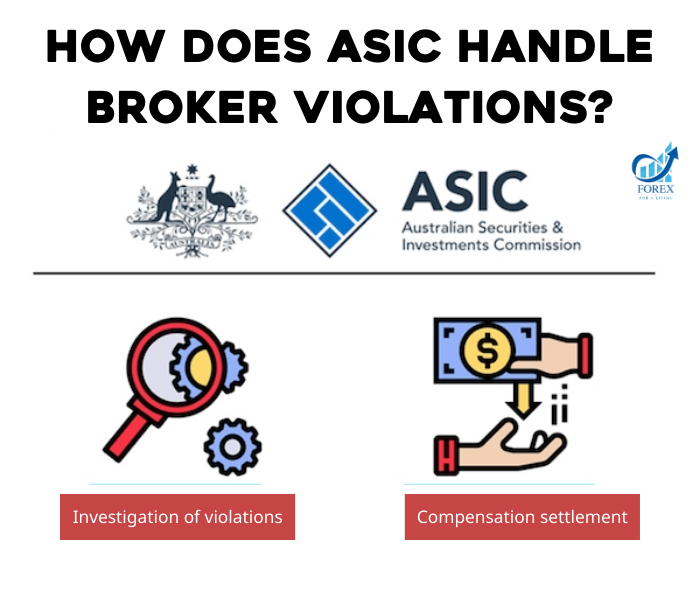
To enforce compliance, ASIC imposes strict penalties on brokers that violate regulations. These penalties are categorized into two main forms:
What happens when a Broker Becomes Insolvent or Bankrupt?
Under the Investor Compensation Schemes, traders have the right to file claims and complaints for compensation. A third-party insurance company will handle the claims and be responsible for compensating affected traders.
So, when platforms trade products, what is the task of the ASIC license?
While ASIC cannot act on behalf of individual creditors, it protects the collective interests of all creditors through these measures:
- Appointing external administrators and ensuring compliance with legal frameworks.
- Overseeing liquidation processes and those responsible for handling them.
- Providing regular updates on insolvent brokers on the official ASIC website.
- Implementing reforms and initiatives related to insolvency management.
What happens when a Broker Violates ASIC Regulations?
ASIC enforces its strict regulatory framework through various Federal agencies to handle trader complaints in the following order:
- Investigating alleged or suspected violations of regulations.
- Issuing violation notices to offending brokers.
- Imposing civil penalties to ensure compliance.
- Banning individuals from financial operations.
- Prosecuting those involved in financial crimes.
Why are ASIC-Licensed Forex Brokers considered trustworthy?
Brokers holding an ASIC license are considered highly reputable due to several key reasons:
- Strong business and financial foundation, transparent transaction process.
- Deposits will be kept separate and traders’ accounts will be kept safe.
- The risk management system is extremely strict.
- There is a mechanism to resolve disputes and compensate players – External Dispute Resolutions (EDR).
Thus, it can be seen that ASIC is currently the world’s leading financial management agency with an outstanding reputation. At the same time, this is also the agency responsible for strictly managing and supervising activities taking place in the financial market. Therefore, traders can completely trade with brokers that have been licensed by ASIC without having to worry about any legal issues or fraud.
How to check if a Forex Broker is ASIC-Licensed
With the power of the internet, traders can easily verify whether a broker holds an ASIC license through these steps:
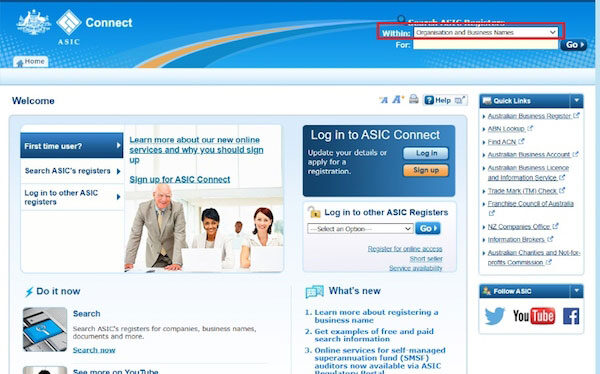
- Step 1: Go to the official ASIC license search portal.
- Step 2: Select “Organisation and Business Names”, then enter the license number or company name.
- Step 3: Click “Go”, and the system will display the broker’s license details. Compare the information with what the broker claims on its website.
By following these simple verification steps, traders can confidently choose ASIC-regulated brokers and trade with peace of mind, free from legal concerns or fraud risks.
Top 5 ASIC-Licensed trading platforms today
Currently, the number of trading platforms is increasing rapidly. Among them, the reputable platforms that hold an ASIC license are:
| Broker | Information | Features |
|---|---|---|
| Mitrade | Authorized by ASIC under license number 398528. Mitrade is headquartered in Australia and was founded by a team of professional CFD trading experts. | – No commission fees.
– Provides traders with the most advanced trading tools. – Diverse deposit and withdrawal methods. – Flexible and varied leverage ratios. |
| Etoro | Just a few months after being founded in Israel, Etoro received an ASIC license. Additionally, Etoro is licensed by several other organizations such as NFA, FCA, CySEC, etc. | – Free stock trading.
– A wide range of trading products. – Features modern copy trading. |
| ThinkMarkets | Regulated and controlled by ASIC under license number 424700. This Forex trading platform is highly popular and prominent in Asian countries. | – Offers protection in case the platform is no longer operational.
– Diverse trading products. – Various deposit and withdrawal methods. |
| IC Markets | IC Markets is a well-known name in Forex trading, licensed by ASIC and CySEC. | – Ideal for traders who prefer ECN.
– Low spreads. – Multiple deposit and withdrawal channels. |
| Pepperstone | Regulated by ASIC since 2013. Currently, Pepperstone operates in over 150 countries worldwide. | – Provides advanced and diverse trading tools and software.
– Fast order execution speed. |
Reputable Financial Licenses for trading platforms
CySEC – Cyprus Securities Exchange Commission
CySEC stands for the Cyprus Securities and Exchange Commission. This financial market regulatory body was established in 2001, with its headquarters in Cyprus. CySEC’s primary responsibility is to oversee companies providing administrative services.
The main objective of CySEC is to effectively regulate brokerage firms and stock exchanges. Additionally, this organization is responsible for auditing and conducting periodic inspections of trading platforms.
To obtain a CySEC license, trading platforms must meet the following basic requirements:
- For STP (Straight Through Processing) platforms, the initial capital requirement is €125,000, whereas Market Making platforms must have €730,000 in initial capital.
- A representative office must be located in Cyprus, with three senior executives who are Cypriot nationals and possess extensive knowledge and expertise in the financial sector.
- A customer compensation fund is required, ensuring traders receive compensation of up to €20,000 in case the trading platform goes bankrupt.
With these strict criteria, traders can be fully confident when investing in any trading platform that has obtained a CySEC license.
FCA – Financial Conduct Authority
The Financial Conduct Authority (FCA) is headquartered in the United Kingdom. Currently, the FCA oversees more than 56,000 organizations and 59,000 financial service companies. Like ASIC, the FCA is an independent authority separate from the government.
The primary goal of the FCA is to ensure the safety and stability of the financial industry by promoting competition, enhancing integrity, and providing appropriate protection for customers.

To obtain an FCA license, trading platforms must meet the following requirements:
- Forex dealers must have a minimum capital deposit of £730,000. Intermediary license holders must maintain a minimum deposit of £125,000. Restricted brokers are required to have a minimum deposit of £50,000.
- The FCA license is highly regarded and widely recognized worldwide. Therefore, trading platforms must meet strict requirements to obtain this license.
- A trading platform must have an official office in the UK and be led by local executives.
FSA – Financial Services Authority Seychelles
The FSA license stands for Financial Services Authority Seychelles. The FSA Seychelles provides tax-related and non-banking financial services for traders and businesses operating in Seychelles.
The primary objective of the FSA is to oversee business registration for international companies, monitor and regulate investment activities, and ensure financial stability. It also helps prevent unauthorized financial losses caused by brokers affecting investors.
CIMA – Cayman Islands Monetary Authority
CIMA stands for the Chartered Institute of Management Accountants. However, this certification is personal and does not serve as a licensing authority for companies or organizations.
In many countries worldwide, the CIMA certification is widely recognized. Besides ensuring compliance with investment safety standards, traders who obtain this certification gain extensive practical knowledge through fundamental professional training courses.
To enroll in a CIMA course, candidates must meet the following requirements:
- Must be at least 16 years old to participate.
- Required application documents include: Completed enrollment application form. University diploma in English (for graduates). Translated academic transcripts for each year of university studies. Other certified documents from relevant authorities.
- English proficiency requirement: Must hold a C-level English certificate or an equivalent qualification.
After successfully completing the course, learners will obtain the CIMA certification, which provides numerous career opportunities in corporate finance and management accounting. Additionally, with knowledge gained from basic to advanced levels, graduates can progressively become professional accountants.
Thus, Forex has just shared detailed insights about the ASIC (Australian Securities & Investments Commission) license in this article. It is evident that an ASIC license is a key factor in evaluating the reliability and quality of a trading platform.To invest with confidence, traders should choose Forex platforms that are ASIC-licensed and hold other reputable financial licenses.
- t.me/finance_solutes
- Website: https://finance-solutes.com
- Hotline: +1 929 5636 439 ( Hotline )
- 26 Broadway, Suite 934, New York, 10004, US
