
 XM
XM Bybit
Bybit Binance
 Robinhood
 Webull
 IC Markets
 Pepperstone
 OKX
OKX Vantage
 VT Markets
 BingX
BingX Gate.io
 Kucoin
 MEXC
MEXC Exness
 Bitget
Understanding the correlation between currency pairs is a fundamental concept that every Forex trader must grasp. Specifically, knowing how currency pairs correlate and how to use this information can help you make more effective trading decisions. In this article, we will also introduce a tool to help identify currency pair correlations. Let’s dive in!
What is currency pair correlation in Forex?
In the Forex market, the correlation between currency pairs is determined by the relationship between their values. Recognizing these correlations can help traders make informed predictions and smarter trading decisions.

In Forex trading, there are two primary types of currency correlations: direct correlation and inverse correlation.
Direct Correlation (Also known as positive correlation)
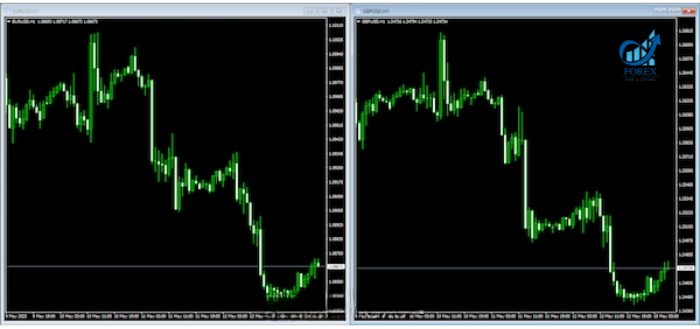
In a direct correlation, the values of two currency pairs move in the same direction. This means that when one pair appreciates, the other also rises, and when one falls, the other follows.
Example:
Typically, EUR/USD and GBP/USD share a direct correlation. If EUR/USD increases, GBP/USD is likely to rise as well, and vice versa—if EUR/USD declines, GBP/USD also tends to drop.
Inverse Correlation
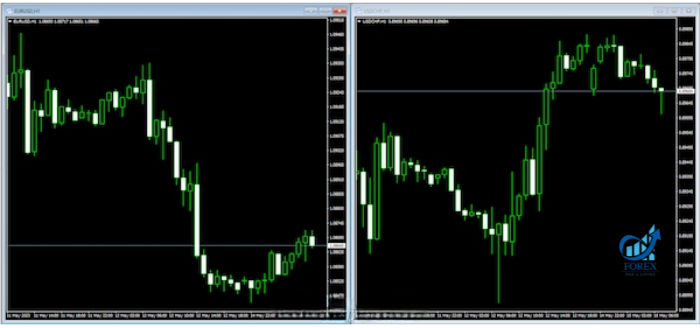
Opposite to positive correlation, in an inverse correlation, the values of two currency pairs move in opposite directions. This means that if one currency pair increases in price, the other will decrease, and vice versa.
Example:
Typically, EUR/USD and USD/CHF have an inverse correlation. If the price of EUR/USD rises, USD/CHF will fall, and if the price of EUR/USD drops, USD/CHF will rise.
The correlation between currency pairs can adjust over time and according to market conditions. This correlation is influenced by economic volatility, political events, news, and financial markets. Traders need to observe and study the market to understand current correlations and adjust their trading strategies accordingly.
What is the Correlation Coefficient?
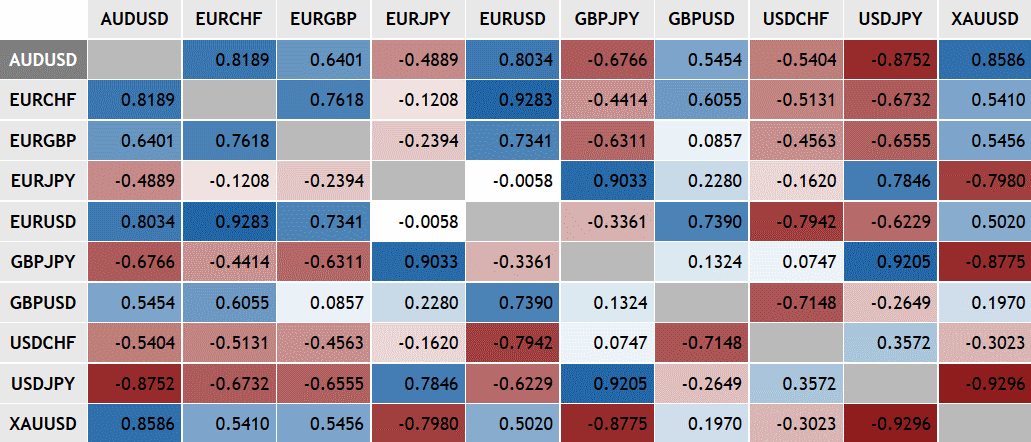
The correlation coefficient is a measure that reflects the strength of the relationship between currency pairs. These coefficients range from -1.0 to +1.0.
It is important to note that identifying exact coefficients at -1.0 and +1.0 can be challenging. However, values close to 1.0, such as 0.8 or 0.7, are more commonly observed.
The closer the number is to 1.0, the stronger the correlation between currency pairs (indicating how closely the asset prices move together). Conversely, the closer the correlation coefficient is to 0.0, the weaker the relationship between the currency pairs.
- A “+” sign indicates a positive (same-direction) correlation.
- A “-” sign indicates a negative (opposite-direction) correlation.
To accurately assess the correlation level between currency pairs, traders should set up a correlation coefficient matrix tool, as shown below:
What level indicates a strong correlation?
A correlation above +0.8 and below -0.8 is considered the strongest level of correlation. If the correlation index is equal to or close to 0, the currency pairs have no correlation at all.
Currency pairs with strong correlation in Forex
The table below lists the most frequently traded currency pairs with either a strong positive or inverse correlation.
| Pair 1 | Pair 2 | Correlation |
|---|---|---|
| AUD/USD | NZD/USD | Positive |
| AUD/USD | GBP/USD | Positive |
| EUR/USD | GBP/USD | Positive |
| GBP/USD | GBP/JPY | Positive |
| USD/JPY | GBP/JPY | Positive |
| EUR/USD | USD/CHF | Inverse |
| GBP/USD | USD/CAD | Inverse |
| GBP/USD | USD/CHF | Inverse |
| USD/CAD | EUR/JPY | Inverse |
| USD/CAD | AUD/USD | Inverse |
It is essential for every trader to observe market correlations. For example, a trader might mistakenly buy the USD/CAD pair and sell the EUR/JPY pair, assuming they have opened two separate trades. However, due to the strong inverse correlation between these currency pairs, they tend to move in opposite directions.
In this scenario, the trader would essentially be making almost the same trade. While this could result in profits from both positions, it also carries the risk of simultaneous losses, as USD/CAD and EUR/JPY have a strong correlation.
Forex correlation calculation tools
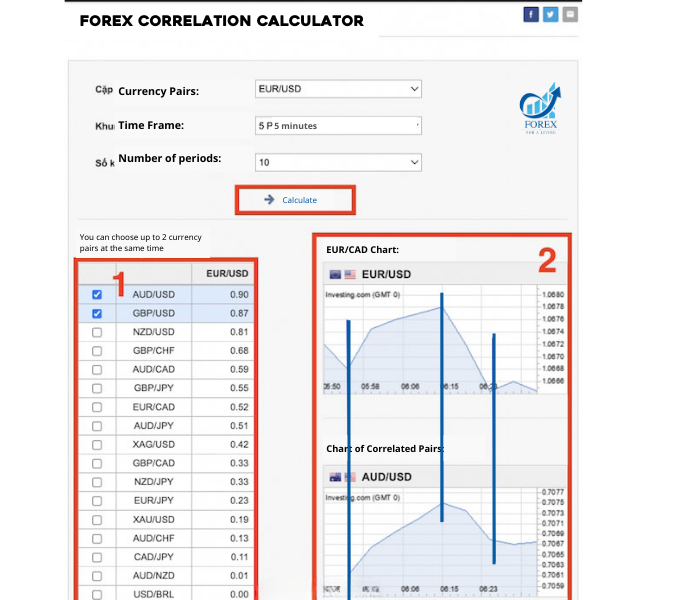
With advancements in trading software, traders no longer need to manually calculate and track correlation coefficients. Instead, they can use readily available software tools to compute correlations efficiently.
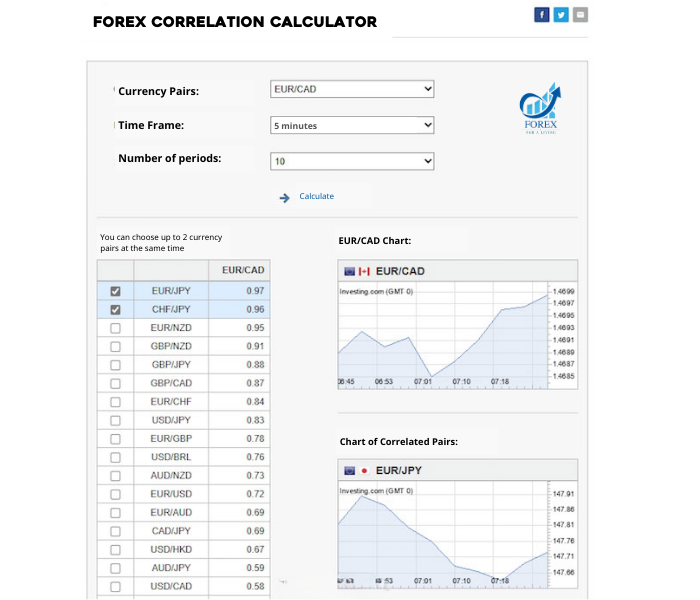
All you need to do is select the currency pair you want to analyze, and the tool will generate a correlation table and display a correlation chart.
Causes of correlation between currency Pairs
Currency correlation refers to the phenomenon where currency pairs move in the same or opposite direction over a specific period. Traders pay close attention to this correlation because it directly impacts their profits and risks in trading.

To talk about the causes of correlation between currency pairs in Forex, including:
- Impact of Economic Factors: Economic events can influence the value of a currency, indirectly affecting the correlation between currency pairs. Example: A weak economy in a country may lead to the depreciation of its currency, which can also impact the value of other related currencies.
- Impact of Political Factors: Political instability can influence currency values and, in turn, the correlation between currency pairs. Example: Major elections, trade negotiations, or geopolitical events can cause certain currency pairs to rise or fall.
- Impact of Market Factors: Fluctuations in the stock and commodity markets can affect the value of currencies and their correlations.
- Impact of Psychological Factors: Market sentiment and trader psychology also play a role in currency pair correlation, as emotions and expectations influence price movements.
Since these factors affect currency values, they also impact the correlation between currency pairs. Traders should consider these factors to determine the strength of correlation in Forex trading.
Correlation between commodity prices and currencies
Trade is one of the key reasons behind currency correlation in Forex. Countries need commodities for trade, and they purchase them using their own currency (increasing demand), creating a positive relationship between commodity prices and the currency of the exporting country.
When a country exports a commodity and its price rises, more money is needed to buy the same amount of that commodity. This leads to increased national revenue, strengthening the economy and boosting the value of the country’s currency.
Example: Canada is a major oil exporter, so the CAD has a strong positive correlation with oil prices. If oil prices rise, CAD strengthens, and USD/CAD tends to decline.
In this scenario, USD/CAD declines not because the USD weakens, but because the CAD strengthens due to rising oil prices. The USD may remain stable, increase at a slower rate than CAD, or even decline.
Consistency of currency pair correlation
To effectively trade using currency pair correlation, traders must assess the consistency of the correlation. A key question is: Is the correlation stable over time? Will the correlation still hold after you enter a position?
The Stability of Forex Correlation
The consistency of currency pair correlation depends on the economic relationship between the countries represented by the currencies .Example: The Eurozone and the UK have a strong economic partnership. As long as this relationship remains stable and continues to develop, the positive correlation between EUR/USD and GBP/USD will persist.
In the market, only time is unique, so when deciding to use correlation between currency pairs in trading, you need to pay attention to the correlation of the currency pair you choose. To check, there are two methods:
- Statistical check: By clicking on the forex currency pair correlation calculator and setting the parameters, you can find out which currency pair currently has the most correlation. You should set a large time frame and a long period of time to see it longer and have the strongest consistency.
- Check the basic factors: This is the main reason for the volatility of a country’s currency. Fundamental principles are usually examined and reported on a monthly, quarterly, and annual basis. The fluctuations of these macroeconomic indicators will be reflected in the currency and create correlations.
Besides the traditional economic factors of an economy, political and economic relationships between countries or the economic structure of a country (services, products, industry, etc.) can also form correlations for that nation’s currency pairs. When two countries have the same economic structure, stand on the same front, share the same goals, and act similarly, their currencies tend to be positively or negatively correlated.
Such relationships can be established or broken when a country’s direction and policies are adjusted. These policies and perspectives tend to adjust cyclically rather than daily, so you can stay updated through government communication channels and their policies, which are announced every six months or quarterly.
When should you use the trading method based on currency pair correlations?
Once you have identified the correlation between currency pairs in Forex and verified their consistency, you can fully incorporate them into your trading activities to improve your results. Professional traders often use correlation through the following strategies:
Hedging
Hedging in forex trading relies on strongly correlated pairs (both positive and negative correlations) to minimize trading risks. For positively correlated currency pairs, you enter a buy order for one pair and sell another. For a negative correlation, you buy or sell both currency pairs. It is important to choose currency pairs with a strong correlation.
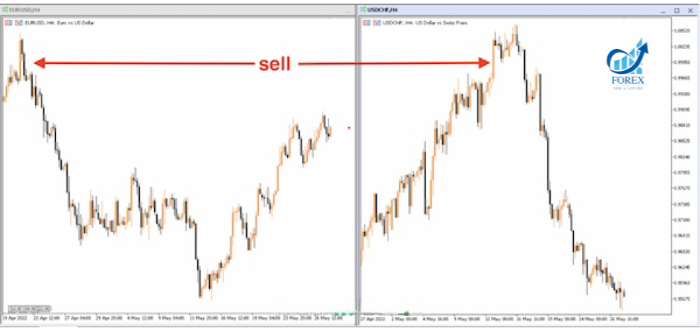
From the illustration above, you can see that when simultaneously executing a sell order (1 lot) with a negatively correlated pair to EUR/USD, you would gain approximately $101 when the price drops by 10 pips. Conversely, if the price increases by 10 pips, you would lose around $99 on the USD/CHF pair (when USD/CHF is at 0.99). In total, you make a $2 profit. In the opposite scenario, if you buy both pairs, you will lose $2.
Since the profits and losses from this method are relatively small, it is typically used by institutions and traders with substantial capital. Due to the large order volumes, even small profits can be significant for them.
Therefore, in real trading battles, it is not always about minimizing risk—sometimes, you must accept risk with good trading signals and hedge long positions with short positions in a strongly correlated currency pair. Remember that the correlation must be very strong because weakly correlated pairs tend to have significant lag, which could result in stop losses on both trades, even when used for hedging.
Risk Diversification
The risk diversification method involves splitting your positions among correlated currency pairs instead of placing orders on a single currency pair. This approach is based on the fact that, despite correlations, volatility can change, never being 100% identical or always having some delay. This provides an opportunity to manage your trades effectively and avoid total losses.
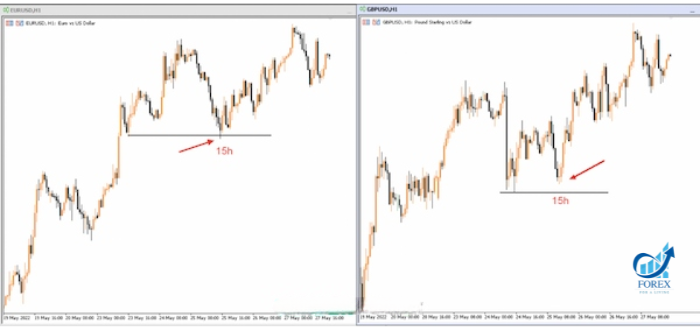
At 15:00 on May 25, 2022, if you did not have a buy order or a stop-loss order below the previous low, you would set a stop-loss for the EUR/USD pair. Instead of having two buy orders in both pairs, you keep one order with only a 0.5R stop-loss, while another order in the GBP/USD pair helps offset the loss from the EUR/USD pair.
Arbitrage Trading
Arbitrage trading arises from delays in correlation. In theory, when two pairs have a positive correlation, they move in the same direction. However, when they diverge or converge (meaning they move in opposite directions), this presents an opportunity for arbitrage trading. Unlike negative correlation, in this case, both pairs still move in the same direction.
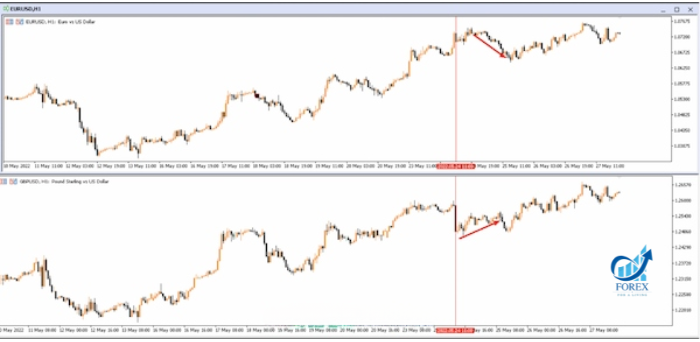
With the illustration above, based on theory, the EUR/USD and GBP/USD pairs move in the same direction. However, around 11:00 AM on May 24, 2022, a divergence formed, causing EUR/USD to rise while GBP/USD moved in the opposite direction. At this point, you could sell EUR/USD and buy GBP/USD, then wait for the prices to converge and take profit. In other words, it’s a quick-in, quick-out strategy.
This method is also applied when traders notice price discrepancies for the same currency pair across different trading platforms. However, with today’s advanced technology, such differences are often minimal and too small for retail traders like us to identify or profit from. These discrepancies are quickly detected and eliminated by the high-frequency trading (HFT) systems of large institutional traders.
One drawback of this strategy is that price discrepancies are rare and usually small. Therefore, multiple orders must be placed to generate decent profits. However, when an opportunity arises, you can be assured that the risk is minimal. To trade using this method, you need to select currency pairs with strong correlations and continuously monitor these correlations to avoid situations where they disappear, causing the pairs to move independently, which could result in significant losses.
Key considerations for currency pair correlations
Here are a few important points to keep in mind if you use currency pair correlations in forex trading.

- Correlation Is Not the Cause of Price Changes: The correlation between currency pairs does not equate to price changes. Understanding why a currency pair’s price fluctuates is complex and involves multiple factors.
- Correlation Is Not Always Accurate: The correlation between currency pairs is not always precise and can shift over time. Therefore, traders should periodically reassess currency pair correlations to stay updated with the latest market trends.
- Correlation Can Adjust Over Time: Currency pair correlations evolve due to changes in economic and political factors. As a result, traders need to stay informed about news and correlation shifts to make effective trading decisions.
- Correlation Does Not Guarantee Profitability: Currency pair correlation is not an absolute measure of profitability and should not be considered a flawless trading method. It should be used as a reference, while trading positions should be based on individual skills and experience.
- Technical Analysis Is Essential: Although currency pair correlations help traders predict market trends, technical analysis remains the most crucial trading tool. Combining correlation analysis with technical analysis is the most effective strategy for making informed trading decisions.
Through today’s article on currency pair correlation by Forex, you now have a clearer understanding of what correlation is and how to use this knowledge effectively in trading. We hope the information provided has answered all your questions on this topic. Wishing you successful trades!
- t.me/finance_solutes
- Website: https://finance-solutes.com
- Hotline: +1 929 5636 439 ( Hotline )
- 26 Broadway, Suite 934, New York, 10004, US
