
 XM
XM Bybit
Bybit Binance
 Robinhood
 Webull
 IC Markets
 Pepperstone
 OKX
OKX Vantage
 VT Markets
 BingX
BingX Gate.io
 Kucoin
 MEXC
MEXC Exness
 Bitget
If you have been actively investing in the cryptocurrency market over the past year, you are probably no stranger to Solana, also known as SOL, a sensation during the summer of 2021. To help investors and newcomers to the crypto market better understand this project and assess whether SOL coin has investment potential, Finace Solutes has put together the following article. It will explain the concept of SOL and provide detailed information about the Solana project—let’s dive in!
1. WHAT IS SOL COIN?
So, what is SOL token or SOL coin? It is a layer-1 blockchain coin. Let’s start by exploring the Solana platform to understand why it has attracted so many investors.
1.1 What is Solana?
Similar to Ethereum, Solana is both the name of a cryptocurrency and a flexible blockchain platform that serves as the foundation for developing and running crypto applications. Solana’s single-chain blockchain is the world’s first web-scale blockchain, enabling high scalability solutions.

The Solana project aims to achieve a high transaction speed of up to 65,000 TPS (transactions per second) with a block creation time of just 400ms, without compromising its decentralization. Solana stands out by combining the Proof of Stake consensus mechanism with the Proof of History algorithm.
The native coin of the Solana platform is SOL, which is used for transaction fees and staking purposes. Holding SOL also grants owners the right to vote on changes and upgrades to the platform in the future.
1.2 Key features of the Solana Project
The Solana project was founded by Anatoly Yakovenko and launched to the public in March 2020. Over a decade ago, Bitcoin became the first blockchain project in the world to solve the problem of financial transactions over the internet without the need for intermediaries like PayPal or Visa, and the blockchain technology of Bitcoin has truly demonstrated the feasibility of this decentralized transaction model.
However, transaction speed is one of the biggest drawbacks of decentralized transactions, and Solana is one of the networks with high processing speeds and scalability that can solve this issue, thanks to the Proof of History algorithm.
1.3 Proof of history consensus algorithm
Time consensus is arguably one of the biggest challenges in distributed systems. In fact, one of the functions of the Proof of Work consensus algorithm on the Bitcoin Blockchain is that it serves as a decentralized clock, which is considered the most important function because it proves both the existence and the order of transactions. For the Solana Blockchain, the Proof of History (PoH) algorithm also provides a similar function.
Decentralized networks have solved this issue with reliable, centralized time solutions. For example, Google’s Spanner uses atomic clocks synchronized across its data centers. Google’s engineers synchronize these clocks with extremely high accuracy and continuously maintain them.
This problem becomes even more challenging in systems like blockchain, where nodes in the network cannot fully trust an external time source or any timestamps appearing in the messages.
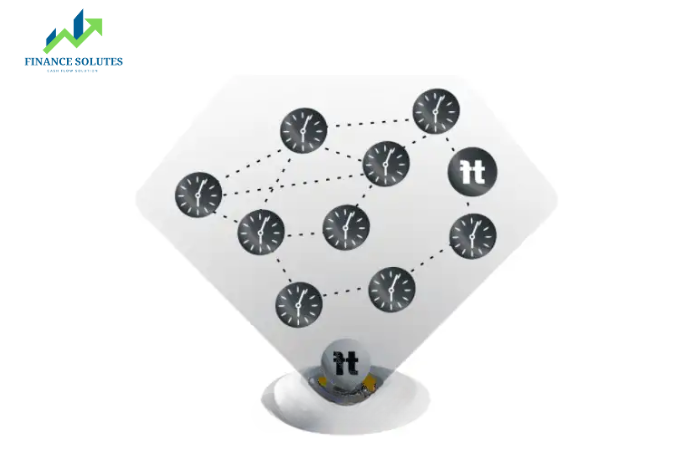
Using Hashgraph as an example, it solves this problem with an “average” timestamp. Every message detected by the network is signed and timestamped by the majority of network members. The average timestamp for a message is what Hashgraph calls a “logical” order. Each message must pass through most of the nodes in the system, then collect enough signatures, and then the entire setup is passed to the whole network, and clearly, this is a very time-consuming process.
What if, instead of trusting a timestamp, you could prove that the message appeared at some point before and after an event? When you take a picture with the New York Times cover in the background, you are providing proof that your photo was taken after the newspaper was published, or you have some way to influence what the New York Times publishes. With Proof of History, you can create a historical record proving that an event occurred at a specific point in time.
2. HOW DOES SOLANA WORK?
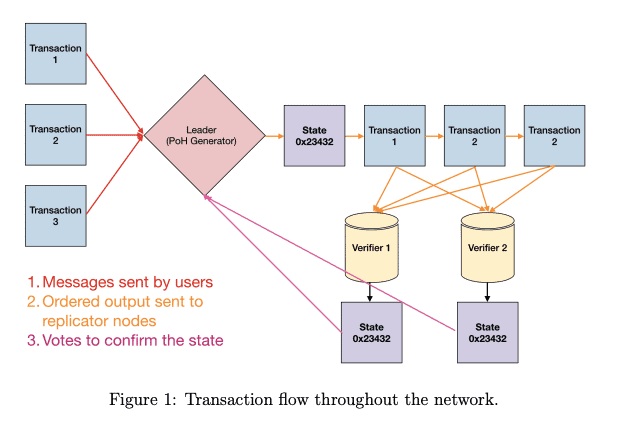
- Transactions are sent to the Leader (PoH Generator).
- The Leader’s task is to order the messages efficiently so they can be processed by other nodes in the network.
- The Leader then continues to perform transactions on the current state stored in RAM.
- The next Leader will output the transactions and final state signatures to the Validators (replicating nodes).
- Validators will then perform similar transactions on their replica states and publish their signatures about the state if the transaction is validated.
- The published confirmations will then serve as votes for the consensus algorithm.
3. SOLANA TOKEN
What is Solana token or SOL? Solana token is the native coin in the Solana ecosystem, so it can be used to transfer to nodes in the Solana cluster in exchange for running on-chain programs or validating their outputs.
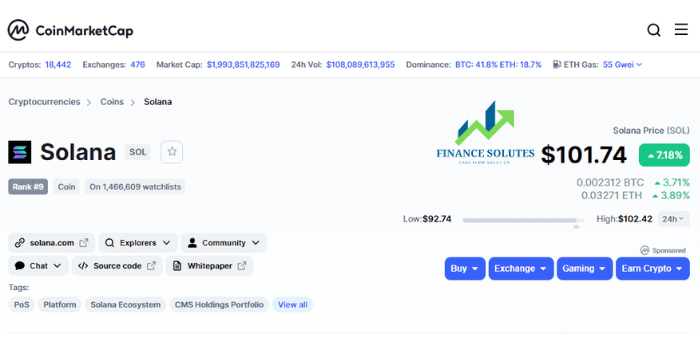
Another application for the SOL coin is to make micro-payments called lamports. The total amount of coins issued and circulating on the Solana market is 26 million SOL coins, with a maximum supply planned to be 489 million SOL coins. The current price of Solana CoinMarketCap is:
Investors who want to hold Solana tokens can also stake them to earn profits with the following basic steps:
- Transfer Solana tokens to a wallet that supports staking.
- Create a staking account.
- Choose a validator from Solana’s list of validators.
- Delegate your stake to the selected validator.
4. SOLANA ECOSYSTEM
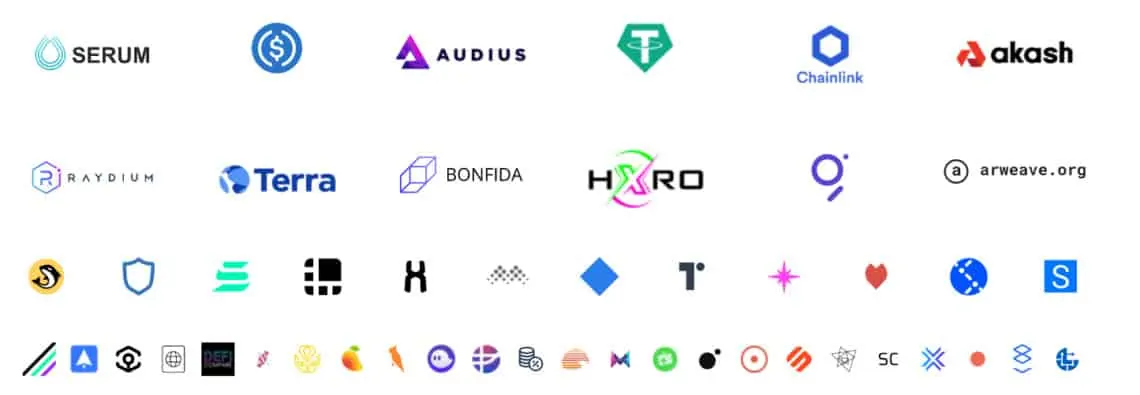
As mentioned earlier, Solana is a blockchain project, meaning there are many projects or applications that can be developed and operated on this blockchain, forming the Solana ecosystem. You can explore more about these applications on the official Solana website through this link: https://solana.com/ecosystem.
5. SOLANA WALLETS
5.1 Solflare Wallet
Solflare is an all-in-one cryptocurrency wallet that works both on the web and as a browser extension, designed for Solana tokens and SPL tokens. The Solflare wallet allows users to securely receive, send, and store tokens on the Solana blockchain, while also enabling integration and access from decentralized applications (dApps) on Solana.

5.2 Sollet Wallet
Sollet Wallet is an open-source web wallet designed for both users and professional developers, used to receive, send, or swap Solana tokens and SPL tokens.
6. SUMMARY
The article from Finace Solutes has provided a detailed explanation of what SOL is, along with fundamental information about the Solana project. It is evident that Solana addresses many major issues faced by earlier blockchain technologies, while also introducing a new solution for transaction verification with a more efficient consensus algorithm. The platform has the potential to become a significant competitor to blockchain projects like Bitcoin and Ethereum.
- t.me/finance_solutes
- Website: https://finance-solutes.com
- Hotline: +1 929 5636 439 ( Hotline )
- 26 Broadway, Suite 934, New York, 10004, US
