
 XM
XM Bybit
Bybit Binance
 Robinhood
 Webull
 IC Markets
 Pepperstone
 OKX
OKX Vantage
 VT Markets
 BingX
BingX Gate.io
 Kucoin
 MEXC
MEXC Exness
 Bitget
The COT report is a weekly sentiment report. It provides traders with crucial information about the positioning of currency pairs. Issued by the Commodity Futures Trading Commission (CFTC), the COT report can be aligned with traders’ core forex strategies.
The forex market is not the only market analyzed in the COT report. This report holds value for all traders.
1. ANALYZING THE COT REPORT IN FOREX
1.1. What is the COT Report?
The COT report from the Commodity Futures Trading Commission (CFTC) offers a unique insight into the positions of futures traders across various markets. It is often used as a representation of the forex trading market. In the weekly report, the U.S. regulatory body breaks down the overall long/short positions and open interest into three distinct trader groups. Knowing traders’ positions is valuable information for developing trading ideas.

The CFTC requires the largest futures traders in the world to report their positions. These positions are easily trackable because of the margin they must pay to hold such large positions, which the CFTC has published since 1962.
Since 2000, reports have been released every Friday at 3:30 PM ET. This information can be highly valuable for traders due to the nature of participants in the futures market. It includes institutions like hedge funds that participate to profit from the corresponding index.
Some of the world’s largest companies, with real-time data on economic health, enter the futures market to hedge against price volatility in raw materials they use for production. This allows traders to assess the market’s positioning at any given moment.
1.2. The Three Main Groups in the COT Report
Commercial Traders – These are typically large multinational corporations with commercial hedging interests in the corresponding futures market. For example, a major Japanese manufacturer might want to hedge against USD/JPY exchange rate fluctuations.
Non-Commercial Traders – This data usually relates to large speculators. They can be Commodity Trading Advisors and other similar large speculative institutions in specific futures markets. For instance, a large commodity fund might believe the U.S. Dollar will appreciate against the Euro, prompting them to bet on Euro forex futures.
Non-Reportable Traders – Non-Reportable Traders are those who don’t fit into the other two groups. Most are considered small speculators. These traders are seen as less significant and aren’t typically included in in-depth COT analysis. For example, this group includes leveraged traders with limited capital, who can be easily swayed by large market moves.
1.3. Overview of the COT Report
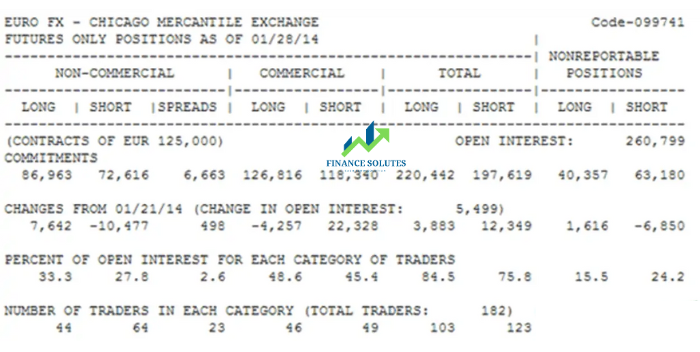
With these general definitions in mind, forex traders can decide how to apply this information. The image below illustrates a snippet of the COT report with the three main groups.
COT Report for EUR/USD Pair:
2. APPLYING THE COT REPORT TO TRADING
The first time you read the COT report, it might be hard to understand how future positions on USD, JPY, GBP, or EUR can be useful for trading EUR/USD, USD/JPY, or EUR/GBP. There is a lot to learn about the COT report, but the most useful insight is identifying where there is a strong divergence between large speculators and major commercial traders.
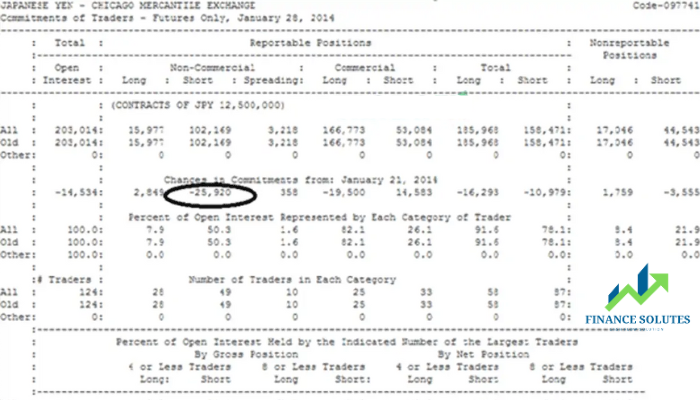
COT Report for USD/JPY:
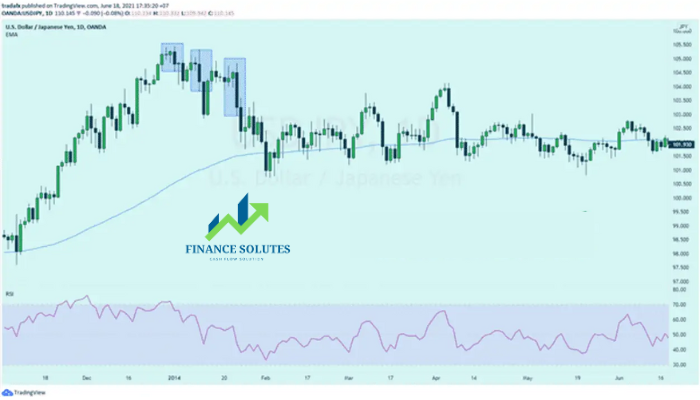
USD/JPY Chart Confirmation by Non-Commercial Organization:
The starting point is to clearly understand the “net positions” shown in the report, as well as the week-to-week differences in the main market trend (circled above).
The specific numbers are not overly important. What matters is a clear indication of the percentage of open interest. This makes it easier to identify when “Non-commercial” traders are moving against the main trend. Furthermore, when recognizing a significant shift in “Non-commercial” sentiment and seeing confirmation on the chart that the trend is weakening, traders are more likely to align their trades with those of large institutions.
3. SUMMARY
Hopefully, through this COT Report topic, you can identify chart assessments of how “Non-commercial” traders are positioning themselves. When a large percentage (greater than 10%) of these traders tends to move against their positions, it can offer valuable insight. Ultimately, traders can deepen their understanding of market sentiment. This also helps assess the example group of “Non-reportable” traders — the smaller traders positioned in the OTC forex market through the IG Client Sentiment Index, updated twice a day.
- t.me/finance_solutes
- Website: https://finance-solutes.com
- Hotline: +1 929 5636 439 ( Hotline )
- 26 Broadway, Suite 934, New York, 10004, US
