
 XM
XM Bybit
Bybit Binance
 Robinhood
 Webull
 IC Markets
 Pepperstone
 OKX
OKX Vantage
 VT Markets
 BingX
BingX Gate.io
 Kucoin
 MEXC
MEXC Exness
 Bitget
There is a strong correlation between interest rates and the forex market. The forex market is influenced by many factors, but currency interest rates can be considered the most fundamental and impactful. Simply put, prices tend to move in the direction of the currency flow with the highest real interest rate. Real interest rate is the nominal rate minus the inflation rate.
Forex traders must always monitor the central bank interest rates of each country, especially when interest rates are expected to change, in order to anticipate currency movements.
1. WHAT IS INTEREST RATE? THE IMPORTANCE OF INTEREST RATES TO THE FOREX MARKET
When traders talk about “interest rate,” they usually refer to the central bank interest rate. Interest rates are of primary importance to forex traders because when interest rates are expected to change, currencies typically move accordingly. Central banks have several monetary policy tools they can use to influence interest rates, most notably:

- Open Market Operations: The buying and selling of securities in the market with the aim of influencing interest rates.
- Discount Rate: The rate charged to commercial banks and other depository institutions for loans they receive from the Federal Reserve Bank’s lending facility in their region.
Central banks have two main responsibilities: managing inflation and promoting the stability of their country’s exchange rate. They do this by adjusting interest rates and managing the national money supply. When inflation rises above the central bank’s target, they raise the benchmark interest rate (using monetary policy tools) to slow down the economy and bring inflation back under control.
Economic Cycles and Interest Rates
Economies are always either expanding or contracting. When economies expand, everything generally improves. When they are in recession, things get more difficult. The goal of central banks is to keep inflation under control. They allow the economy to grow at a modest pace by adjusting interest rates.
When the economy is expanding – with positive GDP growth – consumers earn more money. More income leads to more spending. More money chasing fewer goods results in inflation. If inflation is left unchecked, it can be disastrous. That’s why central banks aim to cap inflation at around 2% (for most central banks) by increasing interest rates. Higher rates make borrowing more expensive, which reduces spending and curbs inflation.
If the economy is contracting – with negative GDP growth – deflation becomes a concern. The central bank lowers interest rates to encourage spending and investment. Companies start borrowing money at lower rates to invest in new projects. This boosts employment, growth, and eventually, inflation.
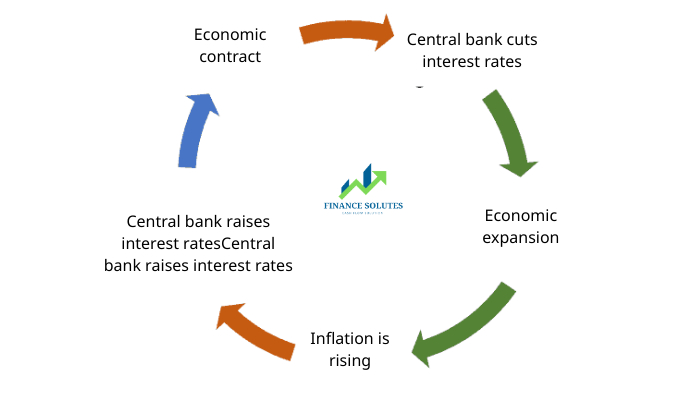
The cycle goes as follows:
2. HOW DO INTEREST RATES AFFECT CURRENCIES?
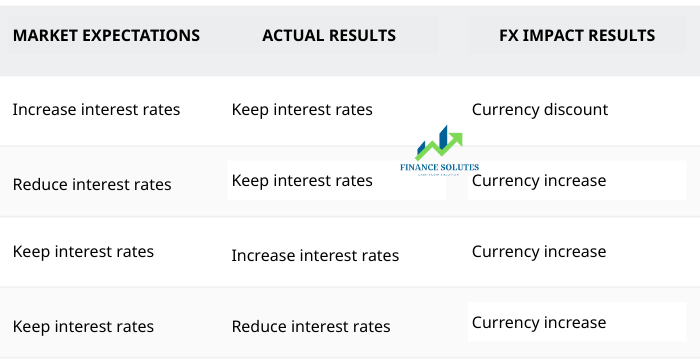
How do interest rates impact the forex market? Interest rates and the forex market are connected through changes in interest rate expectations, which lead to changes in currency demand. The table below shows possible scenarios resulting from changes in interest rate expectations:
The Relationship Between Interest Rates and the Forex Market
Imagine you are an investor in the United Kingdom. You need to invest a large amount of money in a risk-free asset—such as government bonds. Interest rates in the United States are rising, so you buy U.S. dollars to invest in U.S. government bonds.
You (the UK investor) are not the only one investing in a country with higher interest rates. Many other investors also track increasing yields. As a result, the rising demand for the U.S. dollar pushes up the currency’s value. This is the essence of how interest rates affect currencies. Traders aim to forecast changes in interest rate expectations, which can have a significant impact on currency values.
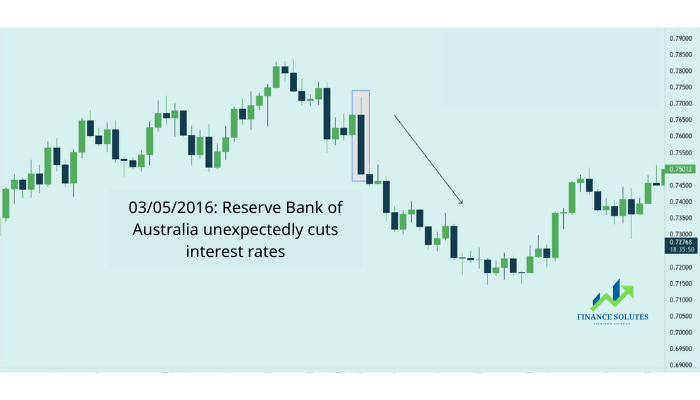
Here’s an example of what happens when the market expects a central bank to hold interest rates steady, but the bank unexpectedly cuts them. The Reserve Bank of Australia was expected to maintain interest rates at 2%, but instead lowered them to 1.75%. The surprise rate cut caused the AUD/USD exchange rate to drop.
3. UNDERSTANDING FOREX INTEREST RATE DIFFERENTIALS
An interest rate differential is simply the difference in interest rates between two countries.
If a trader expects the United States to unexpectedly raise interest rates, they may anticipate that the U.S. dollar will appreciate. To increase the chances of a successful trade, the trader might buy the U.S. dollar against a currency with a lower interest rate—because the two currencies are diverging based on their respective interest rate directions.
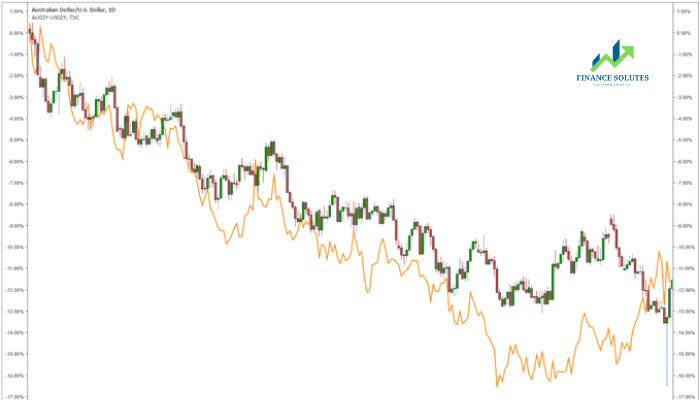
Interest rates and their differentials have a significant impact on the rise and fall of currency pairs. Changes in interest rate differentials are closely related to the appreciation or depreciation of a currency pair. This relationship is easier to understand when visualized.
The chart below compares the AUD/USD currency pair (candlestick chart) alongside the difference between the 2-year Australian government bond yield and the 2-year U.S. government bond yield (orange indicator). It shows that when the yield on Australian bonds falls relative to U.S. bonds, the Australian dollar also tends to depreciate.
Interest rate differentials are widely used in carry trades. In a carry trade, money is borrowed from a country with low interest rates and invested in a country with higher interest rates. However, there are risks associated with carry trading. For example, the invested currency may depreciate against the funding currency used in the trade.
4. HOW TO FORECAST CENTRAL BANK RATES AND THEIR IMPACT ON THE FOREX MARKET
Fed Funds futures are contracts traded on the Chicago Mercantile Exchange (CME) that represent the market’s expectations for the daily official federal funds rate at the time the contract expires. The market always forms its own projections about where interest rates are headed. At this point, a trader’s job is to forecast changes in those expectations.
To forecast central bank rates, traders need to closely monitor what central banks are currently watching. Central banks try to be as transparent as possible with the public about when they expect to raise interest rates and what economic data they are currently focusing on.
Central banks decide to raise or cut interest rates based on several key economic data points. You can stay updated on the release of this data by using an economic calendar. Inflation, unemployment, and exchange rates are some of the primary data points. A trader must stay in tune with the central bank’s policymakers.
This helps anticipate central bank actions before they are publicly announced, allowing traders to benefit from changes in market expectations. This trading method is based on a combination of fundamental analysis and technical analysis.
Forex Interest Rate Trading Strategy
Interest rates and the forex market – Forex traders can choose to trade based on the outcome of interest rate announcements. Currencies can be bought or sold at the moment the news is released.
Professional forex traders may try to forecast changes in central bank governors’ actions, which can influence market expectations. They do this by monitoring key economic indicators such as inflation and trading ahead of central bank speeches.

Another method is to wait for a currency pair to retrace after the interest rate decision. If a central bank unexpectedly raises interest rates, the currency is likely to appreciate. A trader may wait for the currency to pull back before entering a long position, anticipating that the upward trend will continue.
5. SUMMARY
- Interest rate decisions themselves tend to be less important than the expectations of future interest rate moves.
- Trading currencies with a widening interest rate differential can increase the likelihood of successful trades.
- It is crucial to stay updated with economic data using an economic calendar to forecast potential changes in market expectations.
- t.me/finance_solutes
- Website: https://finance-solutes.com
- Hotline: +1 929 5636 439 ( Hotline )
- 26 Broadway, Suite 934, New York, 10004, US
