
 XM
XM Bybit
Bybit Binance
 Robinhood
 Webull
 IC Markets
 Pepperstone
 OKX
OKX Vantage
 VT Markets
 BingX
BingX Gate.io
 Kucoin
 MEXC
MEXC Exness
 Bitget
As part of the series of articles compiling forex knowledge, when it comes to the Dow Theory and Elliott Waves in forex, traders are certainly no strangers to these two methods due to their popularity and effectiveness in technical analysis. However, many traders may not know that Dow Theory in Forex actually forms the foundation for the development of Elliott Wave Theory. These are extremely effective technical tools that traders are currently using. So, what is the correlation between Dow Theory and Elliott Waves? Let’s explore this in the following article with Finance Solutes.
1. OVERVIEW OF DOW THEORY
As mentioned in the previous article, Dow Theory is a set of principles that explain how financial markets move over time. There are six fundamental tenets of Dow Theory, introduced by Charles Dow in a series of articles written between 1900 and 1902.
Dow believed that the stock market is a reliable indicator of overall market conditions in the economy, and by analyzing this broader market, traders can gain detailed insights and identify the direction of the market’s primary trend.
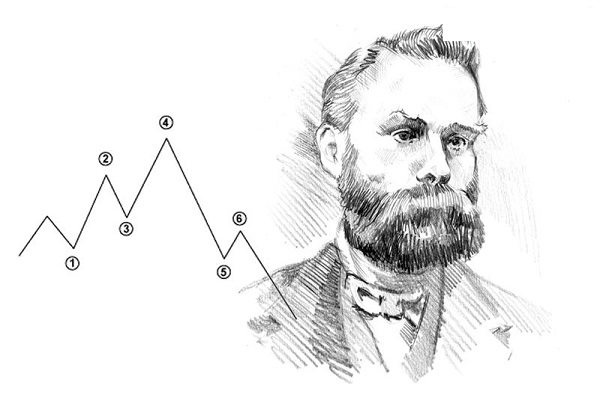
There are 6 fundamental principles of Dow Theory:
- The market reflects everything
- There are three types of market trends
- Major trends have three phases
- Averages must confirm each other
- Volume confirms the trend
- Trends continue until there is a clear reversal
This theory has evolved over its more than 100-year history. It includes contributions from William Hamilton in the 1920s, Robert Rhea in the 1930s, and E. George Schaefer and Richard Russell in the 1960s. Some aspects of the theory have gradually faded — such as its emphasis on the transportation and railroad sectors. However, Dow’s approach remains the foundation of modern technical analysis.
2. OVERVIEW OF ELLIOTT WAVE THEORY
Elliott Wave Theory is a progression from Dow Theory in the field of technical analysis. It can be applied to any asset or commodity such as stocks, bonds, currencies, gold, oil, and more.
The theory was proposed by accountant and market analyst Ralph Nelson Elliott in a study titled “The Wave Principle” published in 1938. He analyzed stock market data over many years using various indexes and was the first to forecast the bottom of the stock market in 1935. Since then, the theory has become a reliable tool for portfolio managers worldwide.
According to Ralph Nelson Elliott, the market always moves in repetitive cycles, influenced by investor emotions shaped by external factors or prevailing crowd psychology.
Elliott Wave Theory posits that market prices constantly move up and down in wave-like patterns formed by trader psychology. The market does not record political, economic, or social events themselves — instead, it reflects traders’ reactions to those events. Elliott wave patterns are considered to be repetitive, enabling traders to make predictions based on historical data. However, each trader may interpret the Elliott Wave structure of the market differently at any given time.
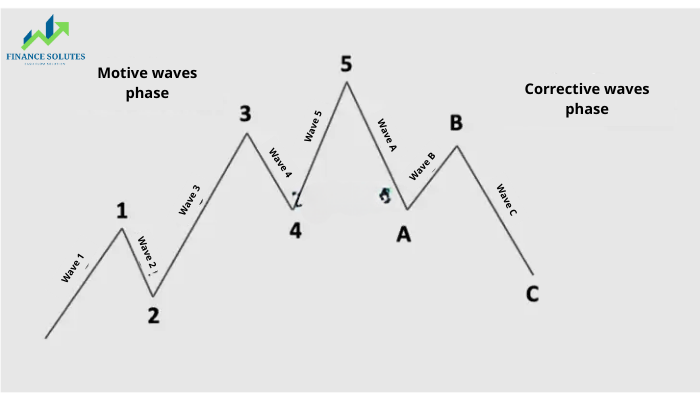
In his theory, Elliott identified two types of waves: motive waves (also known as impulse waves) and corrective waves. By observing these waves, investors can gain insights into ongoing trend dynamics and make deeper analyses of price fluctuations.
3. THE RELATIONSHIP BETWEEN DOW THEORY AND ELLIOTT WAVE THEORY
Through the analysis of Dow Theory and Elliott Wave Theory above, you may notice that they appear to have been developed independently, with each method possessing its own distinct characteristics and principles. However, in reality, Elliott Wave Theory is essentially an extension of Dow Theory, with the goal of making the identified upward or downward trends more measurable and specific.
While Dow Theory only laid out rather rudimentary concepts, it provided a substantial foundation by observing that market price behavior is not random and is closely tied to investor psychology. This very idea serves as the conceptual basis for Elliott Wave Theory.
Dow Theory in Forex describes a trending market; specifically, a bull market is composed of three distinct phases. Elliott Wave Theory builds upon this by adding alternating corrective phases and introducing five smaller waves within the trend.
Unlike Dow Theory in Forex, which is limited to primary and secondary trends, Elliott Wave Theory features a fractal structure that repeats at various degrees across different timeframes. The structure of Elliott waves can be used to analyze charts ranging from a few hours to multiple decades, according to the theory.
The relationship between Elliott’s concept of five advancing waves and Dow’s three upward phases during a bull market is largely compatible. However, Elliott went beyond Dow Theory and enhanced it significantly.
Thus, we can see that within Dow Theory and Elliott Wave Theory, Elliott’s development represents a major and meaningful advancement. This allows traders to apply Dow Theory more practically and effectively in real-world trading scenarios.
4. SUMMARY
Through today’s article, Finance Solutes has shared with you the relationship between Dow Theory and Elliott Waves in the forex market, and has demonstrated that the evolution of Elliott Wave Theory is a significant and meaningful advancement of Dow Theory. We hope that what Finance Solutes has presented will be helpful to you in your journey of investing and trading in Forex.
Wishing you success in your trading career!!!
- t.me/finance_solutes
- Website: https://finance-solutes.com
- Hotline: +1 929 5636 439 ( Hotline )
- 26 Broadway, Suite 934, New York, 10004, US
