
 XM
XM Bybit
Bybit Binance
 Robinhood
 Webull
 IC Markets
 Pepperstone
 OKX
OKX Vantage
 VT Markets
 BingX
BingX Gate.io
 Kucoin
 MEXC
MEXC Exness
 Bitget
Should You Invest in Fund Certificates or Directly in Stocks?
This is a common question for those who are just learning about fund certificates. The article below will help investors understand an overview of what fund certificates (CCQ) are and how to participate in them.
1. What is a Fund Certificate?
Simply put, investors with idle money who want to put their funds into investments contribute capital to form what is called an investment fund. A fund certificate – CCQ – is a type of security that certifies an investor’s ownership of a portion of the contributed capital in a securities investment fund.
The public offering price of a fund certificate is VND 10,000.
The issuing entity is the securities investment fund.
(Clause 4 Article 4, Clause 2 Article 13 of the 2019 Securities Law)
By purchasing fund certificates, you become a “contributor” to that fund. The value of these certificates will increase if the fund performs effectively, and vice versa.
There are two types of fund certificates:
1.1 Closed-end Fund Certificate
A closed-end fund certificate means the fund will not repurchase the certificate when the investor wants to sell. The fund is not allowed to reissue the certificate under any circumstances. The operating term of a closed-end fund is also limited and agreed upon at the fund’s establishment. To ensure liquidity, these certificates are listed on the stock exchange or traded over-the-counter (OTC) like regular stocks after the fundraising period ends (also known as fund closure).
A closed-end fund issues its fund certificates only once during the fundraising phase.
1.2 Open-end Fund Certificate
An open-end fund certificate is an indirect investment method in the form of purchasing fund certificates from an open-ended fund. Investors can earn profits by selling the certificates back to the fund management company as needed, which enhances liquidity and reduces risks.
The value of each certificate corresponds to the value of the assets in the fund. The fund’s asset value fluctuates over time depending on investment performance. Investors can buy fund certificates to participate or sell them to exit the fund.
2. What is the Maturity Term of a Fund Certificate?
Fund certificates are non-fixed-term investments, meaning investors can sell them at any time. However, they are generally considered long-term investments (over 12 months), since time is needed for the fund to study the investment portfolio and for the assets to grow sustainably.
3. What are the Differences Between Fund Certificates, Stocks, and Bonds?
| Feature | Fund Certificate | Stock | Bond |
|---|---|---|---|
| Nature | – A means to establish a securities investment fund- The fund’s core business is investing in securities | – Equity security- Stockholders are owners of the issuing company | – Debt security- Bondholders are creditors to the issuing company |
| Issuing Entity | Public fund – Investment fund issuing to the public | Joint-stock company | Government, enterprises |
| Ownership Role | Only a member of the public fund | Shareholder of a joint-stock company | Not a company member; bondholder is a creditor |
| Ownership Rights | No voting or management rightsAll rights handled by fund management company | – Participate in company operations- Vote at shareholder meetings, nominate, run for board | No operational rightsNo voting, nomination, or candidacy rights |
| Issuance Outcome | Raised capital to establish an investment fund | Increases company capital | Increases company debt, creates repayment obligations |
| Returns | Earn returns from the contributed capital | – Receive dividends- Dividends are variable, based on business performance | – Fixed interest income called bond yield- Independent of business performance |
| Investor Decision Power | No decision-making power – all handled by fund managers | Investors manage and make their own decisions | Investors decide based on their own evaluation |
| Risk Level | Lower risk – decisions are made by experienced professionals | High risk | Usually low risk, depends on the issuing enterprise |
| Investor Duties | Fund manager buys/sells assets on investor’s behalf – no intervention allowed | Investor must evaluate, manage and seize opportunities | Same as stock investors – evaluate and act timely |
4. Fund Certificate Interest Rate – How to Calculate Returns from CCQ
The value of fund certificates increases when the fund invests efficiently, and decreases when it doesn’t.
No fund management company can guarantee a fixed rate of return for investors. Once you buy fund certificates, you share in both the gains and the potential losses. Although there are risks, they are monitored and minimized. Therefore, investors should take time to research and consider thoroughly before investing.
Fund return is calculated as:
Profit = (Selling NAV – Average Purchase NAV) × Quantity of Fund Certificates Sold
Where:
- NAV: Net Asset Value
- Average Purchase NAV = Total Purchase Amount / Number of Fund Certificates Held
Example: You register to purchase Fund A certificates monthly at VND 10 million:
| Month | Amount Invested (VND) | NAV (VND) | Fund Certificates Acquired |
|---|---|---|---|
| Jan | 10 million | 20,000 | 500 |
| Feb | 10 million | 19,000 | 526.32 |
| Mar | 10 million | 18,000 | 555.56 |
| Total | 30 million | 1581.88 |
Average Purchase NAV = 30 million / 1581.88 CCQ = 18,964.77 VND
Assuming selling NAV = 21,000 VND
Profit = (21,000 – 18,964.77) × 1581.88 = 3,219,489 VND (assuming no fee)
Note: Fund returns depend on market conditions and the fund manager’s performance.
5. How to invest in Fund Certificates?
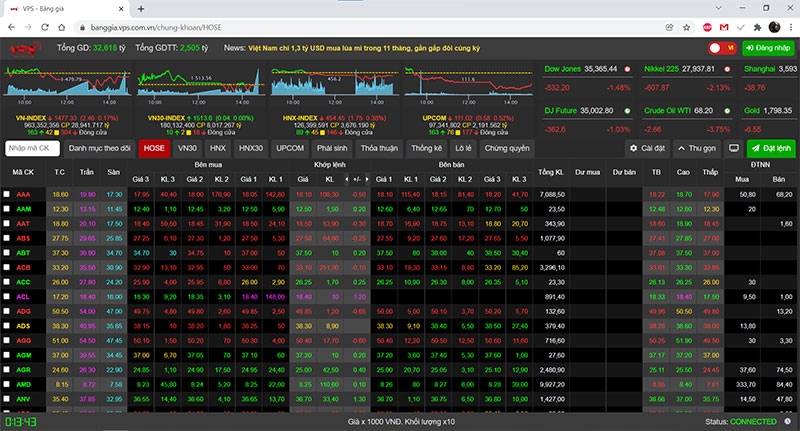
Fund certificates are listed on the stock exchange just like stocks. You can access the investment product section to see a variety of listed fund certificates available for investors to choose from.
5.1 How to choose an investment fund
There are several factors to consider when evaluating the performance of an open-ended fund. The investment portfolio, management team, and investment strategy all need to be assessed. A fund that generates good returns often has the following characteristics:
-
A large proportion of the portfolio consists of high-growth stocks and valuable fixed-income assets. This can help ensure the fund’s profitability and indicates that the fund is performing well.
-
A clear and flexible investment strategy. Objectives and directions should be clearly outlined and aligned with market conditions.
-
Bond funds are typically stable and offer fixed income.
-
The fund is managed by a professional, experienced team. Fund performance reports should show positive returns. In addition, the performance trend should show gradual improvement over time.
Moreover, since the stock market is highly volatile, reviewing the fund’s past projects is crucial. Did the previous projects yield good returns? Were there any major losses? Is the future investment direction promising? These are questions you should ask yourself before deciding to invest in a fund.
5.2 How to manage capital when investing in Fund Certificates
Secondly, cost-related factors are also essential to consider when investing in fund certificates. To effectively manage your capital, understanding all the associated costs is critical. This not only helps you manage your cash flow efficiently but also maximizes your potential profits.
Key costs to be aware of when investing in fund certificates include:
-
Annual management fee: This is the fee paid to the fund management company, typically around 1–2% of NAV per month.
-
Custodian bank fee
-
Generated income tax
-
Transaction fees related to fund certificate trading
An ideal fund is one with low costs and high performance. Investing in such efficient funds allows investors to save on fees and maximize their returns.
Information about these costs is usually published transparently on the fund’s official website.
5.3 Initial Capital Requirement
In reality, participating in an open-ended fund does not require a large amount of capital. With an initial amount starting from just VND 1 million, investors can start participating. You can even earn small returns while learning to invest seriously.
However, as expected, the returns you receive are proportional to the capital you contribute. A small initial investment will result in modest profits. But if you’re looking to try it out, feel free to start with confidence.
6. Conclusion
What is a fund certificate? It is a flexible and effective investment tool. Investing in fund certificates offers benefits such as diversification and professional management. However, gaining a solid understanding and conducting careful research is essential to achieve the best investment outcomes in this market.
Wishing you success and good luck with your investments!
- t.me/finance_solutes
- Website: https://finance-solutes.com
- Hotline: +1 929 5636 439 ( Hotline )
- 26 Broadway, Suite 934, New York, 10004, US
