
 XM
XM Bybit
Bybit Binance
 Robinhood
 Webull
 IC Markets
 Pepperstone
 OKX
OKX Vantage
 VT Markets
 BingX
BingX Gate.io
 Kucoin
 MEXC
MEXC Exness
 Bitget
In the sophisticated world of asset management, the ability to quantify risk is just as important as the ability to forecast returns. For many investors, the central question is not just “how much will I earn?” but “how much volatility must I endure?” This is where understanding what is portfolio variance becomes essential. Portfolio variance is a statistical measurement of the dispersion of returns of a portfolio. It is the core metric used to determine the total risk of an investment pool, representing how much the actual return of a group of assets might deviate from its expected mean return.
At Finance-Solutes.com, we recognize that risk is not merely the possibility of loss, but the mathematical variability of outcomes. A high variance indicates that the portfolio’s performance could see extreme highs and lows, while a low variance suggests more stable, predictable growth. Understanding the mechanics of variance allows investors to move beyond guesswork and into a data-driven approach to wealth preservation. In this guide, we will explore the foundational mathematics of variance, the interplay of covariance, and how these elements coalesce within Modern Portfolio Theory to help you build a more resilient financial future.
1. What is Portfolio Variance?
Portfolio variance is a metric that measures the volatility or risk of the entire portfolio. It reflects the extent to which the value of assets within the portfolio fluctuates around the expected average value. The higher the variance, the greater the risk and volatility of the portfolio.

Portfolio variance is calculated using the standard deviation of each security in the portfolio and the correlation between each pair of securities.
The formula for portfolio variance is based on the variance of each individual asset, the weight of each asset in the portfolio, and their correlation. When combining assets with low or negative correlation, the overall portfolio variance can decrease, thereby reducing risk.
2. Formula for Variance
The variance of stock returns is a metric that measures how much the stock’s returns fluctuate compared to the average daily return. The variance can be calculated using the following simple formula:
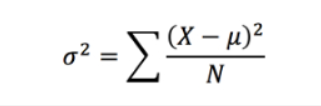
Where:
- σ² is the variance
- X is the daily return
- µ is the average daily return
- N is the total number of observations
Here is a simple example of how to calculate the variance of stock returns:
Problem:
Assume you have the daily return data for a stock over 5 days as follows (in percentages):
- Day 1: 2%
- Day 2: -1%
- Day 3: 3%
- Day 4: 4%
- Day 5: 0%
Requirement: Calculate the variance of the stock’s return over these 5 days.
Step 1: Calculate the average return
First, calculate the average daily return:
Step 2: Calculate the deviation of each day from the average return
- Day 1: 2% – 1.6% = 0.4%
- Day 2: -1% – 1.6% = -2.6%
- Day 3: 3% – 1.6% = 1.4%
- Day 4: 4% – 1.6% = 2.4%
- Day 5: 0% – 1.6% = -1.6%
Step 3: Square the deviations
- Day 1: (0.4%)² = 0.0016
- Day 2: (-2.6%)² = 0.0676
- Day 3: (1.4%)² = 0.0196
- Day 4: (2.4%)² = 0.0576
- Day 5: (-1.6%)² = 0.0256
Step 4: Calculate the variance
Variance is the average of the squared deviations:
Conclusion: The variance of the stock’s return over 5 days is 0.0344 or 3.44% when expressed as a percentage.
3. What is Covariance?
Covariance is a statistical measure that indicates the degree and direction of the relationship between two random variables, such as the returns of two stocks in a portfolio. It shows whether the variables move in the same or opposite directions.
- Positive Covariance: If two variables tend to move in the same direction—when one increases, the other also increases—the covariance is positive.
- Negative Covariance: If two variables move in opposite directions—when one increases, the other decreases—the covariance is negative.
- Zero Covariance: If there is no relationship between the two variables, the covariance is close to zero.
Covariance Formula:

Where:
- Xi and Yi are the values of the two variables (e.g., returns of two stocks) at time i
- X̄ and Ȳ are the means of the two variables
- n is the number of observations
Significance: Covariance shows the relationship between two assets and is often used in portfolio construction. By selecting assets with low or negative covariance, investors can reduce the overall risk of their portfolio.
Example:
Assume you have the daily returns of two stocks X and Y over 5 days:
Requirement: Calculate the covariance between the returns of stock X and stock Y.
Step 1: Calculate the average return of each stock
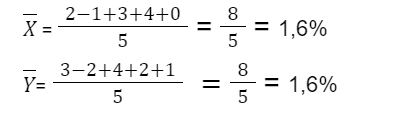
Step 2: Calculate the deviation of each value from the average
Step 3: Multiply the corresponding deviations
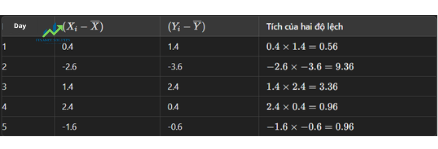
Step 4: Calculate the covariance

Conclusion: The covariance between the returns of stock X and stock Y is 2.0, a positive covariance, indicating that the returns of the two stocks tend to move in the same direction.
4. Portfolio Variance and Modern Portfolio Theory (MPT)
Modern Portfolio Theory (MPT): Developed by Harry Markowitz in 1952, MPT is a theory on how investors can build an optimal portfolio that maximizes expected return while minimizing risk (variance).
MPT assumes that investors can:
- Maximize expected return for a given level of risk
- Minimize risk for a given expected return
MPT uses tools such as variance and covariance to determine the volatility of assets and how assets correlate with each other. An efficient portfolio is one that lies on the Efficient Frontier, which represents portfolios with the highest returns for each level of risk.
Key points of Modern Portfolio Theory:
– Diversification: By investing in many different assets with low correlation, investors can reduce risk without reducing expected returns too much.
– Systematic and unsystematic risk: MPT classifies risk into two types:
– Systematic risk (market risk) is risk that cannot be reduced by diversification.
– Unsystematic risk is risk that can be reduced by diversification.
The connection between portfolio variance and Modern Portfolio Theory:
Variance is the main tool in MPT to measure risk. This theory helps investors balance risk (variance) and return, optimizing the portfolio structure to achieve investment goals.
Portfolio risk is often measured by standard deviation, which is the square root of the variance. If data points deviate significantly from the mean, the variance (and thus risk) will be high. Standard deviation is the main risk measure used by portfolio managers, financial advisors, and institutional investors. Asset managers often include standard deviation in their performance reports.
5. How Does Variance Affect Investment?
Variance in investing measures the degree to which the value of an investment fluctuates around its average value. This volatility reflects the level of risk investors may face. Here’s how variance impacts investing:
- Risk Measurement: Higher variance means greater price fluctuation and higher risk. Investors must accept uncertainty in returns when investing in high-variance assets.
- Portfolio Diversification: Investors often aim to reduce variance by diversifying their portfolios. This minimizes overall risk by avoiding putting all capital into a single asset.
- Investment Strategy Selection: For risk-tolerant investors, they can choose assets with high variance to have a greater chance of gaining profit. On the contrary, investors who prefer stability tend to choose assets with low variance to ensure the safety of their investment.
6. Conclusion
In conclusion, portfolio variance is more than just a complex mathematical formula; it is a vital tool for survival in the global markets. By quantifying the spread of potential returns and understanding the interplay between assets through covariance, you gain the power to design a portfolio that matches your unique risk profile. Whether you are aiming for aggressive growth or capital preservation, the principles of variance and Modern Portfolio Theory remain your most reliable guides.
At Finance-Solutes.com, we believe that informed investors are successful investors. By mastering the concepts of variance, diversification, and the Efficient Frontier, you are no longer at the mercy of market whims. Instead, you are the architect of your own financial stability. We hope this deep dive into what is portfolio variance has empowered you to look at your investments through a lens of mathematical precision and strategic foresight.
- t.me/finance_solutes
- Website: https://finance-solutes.com
- Hotline: +1 929 5636 439 ( Hotline )
- 26 Broadway, Suite 934, New York, 10004, US
