
 XM
XM Bybit
Bybit Binance
 Robinhood
 Webull
 IC Markets
 Pepperstone
 OKX
OKX Vantage
 VT Markets
 BingX
BingX Gate.io
 Kucoin
 MEXC
MEXC Exness
 Bitget
In the world of forex trading, not all price levels are created equal. Some numbers—like 1.1000 or 1.5000—seem to have a magnetic pull on price movement. These aren’t just numbers; they’re Psychological Levels, and understanding them can give traders a strategic edge.
What are Psychological Levels?

Psychological levels are price zones that traders perceive as significant, typically round numbers or previous highs and lows. They’re not based on any intrinsic or fundamental value. Instead, they arise from trader behavior, perception, and emotion.
Often referred to as “invisible lines,” these levels play a major role in shaping market action and can lead to recurring price patterns.
Characteristics of Psychological Levels in Forex
Psychological levels are usually easily remembered round numbers, such as prices ending in “00” (e.g., 1.1000, 1.2000) or mid-levels like “50” (e.g., 1.1550).
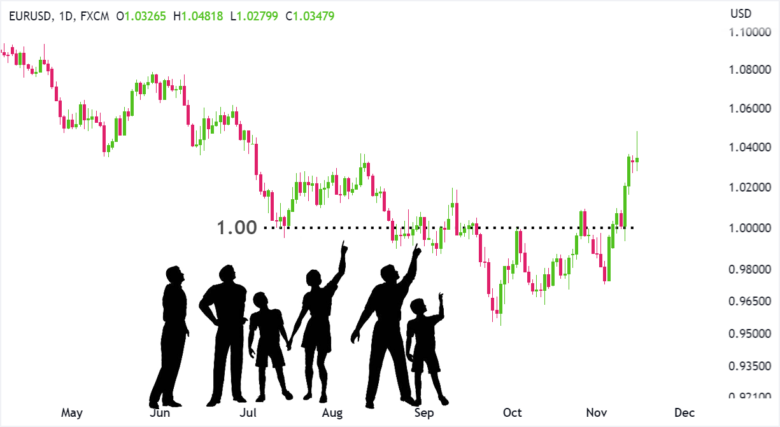
For currency pairs, a price like “1.00” (known as parity) is considered a very significant psychological level.
Traders often make trade decisions around these levels, which can lead to increased buying or selling pressure as price approaches or breaks through them.
A simple way to remember: Traders often go psycho (psychologically tense) as price nears these levels.
Example: When USD/JPY approaches a round level like 100, traders tend to buy or sell more aggressively, seeing it as a key milestone. Likewise, if USD/JPY previously bounced off a certain price level, that level may be viewed as strong support or resistance for strategy adjustment.
Why are Psychological Levels Important in Forex?
Psychological levels play a crucial role in technical analysis because they strongly impact trader psychology and market behavior.
The human brain prefers simplicity and clarity. In forex trading, this tendency shows through a focus on round numbers and easily identifiable patterns.
When many traders focus on the same psychological levels, these can become self-fulfilling prophecies, making price behavior more predictable around those areas.
Example: The 1.0000 level in EUR/USD attracts high attention. As price nears this level, some traders place buy orders expecting a bounce, while others short the pair anticipating a reversal. This causes strong fluctuations around the level, creating attractive trading opportunities.
Examples of Psychological Levels in Forex
Here are some common types:
- Round Numbers: Prices like 1.1000 or 1.5000 are psychologically important because they are memorable and visually clear.
- Previous Highs and Lows: If the price previously reached a notable high or low, that level may act as important support or resistance, where traders expect significant reactions.
- Moving Averages: Moving averages (explained in later lessons) are often used to identify trend direction and potential support/resistance. If price previously bounced off a moving average, it can become a key psychological level.
How to Trade Psychological Levels in Forex
Follow these steps to trade effectively using psychological levels:
- Identify Key Price Levels: Begin by spotting important psychological levels on your currency pair. Use price history to find round numbers that triggered strong reactions.
- Watch Price Action: Observe price behavior closely as it approaches these levels. Strong volatility is a good indicator that the level is attracting trader attention.
- Set Entry and Exit Points: Once a psychological level is identified and price action is assessed, set appropriate entries and exits. For instance, if price bounces from a psychological support, you can place a buy order just above that level with a stop loss just below it.
Summary of Psychological Levels in Forex
To summarize, psychological levels in forex are price levels widely perceived by traders as important—typically round numbers or former support/resistance zones.
These levels matter mainly because of the attention traders give them. Prices often react strongly near these levels, even though they may lack fundamental significance.
Traders tend to place orders around these areas, so when price nears psychological levels, clusters of buy/sell orders may get triggered, causing reversals or stronger trend continuation.
A break of a major psychological level can signal a shift in market sentiment. Example: If EUR/USD breaks above 1.0000, it may indicate strong bullish momentum.
Markets often retest these psychological levels before continuing the trend. Sometimes price will approach a level, pause or reverse, then test the same level again.
- t.me/finance_solutes
- Website: https://finance-solutes.com
- Hotline: +1 929 5636 439 ( Hotline )
- 26 Broadway, Suite 934, New York, 10004, US
