
 XM
XM Bybit
Bybit Binance
 Robinhood
 Webull
 IC Markets
 Pepperstone
 OKX
OKX Vantage
 VT Markets
 BingX
BingX Gate.io
 Kucoin
 MEXC
MEXC Exness
 Bitget
“Is There an Optimal Time to Trade Forex?” is a common question that many traders wonder about—especially those new to the forex market.
As you can see, every trader is different. We all have our own unique personalities—and, as a result, different needs. And if there’s one thing that’s absolutely certain, it’s that you must discover a trading style that fits your own character.
1. FOREX TIME FRAMES
Time frames in Forex are divided into nine standard types:
- 1 minute
- 5 minutes
- 15 minutes
- 30 minutes
- 1 hour
- 4 hours
- 1 day
- 1 week
- 1 month
Even with standard time frames, you already have many options. If that’s not enough, some platforms offer variants of these frames—like 6‑hour, 8‑hour, and 12‑hour charts. The list could go on, but those three are the most common you’ll encounter.
However, in practice, Forex time frames are usually grouped into three categories: Long-term, Medium-term, and Short-term. Traders can choose to use all three, or simply combine a higher time frame and a lower one when analyzing potential trades.
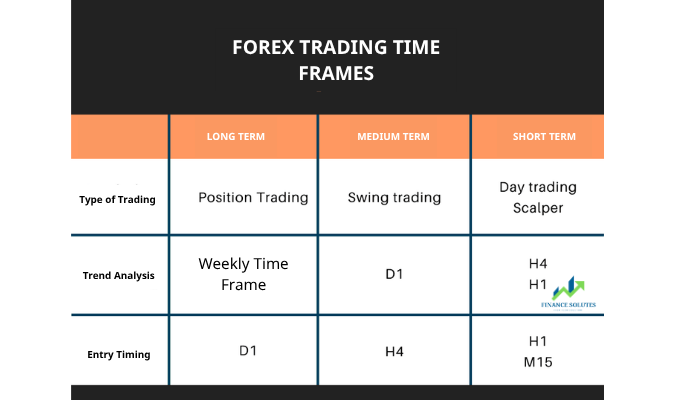
Although longer time frames are useful for identifying market trends, shorter time frames are better suited for pinpointing ideal entry points.
2. GOLDEN HOURS FOR EFFECTIVE FOREX TRADING
Experienced Forex traders using different strategies each have their own idea of the “best time to trade.” Most experts recommend higher time frames, because too-low time frames contain too much “noise” that can trap inexperienced traders.
2.1 Four reasons to choose higher time frames
If you ask expert traders why they favor higher time frames, you’ll hear many reasons. Here are four common ones that make higher time frames stand out.
2.1.1 Acts as a news filter
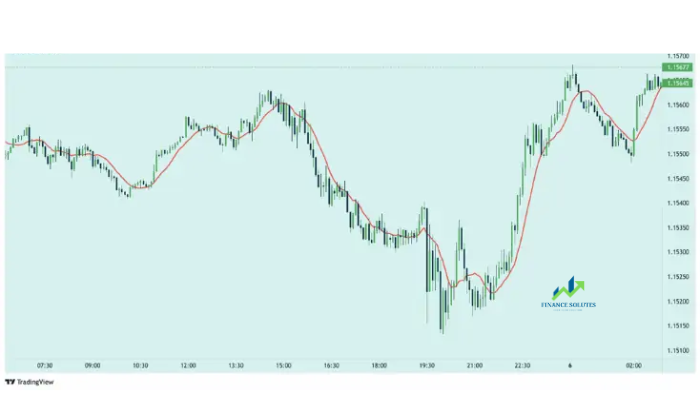
It is obvious that the highs and lows (ranges) of each time period on the daily chart are larger than each time period on the 5-minute chart. But how can we tell the difference between these two time frames? The simplest way is to look at the example of two moving averages: long-term and short-term.
MA 10 line on 5 minute chart
MA 100 line on 5 minute chart
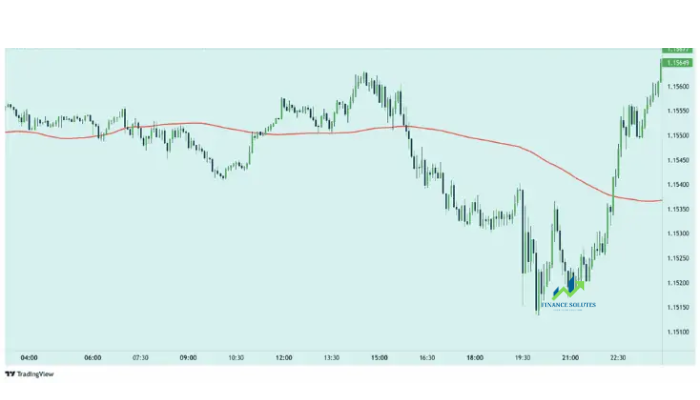
Let’s assume that the 10 MA represents the 5-minute timeframe and the 100 MA represents the daily timeframe. Now, assume that your stop loss is on one side of each moving average in the two charts above, at an equal distance from the moving average.
Which timeframe is more likely to hit your stop-loss sooner? The 5‑minute chart, since it’s more volatile and fluctuates more.
Because the 5‑minute chart is built from 5‑minute intervals, it’s much more sensitive to forex news events than the daily chart.
2.1.2 Easier to spot market trends
Since the daily chart allows you to look at a larger time period; it is easier to develop a directional trend than on lower time frames. Traders use higher time frames because the higher time frames are of higher quality than the lower time frames.
This is simply because it takes longer to form significant levels. For example, a level that took 3 years to form on a daily chart versus a level that formed within 48 hours on a 5‑minute chart. Key support/resistance levels on higher time frames are usually more reliable.
2.1.3 Quality over quantity

Higher time frames generally provide better-quality setups than lower ones—because there are fewer signals.
For example: A Pin Bar candle might appear only once or twice a month on a given daily chart, while you could see 5–10 Pin Bars on a 5‑minute chart in just 24 hours.
Fewer setups mean each one is clearer and more prominent to traders worldwide. As you know, the clearest price action setups are the most tradable.
More frequent setups also mean higher chances of false signals.
2.1.4 Reduced trade frequency
Fewer setups mean you can’t trade as often. That may sound like a drawback—but it’s not. The fewer trades you take, the more space your mind has to recognize quality setups.
If you trade constantly and bite your nails in anxiety, you’re blocking the open, neutral mindset needed to spot good setups when they appear.
“Less is more” has never been truer in Forex. You don’t need 20 or 30 trades per month to make good money.
2.2 Common concerns about trading higher time frames
Here are two frequent worries from traders considering higher time frames:
2.2.1 “I can’t afford to trade higher time frames”
If you have enough money to open a trading account, you have enough money to trade high time frames. You don’t need a $10,000 account to trade daily charts. You don’t even need a $1,000 account.
Thanks to leverage in Forex, even a $100 account can be used to trade daily charts. It’s all about calculating the correct position size relative to the account size.
No one is saying you can’t make $1,000 profit with a small account. But you can trade higher time frames and still work your way up.
If you follow solid advice and stay disciplined, you can build a relatively small account into a large one. The key is to have a “slow and steady” mindset.
Oddly enough, it can be harder to grow a $100 account into a $1,000 account than it is to grow a $10,000 account into a $100,000 account. This is because you will tend to risk more than you should on a smaller account in order to grow it faster.
2.2.2 “Higher time frames are boring”
Does making money bore you? Seriously—this is a question you must ask yourself before making a profit:
Why are you trading Forex?
Are you drawn by the thrill and excitement—or just to earn money?

Most people who enter this market have the desire to trade full-time one day. But if they can’t trade full-time, they can trade part-time; supplementing their income to help support their families and save for vacations – to live a comfortable life.
If you trade Forex for the challenge or excitement, that’s fine—but please do it on a demo account. Trading real money for the wrong reasons is worse than not trading at all.
3. CHOOSING THE RIGHT TIME FRAME FOR YOUR STRATEGY
It’s common for traders to have opposing signals on different time frames.
For example: The daily chart shows an uptrend, but the hourly chart shows a downtrend. Which should you trade?
This confusion can trip traders up. That’s why it’s important to plan which time frame you’ll trade—and ensure it fits your strategy.
3.1 Example: Swing trading
Swing traders who follow a trend-following strategy should avoid making rash decisions when looking at price movements on a smaller time frame chart. Traders may see what looks like a trend reversal on a shorter time frame chart. However, after looking at the daily chart, it is clear that the trend is still intact.
The chart of the EUR/USD pair on the H1 timeframe gives false signals suggesting a trend:
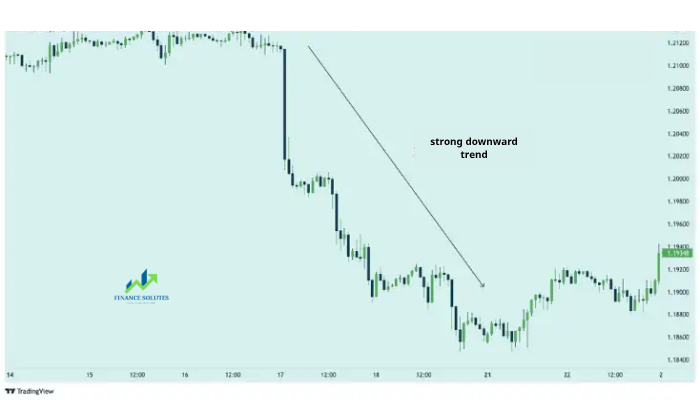
Combining longer time frames allows traders to see the ‘bigger picture’ of the currency pair; getting an idea of the overall trends or market sentiment that are present. While shorter time frames can be used to determine when to enter the market.
Therefore, looking at the daily chart, it is clear that the uptrend is still in place when looking at the right time frame.
EUR/USD daily chart: Clearly shows a continued uptrend. The sharp drop on the H1 chart is just a small pullback on the D1 chart (red frame).
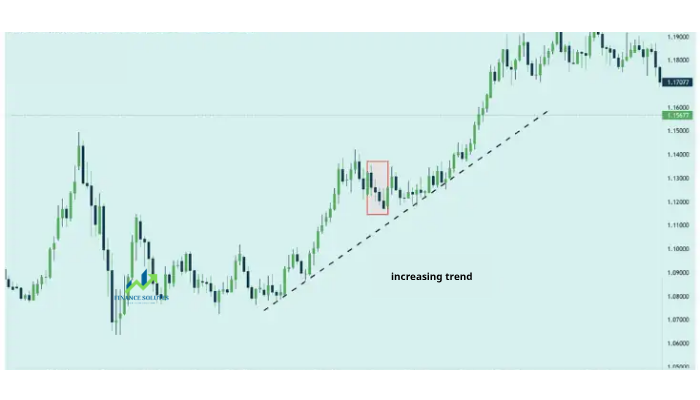
- Analysis techniques to determine trends: Understand and identify forex trend lines. Use additional indicators such as MA, MACD, etc. to confirm.
- Analysis techniques to determine entry points: Use important support and resistance levels, candlestick patterns, etc.
3.2 Multi-time frame analysis
The type of trading strategy used will greatly influence the Best Trading Hours chosen. Additionally, instead of choosing a single time frame to trade, many traders will apply a technique known as Multi-Timeframe Analysis. This involves looking at the same currency pair in different time frames.
With this approach, the larger time frame is usually used to determine the long-term trend; while the shorter time frame is used to spot ideal entry points when entering the market.
- t.me/finance_solutes
- Website: https://finance-solutes.com
- Hotline: +1 929 5636 439 ( Hotline )
- 26 Broadway, Suite 934, New York, 10004, US
