 XM
XM Bybit
Bybit Binance
 Robinhood
 Webull
 IC Markets
 Pepperstone
 OKX
OKX Vantage
 VT Markets
 BingX
BingX Gate.io
 Kucoin
 MEXC
MEXC Exness
 Bitget
 HK
HK
Published by Finance Solutes | Prop Trading Reviews
Goat Funded Trader (GFT) has exploded onto the prop trading scene as one of the most aggressively priced firms in the industry, with challenges starting for just a few dollars and profit splits reaching up to 100%. But behind the eye-catching pricing sits a rule set that’s more nuanced than the marketing suggests. In this in-depth Goat Funded Trader review, the Finance Solutes team breaks down every challenge model, price point, and pass mechanic — and gives you an honest look at the fine print — so you can decide whether GFT is the right funding partner before you buy a challenge.
Goat Funded Trader is a proprietary trading firm (prop firm) launched in 2022/2023 that gives traders access to simulated capital after passing a paid evaluation. Instead of risking your own money, you trade the firm’s simulated funds and keep a share of the profits, with reward shares of 80% by default and up to 100% via a paid add-on.
GFT is known for two things above all: ultra-low challenge prices and a wide variety of evaluation models. It supports five trading platforms — MetaTrader 5, TradeLocker, Match-Trader, cTrader, and Volumetrica Trading — and covers a broad range of markets including forex, indices, metals, energies, commodities, crypto, and stocks. Like nearly every prop firm, GFT operates a simulated-capital model and is not a regulated broker; the company operates through entities registered in Hong Kong and Saint Lucia, which carry no financial-regulator oversight.
GFT’s current lineup is built around five main models — 1-Step, 2-Step, 3-Step, Instant, and the promotional Goat Blitz — each selectable under the popular “GOAT” model type that carries the 80%–100% profit split. All challenges come with a one-time, 100% refundable fee (refunded on your first payout) and bi-weekly rewards. Here’s how the models compare, using the pricing shown on GFT’s checkout during the current promotional period.
Live promo codes: GFT is currently running BOGO40 (Buy-One-Get-One + 40% off) and FIRSTGFT (50% off for new customers). Prices below reflect the discounted rates shown at checkout.
The single-phase evaluation — fastest route to a funded account for confident traders.
| Account Size | Available |
|---|---|
| 15K | $107 (was $178) |
| 25K, 50K, 100K (Most Popular), 200K | Scales with size |
Rules (15K example):
The 1-Step model has the highest single-phase target (10%) but a tight 6% maximum loss, so it rewards traders who can hit targets efficiently without large drawdowns.
The classic two-phase evaluation and GFT’s most balanced model, with the widest account-size range and the largest drawdown cushion.
| Account Size | Available |
|---|---|
| 15K | $59 (was $98) |
| 5K, 8K, 25K, 50K, 100K (Most Popular), 150K | Scales with size |
Rules (15K example):
With a more forgiving 10% maximum loss spread across two phases, the 2-Step is the model most traders will find workable. It’s also one of the cheapest two-phase challenges in the industry. A Standard model type is available alongside GOAT for this model if you prefer different terms.
A three-phase evaluation with lower per-phase targets, spreading the profit requirement across more stages.
| Account Size | Available |
|---|---|
| 15K | $51 (was $85) |
| 10K, 25K, 50K, 100K (Most Popular), 200K | Scales with size |
Rules (15K example):
The 3-Step is the cheapest of the multi-phase challenges. The trade-off for the lower entry price and gentler 6% per-phase targets is that you have to clear three separate stages before funding, and the 8% maximum loss sits between the 1-Step and 2-Step cushions.
Instant funding — no evaluation phase. You get a simulated funded account immediately after purchase, with the widest range of account sizes in the lineup (up to $400K).
| Account Size | Available |
|---|---|
| 15K | $137 (was $228) |
| 5K, 10K, 25K, 50K, 100K (Most Popular), 150K, 200K, 250K, 300K, 400K | Scales with size |
Rules (15K example):
Instant funding skips the target entirely — you start trading a funded account right away. The trade-offs are a higher upfront price than the challenge models and a tighter 3% daily loss limit. A PRO model type (marked “New”) is also available for this model. Note that instant accounts typically carry a first-payout cap and a trailing drawdown, so read the specifics carefully.
A promotional low-target model built for speed, with the lowest entry price of all — a $2.5K account for around $28.
| Account Size | Available |
|---|---|
| 2.5K | $28 (was $47) |
| 5K, 10K, 25K, 50K, 100K (Most Popular) | Scales with size |
Rules (2.5K example):
Goat Blitz has the lowest profit target (just 3%) and the lowest price in the entire catalog, making it the fastest and cheapest way to reach a funded account. The tighter 5% maximum loss keeps risk controlled, and it’s an ideal low-cost way to test GFT’s rules and platforms.
Across all five models the core logic is consistent, with the specifics varying by model:
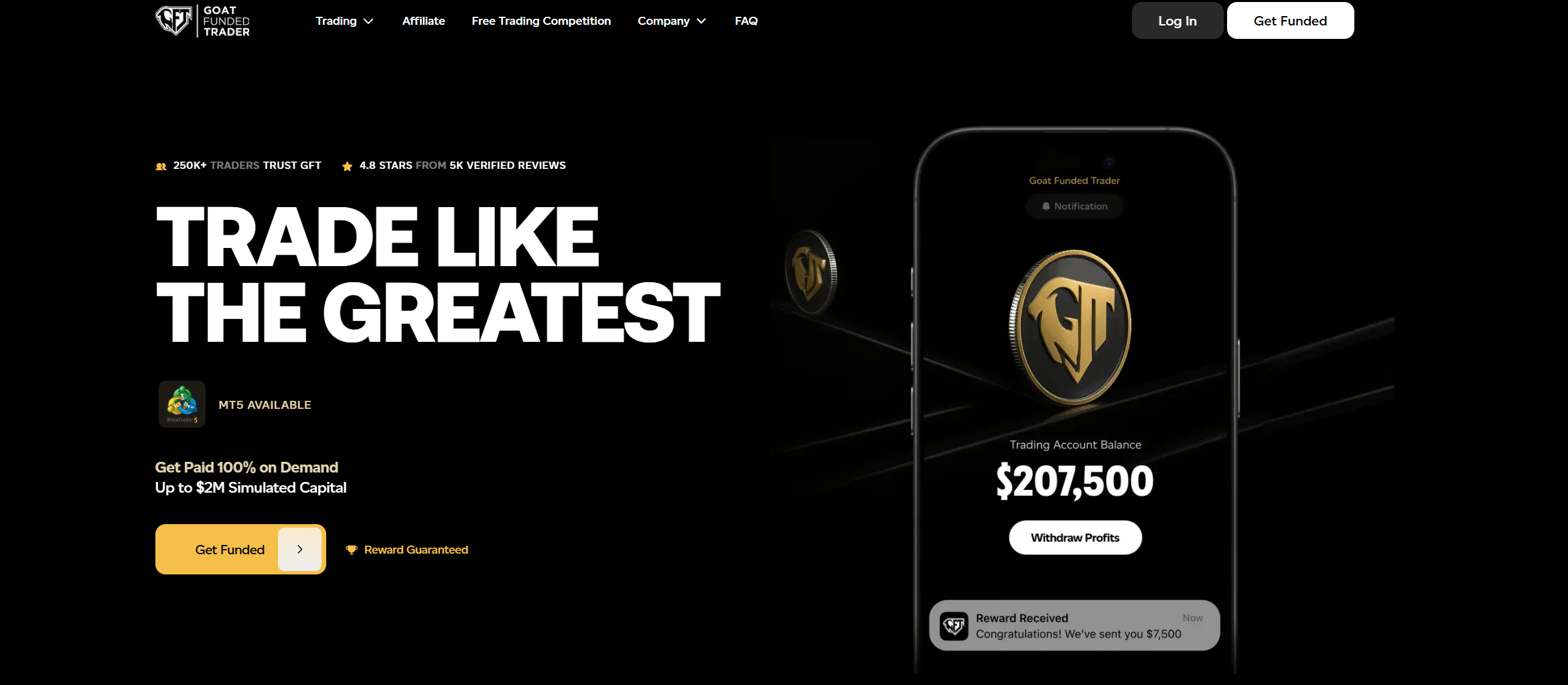
GFT’s headline is a profit split of up to 100% — but the base split is 80%, and reaching 100% requires purchasing the 100% Profit Split add-on at checkout, separate from any discount code. When comparing GFT’s “up to 100%” against another firm’s split, factor in that add-on cost for an accurate comparison.
Rewards are paid bi-weekly by default, with a $100 minimum withdrawal on most plans. <cite index=”24-1″>The standard split is 75–80% by default, rising toward 95% after several payouts, with a faster on-demand option available at a reduced 40% split or 80% after 30 days initially</cite>. <cite index=”25-1″>Withdrawal methods include bank wire transfer and cryptocurrency (Bitcoin/USDT), with crypto payouts generally faster at 1–3 business days and bank transfers taking 3–7 business days depending on location</cite>. On the whole, GFT has a documented payout track record — <cite index=”23-1″>the firm has paid out over $11.6 million all-time, with more than $1 million in a recent 30-day window and an average payout around $814</cite>.
One of GFT’s more distinctive features is a multi-level scaling plan that also includes a rare monthly salary component for top performers. <cite index=”32-1″>The plan reaches up to $1 million (with some sources citing $2 million) across four levels: Level 1 (after 2 months and 4 payouts) grants a 15% capital boost, 90% split, and a 1% drawdown increase; Level 2 (4 months, 6 payouts) grants a 30% capital boost, 90% split, 2% drawdown increase, and weekly payouts; Level 3 (5 months, 10 payouts) grants a 40% capital boost, 92% split, weekly payouts, a free challenge on failure, and a monthly salary of $300–$500; and Level 4 — GOAT Trader (6 months, 15 payouts) grants a 50% capital boost, 95% split, weekly payouts, and a monthly salary</cite>. The salary and free-retry perks are genuinely uncommon in this segment — but reaching the upper levels requires sustained profitability over 5–6 months.
This is the section that separates an informed GFT trader from a frustrated one. Several rules are documented in the help center but rarely featured in marketing, and they show up repeatedly in negative reviews:
Trust is the first question any trader should ask before funding a challenge, and GFT presents a genuinely mixed picture that’s worth understanding honestly.
On the positive side: GFT is a registered, functional prop firm that has paid out millions of dollars to real traders, holds solid ratings on some aggregators (<cite index=”32-1″>a 4.4/5 on Prop Firm Match across 600+ reviews, with only firms passing a strict review process included</cite>), offers among the cheapest challenges in the industry, and provides unusual perks like the salary program and no time limits on most challenges.
On the cautionary side: GFT’s reputation is genuinely divided. <cite index=”23-1″>While it carries strong verified-trader scores on some platforms, its Trustpilot sits far lower with thousands of one-star reviews citing payout denials, copy-trading accusations against independent traders, and unresponsive support</cite>. <cite index=”23-1″>The core issue reported is a risk-detection system that can flag independent traders whose entries happen to resemble others’, resulting in denied payouts and closed accounts</cite>. There have also been operational concerns — <cite index=”28-1″>an April 2026 absorption of another firm (TradeXMastery) left at least one documented unpaid payout unresolved</cite>, and <cite index=”31-1″>GFT has withdrawn and restored MetaTrader services multiple times due to licensing issues, creating platform instability</cite>. Finally, GFT does not accept US citizens or residents.
Goat Funded Trader is one of the most affordable and flexible prop firms in 2026, and for disciplined discretionary traders with independent strategies, it offers genuinely competitive value — cheap challenges, high potential splits, no time pressure, and unusual perks like a monthly salary at higher levels. The documented payout history is real.
The honest caveat is that GFT rewards traders who read the fine print. The Goat Guard split-downgrade rule, the first-payout cap, the 2-minute trade rule, and the strict EA/copy-trading enforcement are where the frustration in negative reviews comes from — not because they’re hidden, but because they’re easy to overlook behind the low prices. If your strategy is manual, independent, and comfortable operating inside those limits, GFT can be a strong low-cost option. If you rely on EAs, copy trading, or fast scalping, look elsewhere. As always, verify the current rulebook and payout terms directly with the firm before funding any challenge.
Is Goat Funded Trader legit? Yes — GFT is a registered, functional prop firm that has paid out over $11 million to real traders and holds a 4.4/5 rating on Prop Firm Match. However, its Trustpilot reputation is mixed, with payout-denial complaints tied to automated copy-trading detection, so read the rules carefully.
How much does a Goat Funded Trader challenge cost? Prices start at around $28 for a $2.5K Goat Blitz account and scale up with account size and model. There’s also a $1 micro account option. All fees are one-time and refundable on your first payout.
What is the maximum profit split at Goat Funded Trader? Up to 100%, but the base split is 80% — reaching 100% requires purchasing the 100% Profit Split add-on at checkout.
Does Goat Funded Trader allow EAs and copy trading? EAs are allowed with restrictions (commercial EAs are banned and ownership may need to be proven), but cross-account copy trading is prohibited entirely, as are martingale and grid recovery systems.
Does Goat Funded Trader accept US traders? No. GFT explicitly excludes US citizens and US residents from its services.
Can I scale my Goat Funded Trader account? Yes. GFT’s four-level scaling plan grows capital up to $1–2 million, with increasing profit splits, drawdown boosts, free retries, and a monthly salary ($300–$500) at the top levels.
This review is for informational purposes only and does not constitute financial or investment advice. Prop trading rules and pricing can change frequently — always verify current terms directly on the Goat Funded Trader website before purchasing a challenge. Finance Solutes may earn a commission from partner links at no extra cost to you.