
 XM
XM Bybit
Bybit Binance
 Robinhood
 Webull
 IC Markets
 Pepperstone
 OKX
OKX Vantage
 VT Markets
 BingX
BingX Gate.io
 Kucoin
 MEXC
MEXC Exness
 Bitget
Understanding what compound interest is marks the fundamental turning point in an individual’s financial journey. Often referred to as the eighth wonder of the world, compound interest is the process where the value of an investment increases because the earnings on an investment, both capital gains and interest, earn interest as time passes. While simple interest is calculated only on the principal amount, compounding creates a snowball effect that can turn modest savings into substantial fortunes. For anyone looking to secure their financial future, mastering this concept is not just an advantage; it is a necessity. This guide provides a deep dive into the mechanics, formulas, and strategic applications of compound interest to help you navigate the complex world of modern finance with confidence and clarity.
In the following sections, we will break down the mathematical foundations that govern compounding and explore why time is your most valuable asset in the market. Whether you are a novice saver or an experienced investor, understanding the nuances of compounding periods and interest rates will allow you to optimize your portfolio for maximum growth. We will examine real-world scenarios, compare various investment vehicles, and provide actionable advice on how to mitigate the “reverse” effect of compounding found in high-interest debt. By the end of this comprehensive analysis, you will possess the specialized knowledge required to make compound interest work for you rather than against you.
The Core Concept: Defining Compound Interest Beyond the Basics
At its essence, compound interest is “interest on interest.” It is the result of reinvesting interest, rather than paying it out, so that interest in the next period is then earned on the principal sum plus previously accumulated interest. This creates a non-linear growth pattern. In the initial stages, the growth may seem slow and insignificant, but as the base amount grows, the interest generated becomes increasingly substantial. This is the fundamental difference between linear growth (simple interest) and exponential growth (compound interest), where the latter accelerates the pace of wealth accumulation over the long term.
To truly grasp what compound interest is, one must recognize that it operates on a feedback loop. Every dollar of interest earned becomes a “soldier” that works to earn more interest in the subsequent cycle. This cycle repeats indefinitely as long as the capital remains invested. In modern financial systems, compounding occurs at various frequencies—daily, monthly, quarterly, or annually. The frequency of compounding is a critical variable, as more frequent compounding cycles lead to a higher effective annual yield, even if the nominal interest rate remains the same.
The Distinction Between Simple and Compound Interest
The primary distinction lies in the base used for calculation. Simple interest is calculated solely on the original principal. For instance, if you invest $10,000 at a 5% simple interest rate for 10 years, you earn $500 every year, totaling $5,000 in interest. The growth is predictable and flat. In contrast, with compound interest, that same $500 earned in year one is added to the principal. In year two, you earn 5% on $10,500, which is $525. By year ten, the interest earned for that year alone would be significantly higher than the initial $500.
This divergence becomes staggering over decades. While simple interest provides a steady, arithmetic progression, compound interest delivers a geometric progression. For long-term financial planning, such as retirement or education funds, the compounding method is the only viable path to outpace inflation and achieve significant capital appreciation. Understanding this difference is vital for evaluating bank products, bonds, and other fixed-income instruments.
2. Compound Interest Formula
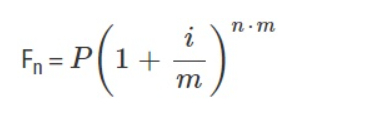
The basic bank compound interest formula:
Where:
- Fn is the future value of the investment after n years.
- P is your current investment amount.
- i is the annual interest rate. For example, with a 10% annual interest rate, i = 0.1.
- n is the number of years you plan to invest.
- m is the number of compounding periods per year. If interest is compounded annually, m = 1.
Example: You have 40 million VND and deposit it in a bank with an interest rate of 7.9% per year. After 4 years, how much will you have in total (principal + interest)?
If you apply simple interest, the calculation is as follows:
- Year 1 interest: 7.9% × 40 million = 3.16 million VND
- Year 2 interest: 7.9% × (40 million + 3.16 million) = 3.40964 million VND
- Year 3 interest: 7.9% × (40 million + 3.16 million + 3.40964 million) = 3.679 million VND
- Year 4 interest: 7.9% × (40 million + 3.16 million + 3.40964 million + 3.679 million) = 3.9696 million VND
Thus, total interest earned after 4 years with compound interest is approximately 14.218 million VND.
The Pillars of Success: Maximizing the Power of Compounding
To leverage compound interest effectively, one must move beyond understanding the math and into implementing a disciplined strategy. The “power” of compound interest is not a passive force that happens by accident; it requires specific conditions to flourish. These conditions include time, consistency, and the avoidance of capital erosion. When these pillars are in place, the mathematical certainty of compounding begins to work in your favor.
The most significant barrier to the power of compounding is the “human element”—the urge to withdraw funds during market volatility or to spend dividends rather than reinvesting them. True compounding requires a “set it and forget it” mentality where the earnings remain untouched. This allows the interest-on-interest cycle to remain unbroken, ensuring that the exponential curve reaches its steepest point in the later years of the investment.
The Critical Importance of Starting Early
Time is the most potent multiplier in the compound interest equation. A person who starts saving $500 a month at age 25 and stops at age 35 (investing for only 10 years) will often end up with more money at age 65 than someone who starts at age 35 and saves $500 a month for the next 30 years. This counter-intuitive reality is due to the extra decade the first person gave their money to compound.
Starting early allows you to take advantage of the “flat” part of the exponential curve while you are young, so you can enjoy the “vertical” part of the curve when you need it most. Delaying your investment journey by even five years can require you to save twice as much per month to reach the same end goal. Therefore, the best time to start was yesterday; the second best time is today.
Consistency and the Habit of Reinvestment
Compounding is fueled by the consistent addition of capital and the strict reinvestment of all yields. In the context of the stock market, this often takes the form of a Dividend Reinvestment Plan (DRIP). Instead of receiving dividend checks as cash, the funds are automatically used to purchase more shares. This increases your share count, which in turn increases your future dividends, creating a self-reinforcing cycle of growth.
Furthermore, regular contributions through techniques like Dollar-Cost Averaging (DCA) ensure that you are continuously feeding the principal. This systematic approach removes the emotional stress of market timing and ensures that the compounding engine always has fresh “fuel.” Over decades, the combination of organic compounding and regular contributions creates a synergistic effect that is the hallmark of wealthy investors.
Compound Interest in the Stock Market: Dividends and Capital Gains
The stock market is perhaps the most accessible and effective environment for witnessing compound interest in action. Unlike a savings account with a fixed rate, the stock market offers two avenues for compounding: capital appreciation (the increase in stock price) and dividends (periodic payments to shareholders). When these two forces are combined and reinvested, the results can be transformative for a portfolio.
In a diversified portfolio, such as one tracking the S&P 500, the historical average return has been approximately 10% annually before inflation. While the market does not return a flat 10% every year—experiencing both booms and busts—the long-term trajectory is upward. Compounding acts as a buffer against short-term volatility; as your total asset base grows, even small percentage gains represent significant dollar amounts.
The Role of Dividend Reinvestment Plans (DRIPs)
Dividends are the unsung heroes of total market returns. Historical data shows that a significant portion of the stock market’s total return over the last century has come from reinvested dividends rather than just price increases. By using a DRIP, you ensure that every cent earned is immediately put back to work. This is vital because it allows you to acquire more shares when prices are low, effectively lowering your average cost per share while increasing your future dividend yield.
For long-term investors, the focus shifts from “what is the price today?” to “how many shares do I own?” As compound interest increases your share count, your wealth grows independently of the daily market noise. This perspective is essential for maintaining the discipline required to stay invested through market cycles.
Strategies for Effective Saving and Investing
To maximize the benefits of compound interest, individuals should adopt a multi-faceted approach to their finances. It is not enough to simply save; one must save in a way that minimizes leakages such as taxes, high fees, and inflation. The following strategies are utilized by financial professionals to ensure the compounding process is as efficient as possible.
- Utilize Tax-Advantaged Accounts: Using accounts like a 401(k), IRA, or HSA allows your money to compound without being depleted by annual taxes on capital gains or dividends. This “tax-free” compounding can result in a significantly larger nest egg.
- Minimize Investment Fees: High management fees (Expense Ratios) act as a “reverse” compound interest. A 1% fee might seem small, but over 30 years, it can eat up nearly 25-30% of your total potential wealth. Opt for low-cost index funds or ETFs.
- Automate Your Finances: Automation removes the risk of human error or temptation. Setting up an automatic transfer from your paycheck to your investment account ensures that your principal is always growing.
- Avoid “Lifestyle Creep”: As your income increases, resist the urge to increase your spending proportionally. Instead, divert the surplus into your compounding vehicles.
The Danger of “Negative Compounding”: High-Interest Debt
It is crucial to remember that compound interest is a double-edged sword. While it can build wealth, it can also destroy it when applied to debt. Credit cards are the most common example of negative compounding. With interest rates often exceeding 20% and interest compounded daily, a small balance can quickly spiral out of control. In this scenario, the “interest on interest” is working for the bank and against you.
Prioritizing the elimination of high-interest debt is the first step in any financial plan. Paying off a 20% interest credit card is mathematically equivalent to earning a guaranteed 20% return on your investment. Until high-interest debt is cleared, the benefits of compounding in your savings will likely be offset by the compounding losses in your liabilities.
Where to invest for good Compound Returns?
Choosing the right vehicle depends on your risk tolerance, time horizon, and capital availability. Not all investment channels offer the same compounding efficiency. For example, while gold can appreciate in value, it does not produce dividends or interest, meaning it doesn’t “compound” in the traditional sense unless you manually sell portions to reinvest in other assets. Real estate and stocks, however, offer robust compounding opportunities.
A balanced approach often yields the best results. By diversifying across different asset classes, you can capture different types of compounding—from the steady interest of bonds to the aggressive growth of equities and the rental yield of real estate.
Comparison of Common Investment Vehicles
| Asset Class | Primary Compounding Mechanism | Risk Level | Liquidity |
|---|---|---|---|
| High-Yield Savings | Monthly interest payments | Very Low | High |
| Index Funds/ETFs | Capital gains + Reinvested dividends | Moderate/High | High |
| Real Estate | Rental income reinvestment + Appreciation | Moderate | Low |
| Corporate Bonds | Semiannual coupon payments | Low/Moderate | Moderate |
Conclusion
Compound interest is the most powerful tool in the arsenal of any individual seeking financial independence. It is a mathematical certainty that rewards patience, discipline, and time. By understanding what compound interest is and how to apply the formulas and strategies discussed in this guide, you can move from a state of working for money to a state where your money works for you. The transition from linear to exponential growth is the “secret” that separates long-term wealth builders from the rest.
Success in finance does not require a high IQ or complex algorithms; it requires the humility to start small and the persistence to let time do the heavy lifting. Whether you are paying down debt to stop the bleed of negative compounding or investing in the stock market to capture the growth of global industries, the principles remain the same. Start today, reinvest your earnings, and let the eighth wonder of the world secure your financial future. At Finance-Solutes.com, we believe that clarity in these concepts is the first step toward a lifetime of prosperity.
Watch more
- Interactive Brokers Review 2026: Expert Guide to Platforms, APIs & AI Trading
- Pepperstone Review 2026: Best Forex Broker for Spreads & Technology
- t.me/finance_solutes
- Website: https://finance-solutes.com
- Hotline: +1 929 5636 439 ( Hotline )
- 26 Broadway, Suite 934, New York, 10004, US
