
 XM
XM Bybit
Bybit Binance
 Robinhood
 Webull
 IC Markets
 Pepperstone
 OKX
OKX Vantage
 VT Markets
 BingX
BingX Gate.io
 Kucoin
 MEXC
MEXC Exness
 Bitget
One of the common tools that provide information about the current and future conditions of a business to its decision-makers, analysts, and investors is the PMI index.
This article provides information on the topic of what PMI is, the three main organizations that produce this economic index, the process involved in generating the PMI, the calculation method, and its use in the economy.
1. WHAT IS PMI?
So, what is the PMI index? The Purchasing Managers’ Index (PMI) is an economic indicator consisting of monthly reports and surveys from private sector manufacturing companies. The index surveys product managers — individuals who purchase the raw materials necessary for a company to manufacture its products.
PMI is used by investors to provide a clear idea of how purchasing managers are projecting the future of their industry. PMI results can reflect market sentiment and sometimes offer valuable insights for trading decisions.
2. ORGANIZATIONS THAT PRODUCE THE PMI
There are three main organizations that produce the Purchasing Managers’ Index (PMI), specifically:
- Institute for Supply Management (ISM) – Founded in 1915, headquartered in Arizona, USA
- Singapore Institute of Purchasing and Materials Management (SIPMM) – Founded in 1972, based in Singapore
- IHS Markit Group – Based in London. IHS was founded in 1959, and Markit merged with IHS in 2016
The PMI values and its components play a crucial role in providing valuable insights into a business’s economic activity for decision-makers, market analysts, and investors.
3. HOW DOES THE PMI WORK?
The Purchasing Managers’ Index works by compiling data from purchasing managers in the manufacturing sector. This data is used to assess industry conditions and provide insight into potential future growth — or lack thereof — within the sector.
One prominent organization that produces PMI is the Institute for Supply Management (ISM). The Purchasing Managers’ Index (PMI) published by ISM is compiled and released monthly. The PMI value is based on a monthly survey sent to senior executives at over 400 companies across 19 major industries, weighted according to their contribution to the U.S. GDP.
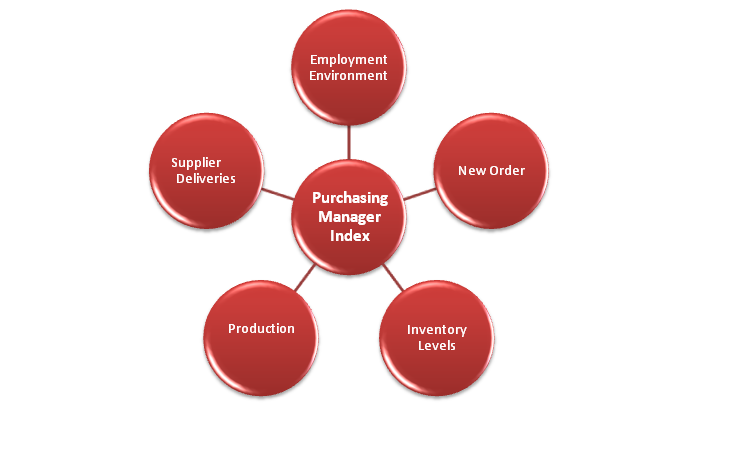
The Purchasing Managers’ Index (PMI) primarily focuses on five key survey areas:
- Employment
- New Orders
- Production
- Inventory Levels
- Supplier Deliveries
The Institute for Supply Management (ISM) gives equal weight to all five of these surveys. The PMI is a number ranging from 0 to 100.
- If the PMI is above 50, it indicates expansion compared to the previous month.
- If the PMI falls below 50, it signals contraction, while a PMI of exactly 50 indicates no change.
4. HOW IS THE PMI CALCULATED?
The PMI is calculated through surveys that ask purchasing managers whether business and industry conditions have improved, remained the same, or worsened compared to the previous month.
The surveys assign equal weight to several categories, each of which is scored independently by the participating purchasing managers. These categories include the volume of new orders, production, supplier deliveries, company inventory levels, and employment figures.
The responses from purchasing managers are combined to generate an overall PMI score for the month. A score above 50 indicates that the manufacturing sector is expanding, below 50 indicates contraction, and a score of 50 shows no change from the previous month.

The Purchasing Managers’ Index (PMI) can be calculated using the following formula:
Purchasing Managers’ Index (PMI) = [P1 * 1] + [P2 * 0.5] + [P3 * 0]
In the formula above, P1 is the percentage of responses reporting “improvement.” P2 represents the percentage of responses indicating “no change,” while P3 is the percentage of responses reporting “deterioration.”
5. WHAT IS THE ROLE OF PMI?
So, what is the role of the PMI in the economy? PMI plays a crucial role in a country’s economy as it serves as an essential decision-making tool for both managers and suppliers. PMI provides information about current and future business conditions to corporate decision-makers, analysts, and investors. Some key roles of the PMI include:
- Suppliers follow a company’s PMI values to estimate future demand for desired products. The Purchasing Managers’ Index also allows suppliers to gauge how much inventory their customers are holding, which can influence the amount of production those customers generate.
- The information PMI provides on supply and demand can impact supplier pricing. A manufacturer may accept price increases from suppliers when new order volumes are rising. Conversely, if new orders decline, the manufacturer might reduce prices and demand lower costs for the components they purchase.
- PMI can be used by a company for annual budgeting, managing staffing levels, and forecasting cash flow.
- The Purchasing Managers’ Index is also used by investors as a leading indicator of economic conditions. PMI plays a key role in providing useful insights into a business’s economic activities, including GDP, industrial production, and employment.
6. WHAT ARE THE ADVANTAGES AND DISADVANTAGES OF PMI?
The PMI index has the following advantages and disadvantages:
6.1. What are the benefits of using PMI?
- One major benefit of using PMI is that it includes data-based responses to questions about actual business conditions. This means the findings in the PMI are based on hard data rather than opinions or confidence-based measures.
- PMI can serve as an effective indicator of economic health due to insights into employment, orders, inventories, and growth provided by purchasing managers.
- Another advantage is that PMI data is usually the first economic data series published each month, making it an early indicator of industry growth compared to the previous month.
6.2. What are the limitations of using PMI?
- PMI reports can only be used to assess the health of the manufacturing sector rather than the entire labor force.
- While the manufacturing sector was once considered a vital benchmark for global economies—especially in the U.S.—its importance is gradually diminishing. Other monthly reports, such as the Non-Manufacturing Business Report (a survey of the U.S. services sector), have been more widely adopted as barometers of economic health.
7. SUMMARY
The article above by Finance Solutes has thoroughly analyzed the topic of “What is PMI?”, the three main organizations that produce this economic index, the process involved in its creation, the calculation method, and how it is used in the economy.
In the world of finance, investors can also use the PMI as a leading indicator of economic conditions. The direction of the PMI can anticipate changes in key estimates of economic activity and output, such as GDP, industrial production, and employment.
- t.me/finance_solutes
- Website: https://finance-solutes.com
- Hotline: +1 929 5636 439 ( Hotline )
- 26 Broadway, Suite 934, New York, 10004, US
