
 XM
XM Bybit
Bybit Binance
 Robinhood
 Webull
 IC Markets
 Pepperstone
 OKX
OKX Vantage
 VT Markets
 BingX
BingX Gate.io
 Kucoin
 MEXC
MEXC Exness
 Bitget
What is Proof of Stake? Proof of Stake is one of the two main and most important consensus mechanisms currently most popular in the crypto market. So what is the concept of Proof of Stake? How does the Proof of Work mechanism operate? Which mechanism is safer between Proof of Stake and Proof of Work, and what are the differences between them? All of these will be answered in today’s article.
1. WHAT IS PROOF OF STAKE?
Proof of Stake (PoS) is an algorithm that maintains integrity within a blockchain, ensuring that participants in the crypto market cannot withdraw coins they have not earned. In other words, Proof of Stake preserves the integrity of the cryptocurrency that has been earned.
Proof of Stake is a system of rules and agreements used to validate cryptocurrency transactions. Proof of Staked Authority allows all nodes (devices in the blockchain network) to agree and validate legitimate transactions.
2. HOW DOES THE PROOF OF STAKE MECHANISM WORK?
The Proof of Stake model allows coin owners to stake their coins and create their own validator nodes. Proof of Stake is known as an alternative solution and an advancement of Proof of Work.
In PoS, network nodes commit to staking tokens for a certain period to receive block rewards. Each project in the crypto market may differ in details, but generally, blockchains using the PoS system mechanism operate with a network of validators—people who contribute or stake their tokens in exchange for the opportunity to validate new transactions, update the blockchain, and earn profits.

For example, if you have 1% of the total tokens, you can have a 1% chance of mining new blocks.
However, the PoS system will have mechanisms and random algorithms to select validators.
– The network will choose based on the number of coins each person has and how long they have staked them. The more coins staked, the greater the chances.
– The selected validators will receive rewards in the form of the native cryptocurrency, distributed according to the percentage of tokens staked.
However, the minimum amount of cryptocurrency that a validator must stake is often quite large. Therefore, most participants will seek large groups to pool tokens together. Additionally, if a validator proposes a chain with incorrect information, they will lose some of the tokens they initially staked.
3. DIFFERENCE BETWEEN PROOF OF STAKE AND PROOF OF WORK
Proof of Stake is a popular consensus method but not the only consensus mechanism in the cryptocurrency market. Another equally popular option in the cryptocurrency market is the Proof of Work mechanism. When comparing proof of stake vs proof of work, there are significant differences. Let’s explore the details of the difference between these two consensus mechanisms below.
3.1. What is Proof of Work?
Proof of Work (PoW) is considered the initial cryptocurrency consensus mechanism, first used by Bitcoin. PoW requires a large amount of computational power to process. This mechanism has some strong advantages, especially for certain types of simple but valuable coins.
3.2. Which is better: Proof of Stake or Proof of Work?
When learning about these two popular consensus mechanisms, many people also ask which is better: Proof of Stake or Proof of Work. This question is still being debated, and there are many differing opinions.

Each consensus mechanism has its own advantages and disadvantages. If you ask whether Proof of Stake is safe, the answer depends on the project. This is because Proof of Stake or Proof of Work can only be seen as tools, and whether your investment is safe depends on the project you invest in.
3.3 Differences Between Proof of Stake and Proof of Work
| Proof of Work | Proof of Stake |
|---|---|
| Similar | Operates with the same goal of achieving fair and decentralized consensus on the blockchain. |
| Different | – Developed a long time ago, used for older cryptocurrencies like BTC. – Requires miners to compete to solve complex mathematical equations, consuming a lot of energy. |
| – Started in 2012 with Peercoin. – Simple, does not require validators to solve complex equations, thus consuming less energy. | |
| – Uses the number of tokens held by the owner to allocate and determine the chances. |
4. Advantages and Disadvantages of Proof of Stake
The main advantages of the Proof of Stake consensus mechanism include:
– Fast transaction times: Compared to cryptocurrencies using the Proof of Work mechanism, Proof of Stake provides faster transaction times and supports higher transaction volumes.
– Low network fees: Cryptocurrencies in blockchain projects using Proof of Stake usually have much lower network fees due to the efficient network validation method.
– Energy efficiency: Another advantage that makes Proof of Stake popular is that this mechanism consumes much less energy to maintain.

The biggest disadvantage of the Proof of Stake mechanism is that a token owner who stakes a large percentage can control most of the mining. In that case, they can take personal actions that may harm others. Additionally, staking tokens means agreeing to lock your tokens for a certain period. During this time, if the coin loses value, the owners cannot predict or intervene in this situation.
The security of the PoS system mainly relates to:
– The value of its token
– The degree of decentralization of the token supply.
5. What are the cryptocurrencies that use Proof of Stake? (Proof of Stake Coins)
More and more Proof of Stake Coins are emerging, meaning that more crypto projects are adopting the Proof of Stake method. Some notable projects that TradaFX can mention are:
– Solana (SOL)
– Polkadot (DOT)
– Cosmos (ATOM)
Additionally, the Ethereum network plans to transition from the Proof of Work mechanism to Proof of Stake in the ETH2 blockchain. This Proof of Stake version of Ethereum will use a consensus mechanism that is faster and more resource-efficient.
6. How to Mine POS Coins
Mining in crypto is the process of securing and verifying transactions on the blockchain. Participants in the mining process are rewarded for contributing their resources and time. Cryptocurrency mining can be done through either the Proof of Work (PoW) or Proof of Stake (PoS) consensus, depending on the type of coin.
Instead of using a specialized machine system in Proof of Work to calculate the targeted hash rate, PoS coin mining requires staking a certain amount of cryptocurrency to mine a new block.
When investing in or mining PoS coins, the benefits you gain are not only from the price appreciation of that coin but also from potential profits through staking.
Step 1: Choose Proof of Stake Coins
To mine PoS coins, choose a project that has coins following the Proof of Stake mechanism. Then, go to exchanges like Binance or Huobi to purchase the coin. Currently, some exchanges also allow you to stake coins directly on the platform, and you can choose from the coins that the platform offers.
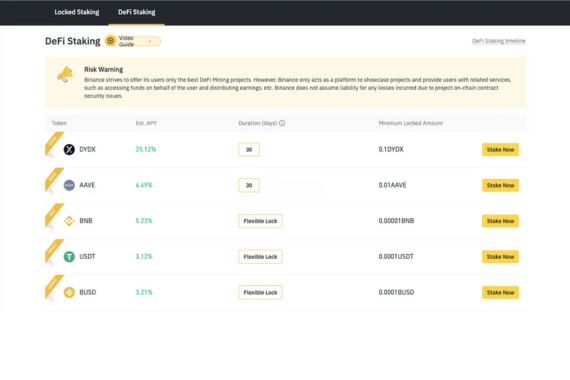
Step 2: Buy coins on the exchange
Buy the coin you selected in the spot trading section of the exchange. Staking for PoS coin mining aims to prove that you own a certain number of tokens from the total supply. During PoS coin mining, the coins you stake will typically be locked.
Step 3: Sync or transfer coins to your wallet
After successfully purchasing tokens on the exchange, sync or transfer them to a digital wallet. Some wallets require a minimum time that the tokens must remain in the wallet. For example, Peercoin requires tokens to be in the wallet for at least 30 days. Additionally, some PoS systems have mechanisms that calculate the “age” of the token or coin.
Coin Age = Number of coins in the wallet * Number of days the coin has been in the wallet
Wallets with this mechanism typically give a higher chance to those with greater coin age. However, since PoS systems always involve a random factor, think of it like a lottery—having a higher coin age or more tokens gives you more “lottery tickets,” but it does not guarantee that you will be chosen to create the next token or blockchain.

Step 4: Start Staking
After syncing or transferring your coins to your wallet, you can start staking. You can save more by purchasing a Virtual Private Server (VPS). Over time, as the coin starts capturing blocks and winning to create blocks, you will receive rewards transferred to your digital wallet.
If you no longer wish to stake or mine PoS coins, you can transfer your coins from the wallet to the exchange and sell them in spot trading, just like when you purchased them.
7. Conclusion
With the knowledge provided in today’s article on Proof of Stake, we hope you now have a clear understanding of the concepts related to this consensus mechanism. Additionally, you should now be more familiar with the PoS system and how to mine PoS coins.
Indeed, PoS still has some limitations and vulnerabilities, but the benefits it offers far outweigh these drawbacks. Proof of Stake can be considered as the next significant development in consensus mechanisms in the crypto market.
- t.me/finance_solutes
- Website: https://finance-solutes.com
- Hotline: +1 929 5636 439 ( Hotline )
- 26 Broadway, Suite 934, New York, 10004, US
