
 XM
XM Bybit
Bybit Binance
 Robinhood
 Webull
 IC Markets
 Pepperstone
 OKX
OKX Vantage
 VT Markets
 BingX
BingX Gate.io
 Kucoin
 MEXC
MEXC Exness
 Bitget
If you are an investor in the cryptocurrency market, Staking will surely be a familiar concept to you. It is considered a new trend that has emerged to address the increasing energy demands from PoW (Proof of Work) protocols. So, what is Staking? How does Staking Coin work? What are the benefits and risks of participating in this investment method? Let’s dive into the details in the series of articles about COIN with Forex.
Let’s get started!!!
1. WHAT IS STAKING COIN?
Before diving into “What is Staking”, it’s important to understand the concept of PoS (Proof of Stake).
PoS is a new consensus algorithm used by certain cryptocurrencies. This mechanism creates new blocks that are added to the Blockchain. These blocks are placed by holders of a certain amount of cryptocurrency and help validate new transactions on the platform. Participants in PoS are rewarded (including block rewards and transaction fees) to incentivize their contributions to the project.
Thus, the term Staking Crypto refers to storing a certain amount of cryptocurrency in the wallet of a Blockchain project for a specific period to receive rewards. The amount of rewards depends on your initial investment, which includes: the amount of staked coins and the staking duration.
1.1. The Origin of Staking in Crypto
Scott Nadal and Sunny King were the first to propose the idea of PoS and Staking in 2012. At that time, the Peercoin coin was developed to work based on a combination of PoS and PoW, gradually eliminating the role of PoW. This allowed investors to mine and support the project in its early stages without relying entirely on the PoS system.
In 2014, Daniel Larimer developed the DPoS (Delegated Proof of Stake) mechanism, which was first used as part of the Bitshares network. Larimer later introduced Steem and EOS, both utilizing the DPoS model.
1.2. Types of Staking Coins
The Staking Coin investment method is divided into 2 types as follows:
Staking with PoS Consensus Mechanism: As mentioned above, this is the method where investors use a certain amount of cryptocurrency to participate in Staking and receive rewards for transaction verification activities. This method is executed and directly affects the Blockchain network. Some projects that implement Staking with the PoS consensus mechanism include: TRX, WAX, IOST, TomoChain, and more.

Staking with Delegated Mechanism: In this form, investors will send their coins to the wallet of the project development team (not a separate Blockchain) and receive periodic profits. Therefore, you will not participate directly in validating transactions or any tasks related to activities within the network, but it is still called Staking.
2. HOW DOES STAKING COIN WORK?
To fully understand how Staking works, you also need to grasp how PoS operates.
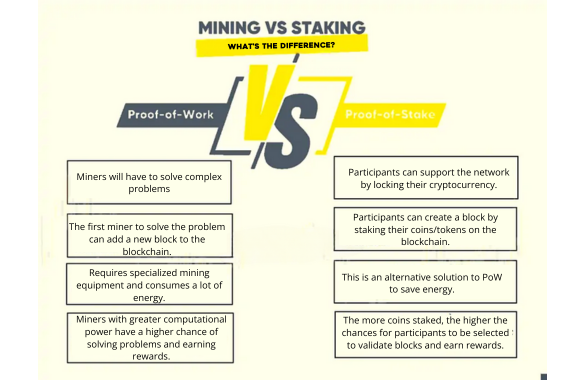
As mentioned earlier by TradaFX, PoS (Proof of Stake) is the authentication mechanism or consensus algorithm of Blockchain. In PoS, block data validation does not occur through Mining as in PoW, but it is carried out through Staking coins/tokens. The larger the amount of staked assets, the higher the chance of being selected as a validator and receiving a reward.
When the validation process is successfully completed, the rewards are distributed to participants according to the proportion they contributed. Refer to the image below to see the difference between Staking and Mining:
Additionally, anyone who wants to participate in Staking must own a certain amount of coins/tokens within the Blockchain system. After successful Staking, these coins/tokens will be locked as collateral for the network.
3. WHAT ARE THE BENEFITS AND RISKS OF PARTICIPATING IN STAKING CRYPTO?
In this section, let’s explore the benefits and risks involved in participating in Staking Coin.
3.1. What are the benefits of Staking coins?
Here are some of the benefits we can mention when investing in Staking in Crypto:
Creating Passive Income
Instead of leaving your coins on exchanges where they remain idle, you can participate in Staking to earn additional profits. Of course, this depends on the amount of idle coins/tokens that you don’t need to use for a period of time. If you are a trader who frequently needs to swap or use those coins, Staking will lock your coins for a period, which could cause you to miss out on better investment opportunities.
Reducing High Investment Costs
One of the biggest advantages of Staking coins is that it doesn’t consume a lot of electricity or require expensive equipment like high-end GPUs or ASICs. This allows investors to easily participate without incurring high operational costs like mining.

Easier and Simpler
Staking does not require investors to have knowledge of complex computer algorithms or how mining machines operate. All you need to do is buy coins/tokens and place them in a wallet to stake. In some platforms, you won’t need to do anything at all. For example, on the Binance exchange, you just need to buy coins/tokens and hold them on the platform to receive rewards.
Increasing Network Security
You may not know, but in order to carry out an attack, hackers must control 51% of the network’s power. This means they need to own more than 50% of the total circulating coins/tokens on the market. And the only way to do this is by buying those coins.
In reality, it is very difficult for a hacker group to have the capacity to purchase such a large amount of coins/tokens. Therefore, the likelihood of a network being attacked by hackers is extremely low.
3.2. What are the risks of Staking?
In addition to the benefits mentioned, Staking can also come with some risks:
Market Risk
This is the risk that the value of the coins/tokens you hold may decrease during the staking period. The reason is that when you stake, your coins are locked for a certain period, and you cannot liquidate your assets if the market drops. This will affect your overall profitability.

The Risk of Theft and Loss
Cybersecurity incidents can cause you to lose the assets you have staked in exchange wallets or online wallets. To mitigate this risk, many investors choose to stake in cold wallets.
Storing digital assets in cold wallets protects your assets from cyber attacks since the hardware is not connected to the Internet. However, the risk of loss or damage to the hardware can still occur when you stake using this method.
4. WHAT IS STAKING INVESTMENT ON BINANCE?
Binance Staking is a service that supports staking certain cryptocurrencies when storing assets on the Binance exchange. This means you only need to deposit the cryptocurrencies that the broker supports for staking to start earning profits from this method on Binance.
4.1. Types of Staking on Binance Exchange
Here are 3 types of staking investments on the Binance exchange:
What is DeFi Staking?
This is a method that allows you to easily access DeFi products. In this case, the exchange acts on your behalf to invest in DeFi projects, earn income, and distribute the profits to you.
The returns from this method are usually much higher than other methods. However, it also comes with considerable risks since you are not directly staking, but delegating to Binance.
What is Locked Staking?
Locked Staking, also known as fixed staking, means you lock a certain amount of cryptocurrency to stake on the Binance exchange. The fixed periods you can choose from are 30, 60, or 90 days.
The advantage of this method is that the average annual return is relatively high. Therefore, it is particularly suitable for investors who want to grow their assets over the long term.
ETH 2.0 Staking
This is a very popular method among cryptocurrency investors, and it has even become a booming trend recently. ETH 2.0 will be released in 3 phases, with staking being an essential part of it. To participate in ETH 2.0 Staking, you must stake a minimum of 32 ETH, making it not simple or easy for all investors.
However, Binance has created an ETH 2.0 staking method on its platform, allowing investors to access it more easily. You can start this staking method on Binance with just 0.1 ETH.
4.2. Should You Participate in Binance Staking?
Binance has long been known as a reputable cryptocurrency exchange with a strong presence in the market. You can trust that Binance will select potential DeFi projects for investors to access, minimizing basic risks such as lack of experience or projects that are weak or not well-evaluated.
However, you also need to understand that Binance is just an intermediary connecting investors with the projects. Therefore, it will not be responsible for any unnecessary risks.
5. 5 FACTORS TO CONSIDER WHEN PARTICIPATING IN COIN STAKING
Here are 5 factors you need to consider when participating in staking any project:
5.1. Lock-up Period
This is the period during which your coins/tokens are locked, and it depends on your initial choice. For example: 1 month, 3 months, 1 year, etc. After this period, you will be able to receive the amount you staked (including the profit).
5.2. Unlock Period
In fact, you can stop staking before the specified time by using the Un-Stake feature. However, you will not be able to immediately receive the staked amount, and there will be a waiting period.
The sudden Un-Stake could impact the normal operations of the network, which is why this rule is in place to reduce risk and give the system time to process if there is an unexpectedly large Un-Stake request.
5.3. Interest Rate
This is the rate of return after the staking period ends. Therefore, all investors aim for the highest interest rate when participating in this form of investment.

5.4. Inflation Rate
This rate is calculated based on the number of new coins/tokens created and the number of coins/tokens currently circulating in the market. Crypto is similar to traditional financial markets, where a certain amount of new cryptocurrency is always created and introduced into the market, leading to inflation. Therefore, it will directly affect market prices.
5.5. Weight
Weight can be understood as the value of a coin and directly affects the rewards that investors will receive after unlocking. The longer the staking period and the larger the amount of coins, the higher this value will be. In addition, it also increases the chances of obtaining the right to process transactions and create the next block.
6. WHAT IS THE DIFFERENCE BETWEEN STAKING AND FARMING?
In this section, let’s compare the differences between Farming and Staking in cryptocurrency trading. You can follow the table below:
| Staking | Farming |
|---|---|
| Currently, most large projects have an APY of 3-20%, with some new projects having an APR that fluctuates higher, such as 50-120%. This is lower compared to Farming. | High interest rates, sometimes reaching up to 1000%, along with increasing token rewards creating huge profits for liquidity providers. |
| Staking does not carry as many security risks as Farming. Therefore, it is the safest solution for those who prefer a slow pace, dislike risks, and are not too quick to adapt to the DeFi market. | Along with such high interest rates, Liquidity Providers (LP) must bear significant risks, such as Smart Contract risks due to lack of audits, system risks (which can cause LPs to lose tokens in the pool), and permanent loss risks (permanent loss occurs when tokens are withdrawn by LPs from the pool during temporary losses – Impermanent Loss). |
| Does not suffer from Impermanent Loss. | There are no specific time or quantity requirements for participation. |
7. HOW TO START PARTICIPATING IN STAKING COINS
So, how can you choose a good Staking project? The answer will be provided below.
7.1. How to choose a good Staking project?
To choose an effective and safe coin/token for Staking, you need to take time to research and gather information. Here are some suggestions that TradaFX would like to recommend before you start investing in Staking:
- Where is the market primarily concentrated?
- Is liquidity good?
- Is the coin investor community large?
- Is the roadmap realistic?
- Is the project development team effective?
- What is the reward rate for the coin?
7.2. Steps to participate in Staking.

Here are 4 steps to help you stake and earn profits from cryptocurrency projects:
- Step 1: Choose a cryptocurrency that allows you to stake. Consider the metrics provided by Forex in section (5) to select the coin you want to stake. These metrics must align with your needs, interest rates, capital, and expectations.
- Step 2: Set up your wallet or configure your computer.
- Step 3: Deposit coins/tokens into your wallet, computer, or exchange to begin staking.
- Step 4: Start receiving rewards.
8. SUMMARY
Thus, in today’s article, Forex has shared with you the knowledge about what staking is, how staking works in coins, the benefits and risks of participating in crypto staking, along with the steps to get started with this investment method. We hope that what we have mentioned will be helpful in your research and understanding of this term.
If you have any questions, feel free to leave a comment below, and Forex will answer you right away.
Good luck in your trading career!
- t.me/finance_solutes
- Website: https://finance-solutes.com
- Hotline: +1 929 5636 439 ( Hotline )
- 26 Broadway, Suite 934, New York, 10004, US
